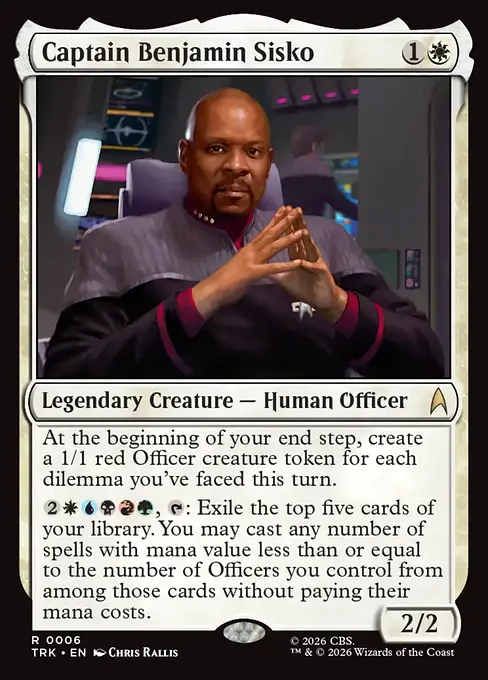
I love when we get a theme that takes a current idea in Magic and rewards us for it. In Star Trek, we’ve already gotten two potential Commanders for decks built around making choices. They’ve settled on calling this a dilemma, which fits nicely into being a Starfleet Captain.
Both Seven of Nine and Captain Sisko reward you for facing dilemmas, and we’re likely to see more cards referencing this game mechanic. So let’s go over what we’ve got for such choices, as well as choosing some potential specs.
The rest of this content is only visible to ProTrader members.
Cliff (@WordOfCommander at Twitter and BlueSky) has been writing for MTGPrice since 2013, and is an eager Commander player, Draft enthusiast, and Cube fanatic. A high school science teacher by day, he’s also the co-host of the MTG Fast Finance podcast. If you’re ever at an event and you see a giant flashing ‘CUBE DRAFT’ sign, go over, say hi, and be ready to draft.
There’s about to be a whole lot going on in Magic, with the Star Trek preview incoming, but there’s even more on the horizon!
The calendar year has about ten weeks left, give or take, and we’ve got a lot of Secret Lair drops/releases happening before we turn the page to 2027.
Some of the details are confirmed, and some of the dates are a little hazy, but let’s get into what’s left on the schedule, including Monday’s release.
The rest of this content is only visible to ProTrader members.
Cliff (@WordOfCommander at Twitter and BlueSky) has been writing for MTGPrice since 2013, and is an eager Commander player, Draft enthusiast, and Cube fanatic. A high school science teacher by day, he’s also the co-host of the MTG Fast Finance podcast. If you’re ever at an event and you see a giant flashing ‘CUBE DRAFT’ sign, go over, say hi, and be ready to draft.
Magic’s going through an expansion period, and the dovetailing of multiple factors all at once has led to a development that is exemplified by Collector Boosters: Magic has become both relatively cheap to play AND has never had more expensive cards.
I want to take a look at where prices are in general, where they could go, and what that means for how we get cards: Play Boosters, Collector Boosters, and Secret Lairs.
There’s a theme for recent decks (last couple of years) where most of a deck is pretty cheap, and then you’ll have 1-3 cards which are redonk powerhouses and you need four of these.
Examples from recent history include:
Badgermole Cub
Bristly Bill
Vivi Orniter
Agatha’s Soul Cauldron
Sheoldred, the Apocalypse
Atraxa, Grand Unifier
Cavern of Souls
More words, all mythics, several banned. Sheoldred and Jace, Vryn’s Prodigy were $100 cards in their Standard. The common point here is that if you look at Standard, it’s pretty cheap to build a deck until you get to the key/important/overpowered mythics, and that’s what gooses the prices up.
Modern and Legacy are pretty warped, and I’m leaving those out. (Modern is dominated by the Modern Horizons cards anyway). But Magic’s most popular format is Commander, and that is also getting cheaper…depending on what you’re playing.
If you have to maximize your Commander deck for peak efficiency, then yes, Commander is pretty pricey. You’ll need shocklands and fetches and duals, because you need everything untapped.
But if you’re willing to accept a turn slower, or even the chance of a turn slower, you can run cards like Canopy Vista, Deathcap Glade, or Sea of Clouds. The Triomes haven’t been reprinted, but there’s an ocean of cards for helping you with a three-to-five color manabase, if you’re willing to give up one mana (Cascading Cataracts) or entering tapped (Path of Ancestry).
There are absolutely some super-expensive cards that people build around and Wizards reprints at a glacial pace. And if you don’t want to pay for a Rhystic Study, then downgrade a little and play Mystic Remora, Insight, Insight Engine, Ghostly Pilferer, etc.
Commander is a game that doesn’t ask you to optimize, and has a whole level structure for the spectrum from ‘100 random cards’ to ‘100 shark teeth pointed at your groin’ so you can tell people what you’re doing at the beginning, when you first sit down to play.
On the opposite end, if you want to get fancy and be a total Smaug, hoarding the best of everything, then Commander is exactly your jam. I have a Dragon deck stacked with the best and shiniest that I can do, though I’ve had to make accommodations. I don’t want to pay for OG foil Onslaught fetches, so I got the ten fetches from ZNR in foil. Guru basics would be pretty radical, but for the memes I’ve got full-text lands.
Go for artist proofs, or textless foil Gaea’s Cradle, or Alpha Timetwister. Get as fancy as you want. Magic is one of the last bastions of playability over collectability, but you can be sure that there are top-level Commander decks and Cubes out there that are not skimping on anything to be both collectible and powerful.
The point here is that aside from certain staples, no one has to spend a ton on a deck. The cards that get pricey are the ones that make a splash immediately and combo off or represent an incredible boost in a deck’s power. Standard doesn’t need a set of fetches, and even if they reprinted them into Standard, there’s enough on the market that the price is still reasonable.
Shocklands are another great example of Wizards’ dedication to making staples cheap and at the same time, represents the excess someone can go to. Steam Vents, traditionally the most in-demand of the shocks, can be had for just over $10 per copy or $2700 for the cheapest serialized copy on TCGPlayer.
This gap in value, without sacrificing anything but being shiny and serialized, is completely due to Wizards making good cards in Play Boosters and then putting rare/pretty versions into Collector Boosters. No longer are players forced to go lurking through eBay for foreign foils, now we’re given a selection of treatments and Secret Lairs for our magpie selves.
And this is also why most Collector Booster boxes are rising in price: we’re attracting collectors from all over, a trend that started in Final Fantasy. We’re about to get all the Star Trek collectors with signature-playable chase versions of cards, which should make for another Universes Beyond set that brings in a lot of new interest and lots of liquid cash.
Play Boosters haven’t moved much in price, but Collector Boosters have all risen across the board. There’s even sales of the empty CB boxes, a thing I could not have fathomed but I imagine people are decorating with them or using them as backdrop for streaming. Something purely decorative and pretty.
We’re all chasing how Lord of the Rings’ Special Edition went to ridiculous heights, hitting $12,000 sales on TCGPlayer before coming back down to the current valuation of $6,000. Collector Booster boxes for Final Fantasy were under a grand at the start of the year and have climbed to $1,700 with clear eyes on passing two grand.
We haven’t seen that huge growth in other UB sets, but Hobbit is trying real hard, bobbing up to $900 and currently trending down to under $800, but with its cousin being the flagbearer there’s a lot of predictions about where it’ll end up.
I talked about this with James on MTG Fast Finance recently, and I fully believe that opening packs has never been more of a gamble. Every set, I break down the odds of opening every type of card you could want, and even the ‘good’ odds are more than 100 packs to open. Gleaming Splendor, one of the hottest cards from the set, is 90 Collector Booster packs to get a nonfoil book cover, 166 packs to open as a book cover foil, and 333 packs as a surge foil book cover. Just buy the singles you want! Opening packs is a losing proposition, even though it feels so so good.
Know what else feels good? Buying CBs for a good price, then waiting a year and selling them at amazing prices. Keep aware of the trends and stay strong.
Finally, I want to talk a little about Secret Lairs, Wizards’ golden goose. Every Secret Lair drop is ridiculously profitable for Wizards, even things like the Zeta drop which went badly. They have to pay for the art, and a little bit of graphic design, and then the print costs. That’s it, and that’s sold directly to us for $30/$40 or more. Margins through the roof, profit like never before, and now they are doing the hybrid of limited printing and print to demand by offering to let us buy it now and pay for it to arrive in a year.
That method has worked on the Miku decks, which are under $300, compared to the nearly $500 that Goblinstorm immediately got to. I maintain that the Zeta cards are ugly and should end up as the cheapest version of their cards, but the packs selling out in something like 45 minutes of available time means the reselling is fierce and profitable. If I’d known the print run was that small, I would have ignored the appearance and gone for all I could get.
We’re not going to see a decrease in Secret Lair printings. Ignore the ones you want to ignore, focus on value, but the FOMO on the sold-out offerings will power prices to the $100 range immediately. Print run is the big unknown, and will continue to be.
CBs and Secret Lairs are the main products we can make money on by being thoughtful, so stay tuned here and to the podcast for the best insights.
Cliff (@WordOfCommander at Twitter and BlueSky) has been writing for MTGPrice since 2013, and is an eager Commander player, Draft enthusiast, and Cube fanatic. A high school science teacher by day, he’s also the co-host of the MTG Fast Finance podcast. If you’re ever at an event and you see a giant flashing ‘CUBE DRAFT’ sign, go over, say hi, and be ready to draft.
Next week, we get the double whammy: eight Secret Lair drops on Monday, and 48 hours later, the Chaos Vault gives us a new booster pack product. That’s a lot of money to be spent, in the middle of Hobbit-mania and between a LOT of other drops.
So let’s talk about what goes on sale and what’s worth buying next week!
For each drop, I’ve listed the EDHREC numbers and tried to list what the other premium versions of a card go for. I like art, and I LOVE small print runs, but the popularity of a card and what its other versions go for tell me what I’m buying.
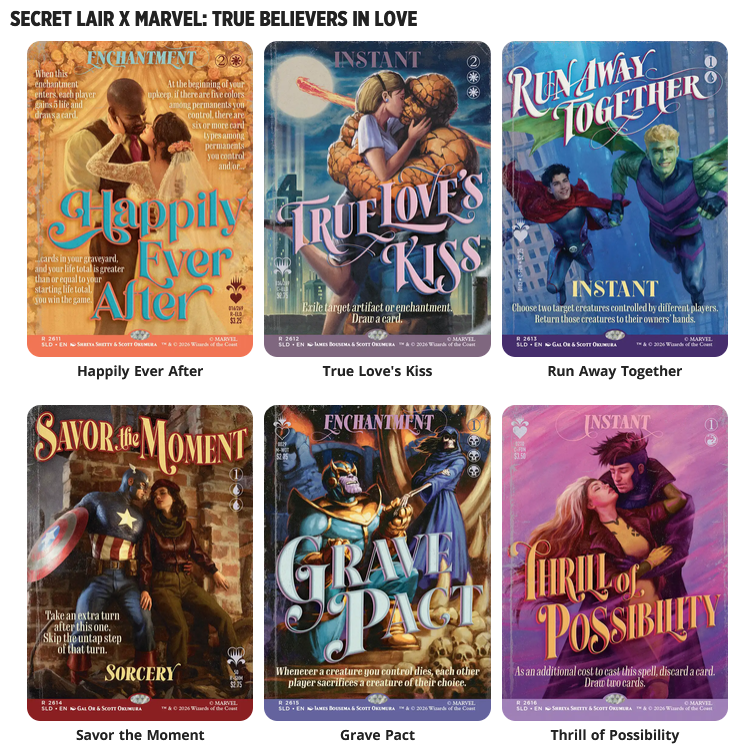
MAR Borderless ~$2.47; MAR Borderless Foil ~$4.62; SLD Borderless ~$5.73; SLD Borderless Foil ~$6; STA Etched ~$1
I am a big fan of two things in this drop. One, the romance-cover look of these is top-notch, and for my money, what SLD should be about. Two, Grave Pact is a great anchor here. It’s had plenty of printings, and held up very well.
MAT Extended Art ~$5 / Foil ~$13; TLA Eternal Borderless ~$5
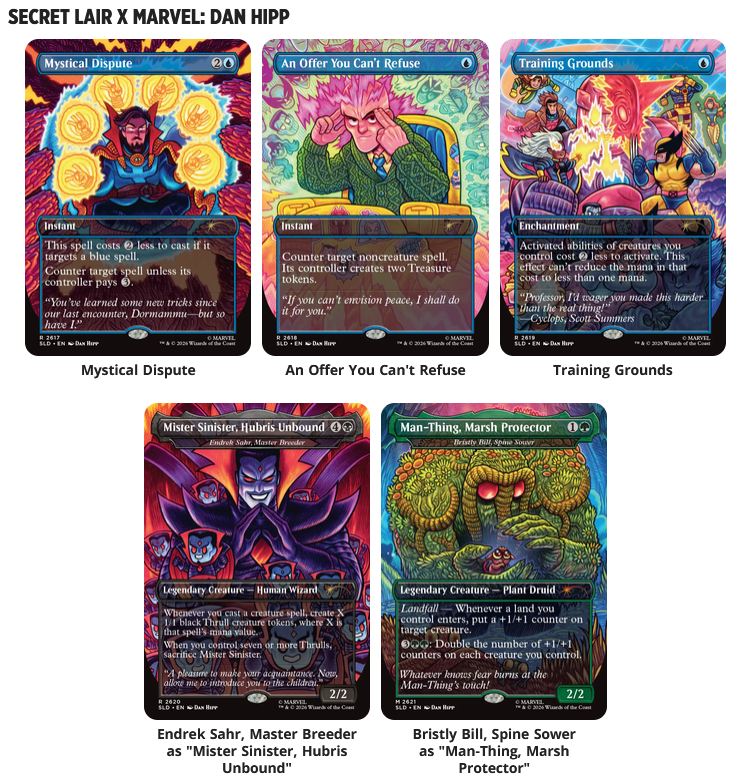
Endrek Sahr, Master Breeder
47.6k
CMM Foil Etched ~$12
Bristly Bill, Spine Sower
149k
OTJ Extended Art ~$64 / Foil ~$89
Same notes here. Love the treatment, and the biggest thing is the fantastic anchor of Bristly Bill. This is also the first special for him. All of these are solid picks, but Bill really shines here. I like the comparison to Toby’s Journey, with the Prismatic Vista, and if Bill ends up with $20 or even $15 copies I’ll grab more at Dump Week.
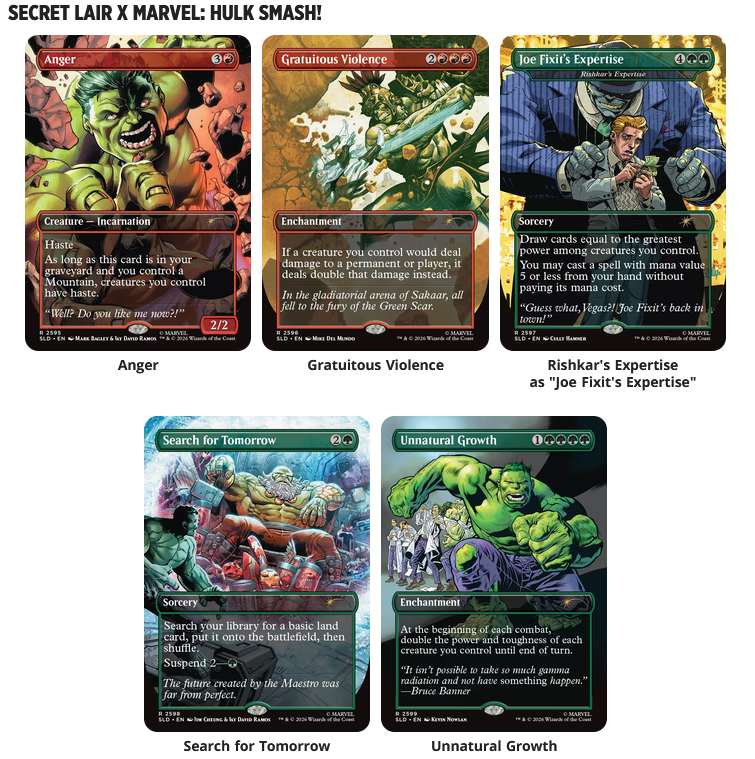
Anger and Violence are not enough to save this drop for me. I’ve been diligently buying every Marvel Lair in anticipation of selling mega-Marvel sets and now I’m drawing the line. This is mediocre at best and even GV’s pack foil from Onslaught is only $25.
Card Name
EDHREC Count
Special Printings
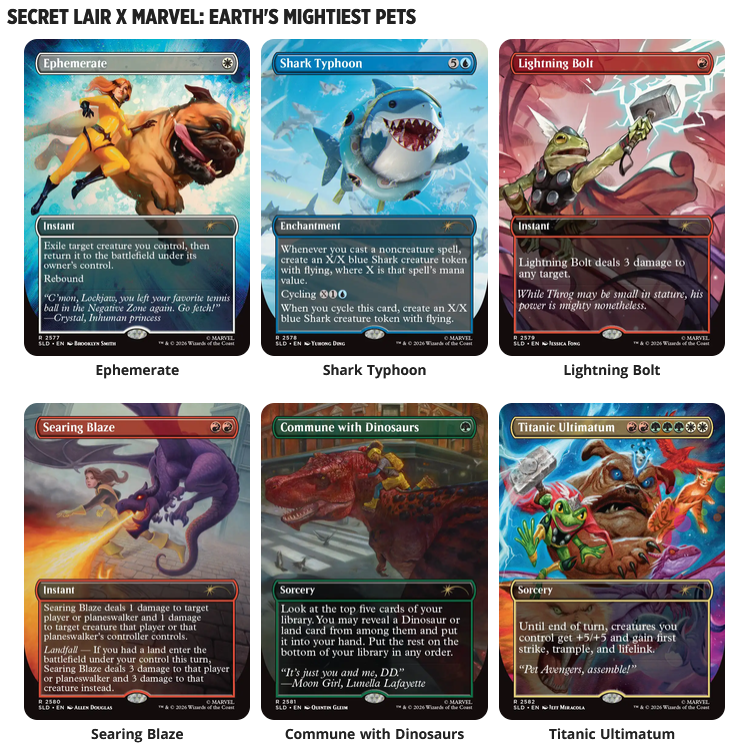
Ephemerate
273k
MAR Borderless ~$4.50 / Foil ~$8.85; STA Showcase ~$6.90 / Foil ~$17.70; H1R Alt-Art Etched ~$9.40 / Foil ~$10.60; SLD Borderless ~$8 / Foil ~$7.50; STA Mystical Archive ~$28.55 / Foil ~$52; STA Etched ~$16 / $32
Shark Typhoon
73.1k
IKO Extended Art ~$4.45 / Foil ~$5.45; SCH Inverted Foil ~$5.10; SLC Borderless ~$5.95 / Foil ~$6.90
Lightning Bolt
547k
M25 Borderless ~$4.20 / Foil ~$6.10; STA Mystical Archive ~$13.75 / Foil ~$12.35; Japanese STA ~$20 / Foil ~$40+; SLD Borderless versions ~$3–8 / Foil ~$3–14; SLD Street Fighter Foil ~$11; Secret Lair Showdown versions ~$55+
Searing Blaze
3.30k
No non-regular frame printing
Commune with Dinosaurs
11.7k
No non-regular frame printing
Titanic Ultimatum
20.4k
No non-regular frame printing
Another big yawn from me. Bolt and Ephemerate have tons of special versions and this doesn’t even have cute cats/dogs to save it. (sorry, Lockjaw) I don’t plan to buy this one either.
Card Name
EDHREC Count
Special Printings
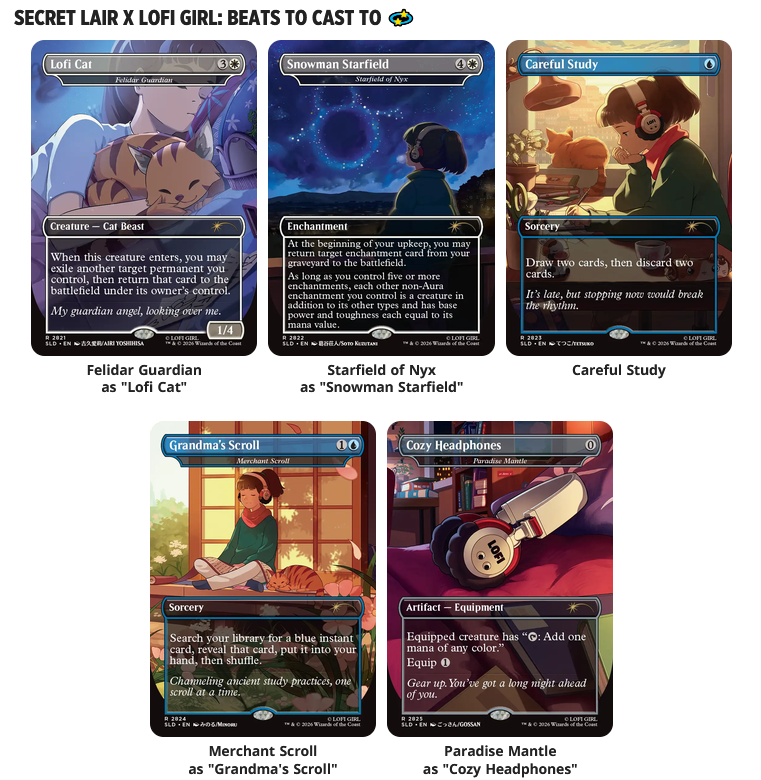
Felidar Guardian
93.2k
No non-regular frame printing
Starfield of Nyx
71.1k
No non-regular frame printing
Careful Study
58.2k
SLD nonfoil $8/foil $7
Merchant Scroll
61.7k
Judge Gift Foil ~$60
Paradise Mantle
85.8k
Mystery Booster 2 Retro ~$9
I really want to like this, as I’m a big lo-fi beats listener, but as a spec this leaves a lot to be desired. Nothing over 100k decks, which is amazing to me, as I thought Starfield was a MUCH more popular card in decks. I’m going to buy a couple of these for my ‘pretty things’ binder but I know this will linger and not gain quickly.
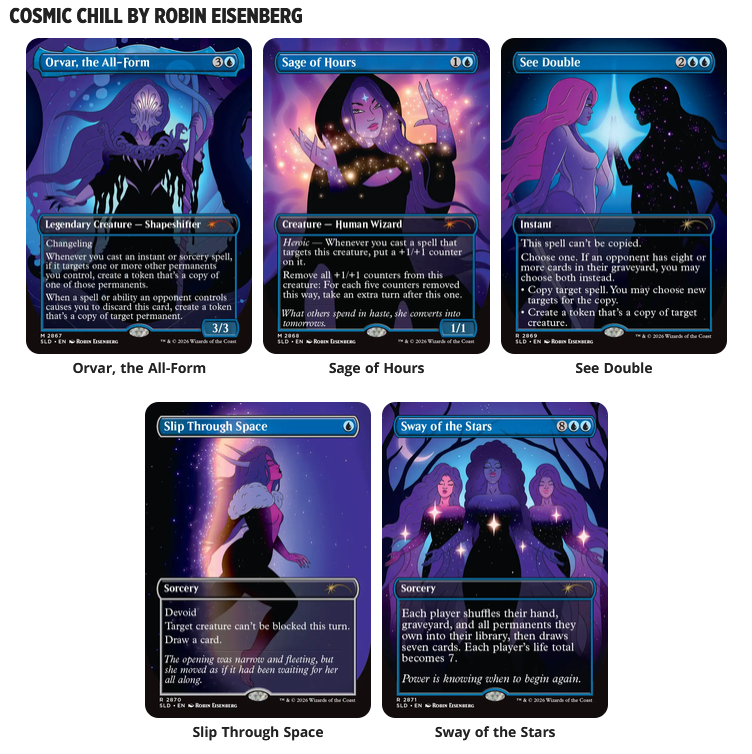
The star here is kind of hidden in Sage of Hours. There’s combos with this card every couple years, and it’s got the regulars at $10 and the foils pushing $50. Sway is straight-up banned in Commander, so there’s some value that will never materialize. I’m impressed at the 3,000 uploaders who put the deck in there, though. I dig the art, and I’ll grab a copy for personal, but the value is sorta lacking here otherwise.
No non-regular frame printing; regular is $27 and foil $115
Quest for Renewal
46.9k
No non-regular frame printing; regular is $5 and foil $30
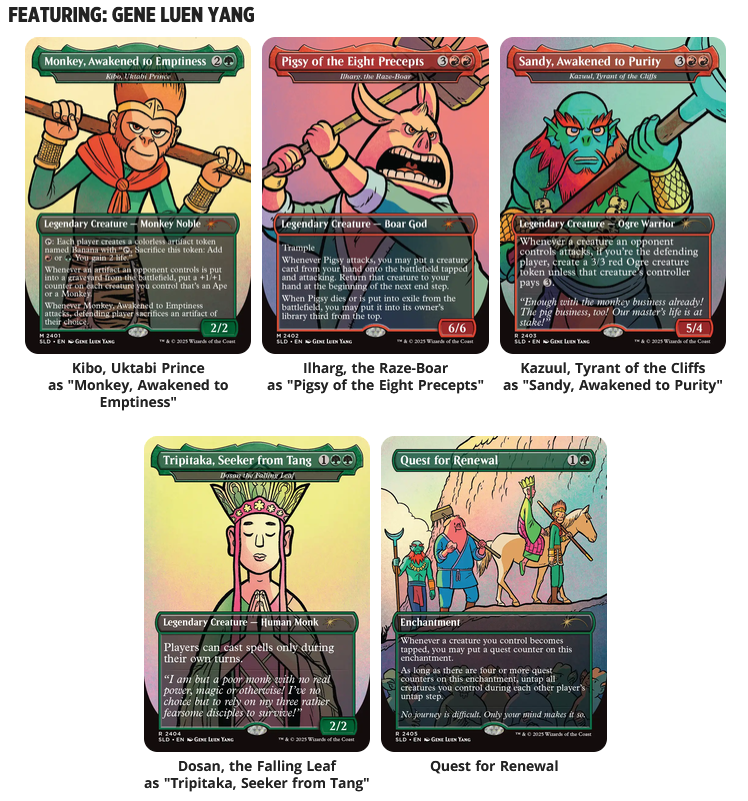
Ilharg is one of the cheapest serialized you can buy right now, if you’re in the market for anything with a number on it. This drop has Kibo, who bounced a lot of Monkey/Ape priced at his first printing, but now the hype is gone and this drop has such a mirage covering it. Three cards getting their first special printing, and Dosan has gone 22 years without a reprint at all! Reprint Equity is the phrase, and here it’s being mined to give the illusion of being expensive but none of these cards are going to be expensive. Pass.
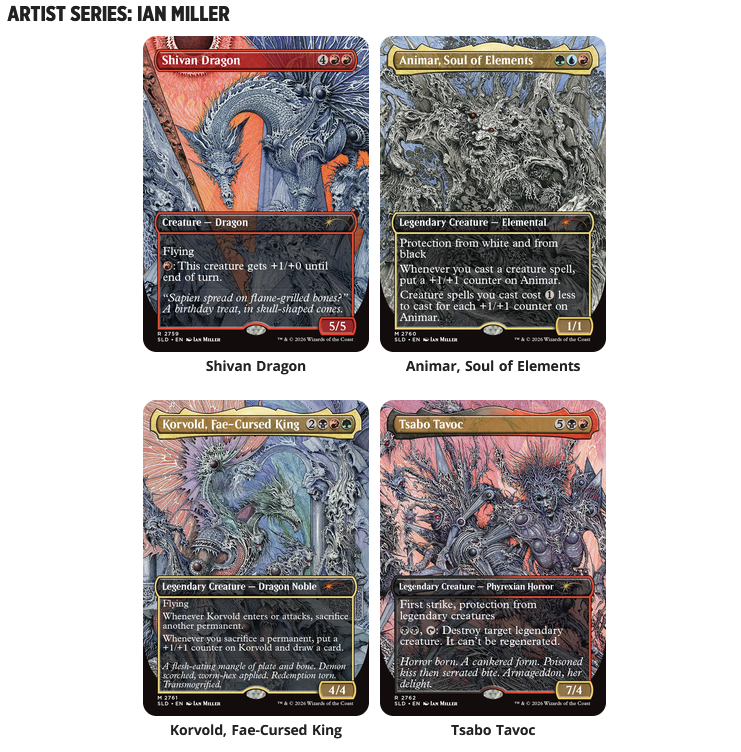
Korvold and Animar are two of the top 100 commanders of the last two years, and each have had special versions that have held up over time. Tsabo Tavoc has an Invasion foil over $40 but again, the lack of reprints and the old age are why it’s expensive, not demand.
This drop should be decent but there’s no star here. It’s solid, and should grow slowly over time, but I’m a skip.
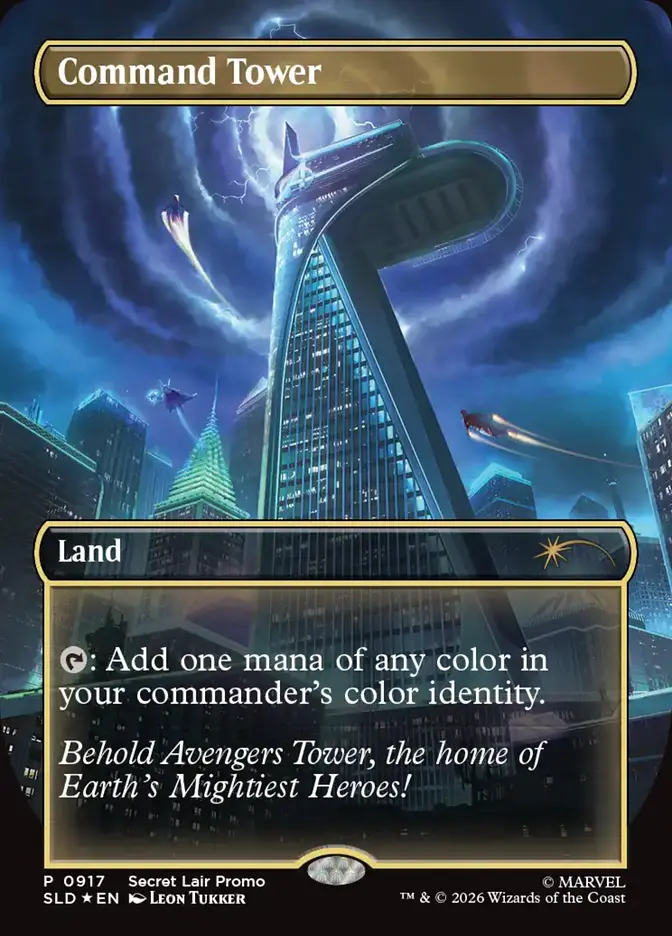
For each $199 you spend, you get a copy of this:
The Earth’s Mightiest Signet from the first Marvel drop has held an impressive $30+ price tag, but there’s so so many Command Towers out there that I’m not convinced on this one. It’s really rare for the ‘spend X dollars’ promos to be big scores.
As for the Bundles, Marvel is $20 off, as is the all-foil bundle. The nonfoil Bundle is $15 off, and the mega-bundle is a total of $40 off. A free Lair isn’t terrible, especially when there’s no lands Lair, but there’s so much mediocrity in this Lair I’m okay sans bundles.
I also strongly suspect that there’s a lot of these Lairs printed. We see that with The Hobbit lairs, except for Second Breakfast which sold out in something like 30 minutes. The rest took a lot longer or still didn’t sell out. If they short-printed one of these Lairs, that’s what I need to know above all else and unfortunately, that’s information we just don’t have. Knowing there’s a ton printed, I’m not going to go wild on the drops, as I expect none to sell out super-fast.
So personally, I’m focused on Hipp and True Believers, with a little of Cosmic Chill and Lo-Fi Girl for personal enjoyment.
And if your wallet isn’t exhausted yet, there’s more madness the next goddamn day. Amazingly, there’s no official Magic News post, just a series of stuff released on social media and interviews done.
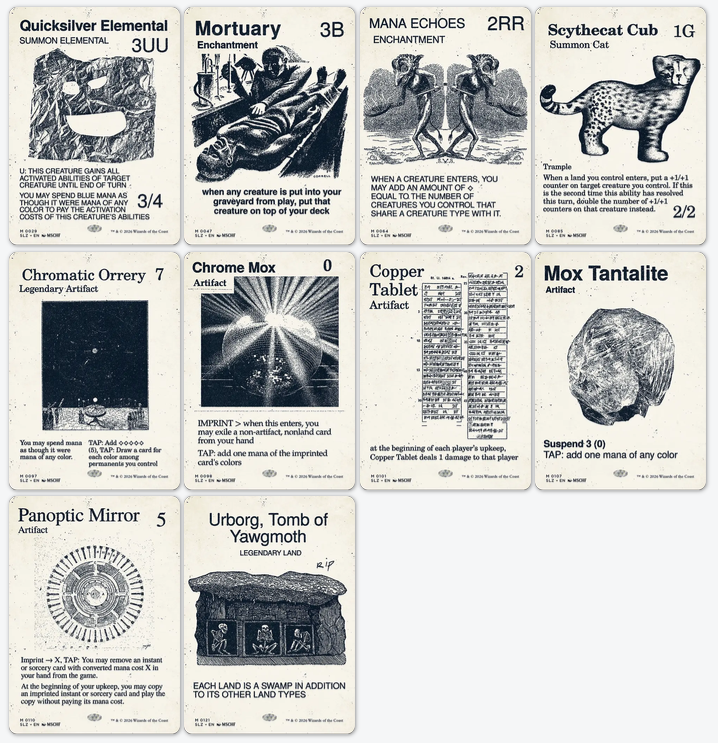
Secret Lair will be selling booster packs out of the Chaos Vault 24 hours after the Perfectly Normal drop. 121 cards, with common/uncommon/rare/mythic drops, with three versions of each. Regular, dark mode, and color bands. Notably, these are never shiny.
The booster packs are $20, and again, the main thing is how fast they sell out when limited to 12 per account. I strongly suspect there’s a boatload of these printed, and when they don’t instantly sell out, the cards will be available for cheaper than you think.
Magic players have shown us that they don’t like ugly cards. Yes, these are made to look like the Gamma cards from when Richard Garfield was playtesting Magic in 1992, but compared to the modern aesthetic these are pretty ugly. The comparison to Magic’s frenzy for old-border foils comes to mind, and players have demonstrated that ugly cards don’t get nearly the love. Invocation frames, Breaking news, if it’s ugly, it’s literally worth less money.
These are some incredibly swingy packs, and Wizards is selling them for $20 a pop. This isn’t far off what they make selling CBBs to distributors if the MSRP is $38 for a Collector Booster, so I expect they printed a lot for this direct sale.
Again, everything depends on the volume here. If it turns out to be a super-short run, then these could go wild. I’m staying far away, I’m willing to take the risk of missing out and letting my wallet recover. Keep in mind, we’ve got the Masters of the Universe in two weeks, and the Odds and Ends Commander deck coming too. Lots of great places to make money, I’m just not interested in these at all.
As ever, if you want to talk about these ideas or correct some of my points, reach out on social media or the ProTrader Discord, and may your queue times be short!
Cliff (@WordOfCommander at Twitter and BlueSky) has been writing for MTGPrice since 2013, and is an eager Commander player, Draft enthusiast, and Cube fanatic. A high school science teacher by day, he’s also the co-host of the MTG Fast Finance podcast. If you’re ever at an event and you see a giant flashing ‘CUBE DRAFT’ sign, go over, say hi, and be ready to draft.
MAGIC: THE GATHERING FINANCE ARTICLES AND COMMUNITY
 ProTrader: Magic doesn’t have to be expensive.