By: Travis Allen
Khans of Tarkir is nearly upon us. Players from every format can’t wait to start cracking packs due to the long-awaited return of the Onslaught Fetchlands. The return of the fetches, along with the curious nature of the block, the change to the Standard rotation model, and the official arrival of wedges has sent people into a tizzy. It’s that lovely time of year when every card is bursting with potential and brewers are salivating uncontrollably.
The pricing for this set, like most fall sets before it, will have its own little wrinkles. The major factor in thinking about card prices for Khans is the fetches. Demand for these is going to extend across virtually every single format. Vintage, Legacy, Modern, Standard, Cube, and EDH players alike are going to want copies. With such a massive amount of demand they will easily be the most expensive rares. When five rares are hogging the lion’s share of the box value it’s going to suppress the price of the entire rest of the box. Rares that would have been $10+ in another set will be $4-$6 instead. Mythics will still be worth the most, but their ceilings will be lower than they would have been otherwise.
Of course card prices are still limited by the value of a box. As soon as cracking packs gets more valuable than selling boxes sealed, vendors will immediately start doing so. A natural balance is reached and demand is satiated while prices stabilize. This means we won’t be seeing any $30 Polluted Deltas, but it does mean we’re going to see a lot of the non-fetch rares in circulation. Oh, did I also mention this is going to be the most opened set in history? It will be. Theros was similarly the most opened at its launch, and hype for Khans is higher what with the fetches in the set. Because of this, it may appear that a lot of my prices are on the low side. I prefer to err on the side of prudence anyways, but it is especially wise in light of this set’s dynamics. In fact, take a look at Theros prices right now.
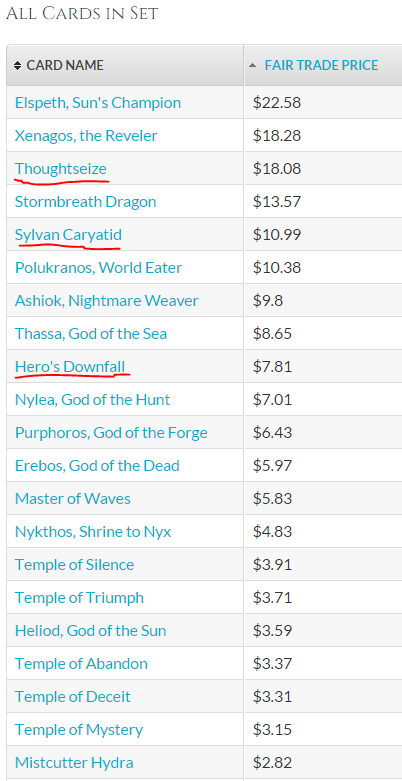
There are a whopping three non-land rares over $3. These prices should rise a bit between now and Christmas, so while a few more may break into the $5+ range I doubt it will be more than a small handful. Also notice that all five rare lands are sub-$4. Imagine what the set breakdown looks like when you jack those five up into the $8-$15 range. All the rest of the cards, mythics included, get noticeably cheaper.
I bring all of this up to make a point that nearly all of these cards will drop from their current values, and they will drop hard. I discuss prices for many of these rares that would be over $2-$3, but only two or three from all that I discuss will manage that. The rest will drop firmly into bulk.
One last thing before I jump into the review. It’s important to remember when reading any set review that we are forced to evaluate cards in a pseudo-vacuum, but they never exist as such. When I look at Brimaz, King of Oreskos I have to consider the card individually, free of whatever the metagame looks like that particular month. Brimaz’s text box isn’t going to change, but the cards other people are playing will. I need to focus on what concrete information I have available to me. Because of this, set reviews are especially challenging. I have to look at Brimaz and make an evaluation based strictly on the words printed on the card, but his true worth will be dependent on the cards around him, a pool that will change significantly over time. Cards that are excellent right now may have been trash in an alternate timeline. It would be easy to construct a Standard environment where Desecration Demon is crap (such as he was in INN-RTR when Lingering Souls was legal,) or where Prime Speaker Zegana is a chase mythic. Even the hallowed Jace, the Mind Sculptor was nigh unplayable at release since there wasn’t a single other playable blue card in the format and Bloodbraid Elf + Blightning threatened to shut him down as soon as he resolved.
The point I’m making is that when considering this review, and all other reviews, it’s important to be good Bayesians and recognize that while a powerful card should be good, and a weaker situational card should be bad, the constraints of the format around them, complete unknowns to the hapless reviewer, will be the true determining factor in identifying whether a card is a bulk mythic or a $20 rare.
If you just want to know what to expect from the lands, click here.
White
Bulk:
Herald of Anafenza
High Sentinels of Arashin
Master of Pearls
End Hostilities
1 Month: $2-$4
Fate Reforged: $2-$3
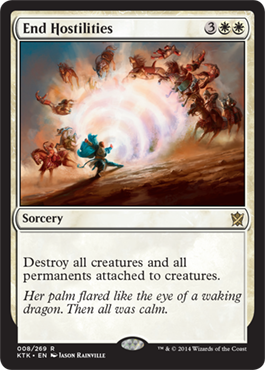
With the departure of Supreme Verdict, the cheapest unconditional sweeper we are left with is End Hostilities at five mana. (I believe there has only been one other brief period where there was no four-mana sweeper.) Even given that history it isn’t terribly surprising Wizards finally tossed it, as morph really wants the format to slow down a bit so it has time to shine.
End Hostilities will certainly be played, but only in Standard. While Verdict was exciting because of applications in Modern and Legacy, Hostilities has none of that appeal. Supreme Verdict hung around $3-$6 for most of its lifespan. End Hostilities should be a tad lower; probably in the $2-$4 range for the most part. People will play it and there will be demand, but they will do so because they have to, not because they want to.
Wingmate Roc
1 Month: $4-$6
Fate Reforged: $3-$5
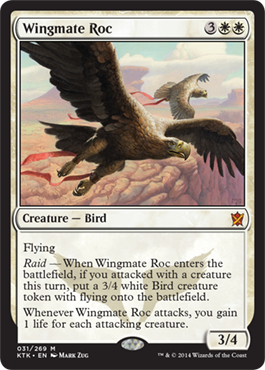
Imagine for a minute that instead of mythic this was printed at rare. Would you even give it a second look? If I told you this was an intro deck rare, would you believe me? I’m thinking it’s likely.
Perhaps I don’t “get” Roc. That’s entirely possible. It’s just that this feels rather underwhelming to me. Broodmate Dragon was good during his time, but as long as you tapped the mana you were getting eight flying power. Roc loses 25% of the damage and becomes conditional in exchange for easier mana and a small lifegain trigger. I’ve heard people compare Wingmate to Archangel of Thune. I don’t see them as being similar though. Archangel immediately put an end to racing. Attacking into it was so difficult because of the lifegain, and as soon as your opponent untapped with it their entire army was growing along with their life total.
That raid trigger isn’t just going to fire every time either. There are plenty of situations where you either will be unable to trigger it at all, or you’ll be chump-attacking to turn it on. In those situations you trade whatever for a ¾ flyer. Occasionally you’ll be happy to make that exchange, but not always. Finally, the lifegain is fairly minimal. If you only attack with your two Rocs you’re gaining a whopping two life. Sure you can alpha strike and gain maybe five or six, but aren’t you in great shape at that point anyways?
Archangel was pretty expensive. Archangel was also a major Standard threat, Modern playable, and an Angel. I don’t see Roc doing much at all in Standard, but I accept that I could be totally wrong on that. If we see it start putting up results then the price will certainly rise and you’ll have time to get in, but until then, I’d trade my copies away.
Blue
Bulk:
Dig Through Time
Icy Blast
Kheru Spellsnatcher
Clever Impersonator
1 Month: $7-$10
Fate Reforged: $5-$8
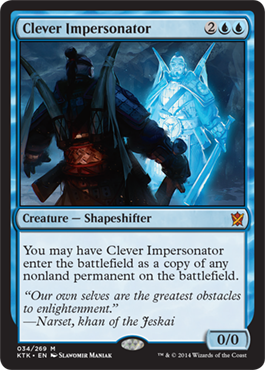
First things first, EDH is going to love this. If you have blue in your deck this is basically an auto-include. Impersonator is getting a good chunk of demand from there, especially the foils. Now how about sixty card formats? The last time a clone was playable was back in the M12 days when we had both Phantasmal Image and Phyrexian Metamorph. We also had something else at that time: Birthing Pod. Birthing Pod decks brought a giant pile of ETB creatures to the table that both Image and Metamorph were happy to copy, and Metamorph could even copy Pod as well. Image continued to see support in Modern and Legacy where it acts as another two-drop lord for fish. You’ll notice that no merfolk decks are running any other clones though.
Unless there’s a deck with a great deal of ETB effects, I don’t see Impersonator making huge waves in Standard. Yes, cloning your opponent’s Planeswalker is awesome, but it doesn’t actually solve the problem of your opponent having a Planeswalker. (Unless it’s Garruk.) They also got theirs down before you. When using a clone effect cloning your opponent’s creatures is usually plan B, so you’re really only playing this to clone your guys. Without a Pod deck, is it going to be good enough? Given that Siege Rhino is in Abzan, I’d guess not.
As I said, EDH demand will persist for Impersonator. There will also be people eager to try it out at FNM. As such, the price is likely to stay north of $4, but I doubt by too much. I’d expect a slow descent until next Spring.
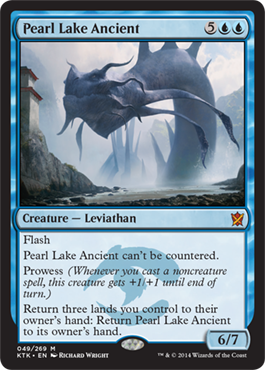
Pearl Lake Ancient
1 Month: $2
Fate Reforged: $1-$3
Pearl Lake Ancient is a control finisher, and by definition, a one or two-of. Even Aetherling, the most obnoxious control finisher in years, spent his entire Standard tenure dwindling towards his current price of seventy cents. Pearl Lake will hang out at mythic bulk.
Black
Bulk:
Retribution of the Ancients
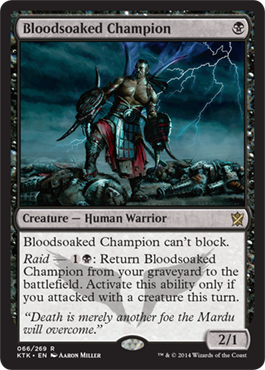
Bloodsoaked Champion
1 Month: $2-$4
Fate Reforged: $2-$5
Bloodsoaked Champion is a curious one. Normally it would be a pretty easy bulk rare. A few aggro black lists would run it, but generally it would be unlikely to have a large enough presence to warrant a real price tag. The equation this time around is changed by the Mardu hotness Butcher of the Horde, which we’ll discuss further down in the multicolor section. The hook here is that you can sac Champion to Butcher for haste or lifelink, swing with Butcher, then rebuy your champion for 1B. As a creature that can come down on turn one then become relevant with your curve-topper later, Champion has potential.
I don’t think he hits bulk anytime soon. His preorder price is in the $4-$5 range and cards don’t typically drop to bulk from there too quickly. There are two possible paths for Champion. The first is that there aren’t enough lists running him alongside Butcher, which means his price dwindles towards bulk further down the road. The second path is that he and Butcher become bestest buds, which should shore his price up in the $3-$5 range, depending on how good the lists end up being.
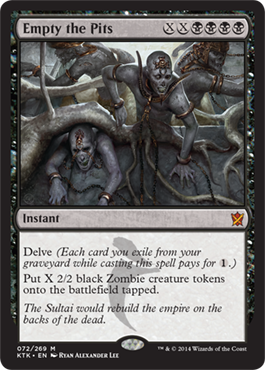
Empty the Pits
1 Month: $2-$4
Fate Reforged: $1-$4
When I read this at first I saw “XBBBB” and I figured it was a real card. Then I noticed it was XX instead. Oof.
What happens when you pay real mana for this? Six mana gets you a 2/2. Eight for four power. Ten for six. Twelve mana for eight power. Meanwhile, Wingmate Roc up there is getting you six power for half the cost, and it’s all in the air. Clearly we’re supposed to be paying for this with Delve. How reliable is delve going to be? On average I’d say you could probably expect to get one to three extra zombies around turn six. Let’s say that on turn six you can exile four cards. That means you’re paying six mana (one zombie) and exiling four cards (two more zombies) for a total of three zombies. At that point it’s a six-mana instant that says “put three 2/2 zombies into play tapped.” Limited all-star perhaps, but we’re playing constructed here.
As the game goes late this clearly gets much stronger, and with that mana cost later rather than sooner is going to be the game plan anyways. On turn eight you could potentially threaten fix or six zombies at end of turn which will certainly win a game, but hardly feels format-breaking.
Even if you imagine this in a best-case scenario, how often do decks run more than two copies? Only the most devoted self-mill decks could conceivably run four. As with any delve card, each copy of Empty the Pits in your deck makes the rest of them worse. That doesn’t bode well for financial gains.
I have difficulty seeing Empty the Pits doing much to really shape the way the format plays. I don’t doubt it will see action, perhaps even consistently, in a few black lists. It’s just that the quantity used will be limited and the slot fillable by other late-game finishers if you prefer. As for casual demand, Army of the Damned seems like it would be better in 80% of situations, and that card is $1.80. I see Empty the Pits petering out over the next few months towards mythic bulk.
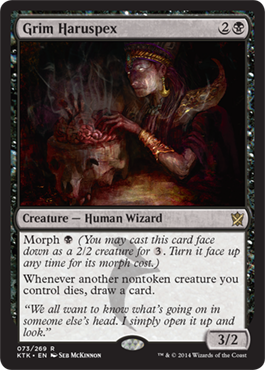
Grim Haruspex
1 Month: Bulk
Fate Reforged: Bulk – $2
I’m tossing this in here basically as a heads up that I think this card may be playable. The drawing condition is a bit restrictive, but with Bloodsoaked Champion and Butcher of the Horde you’re certainly setting up a machine to get paid. The unmorph cost is about as aggressive as it gets, and while a 3/2 for 3 isn’t winning any awards it isn’t shameful either. I don’t think this ever really breaks $3 but I wouldn’t hesitate to pick up a set now if you want to play a Bloodsoaked Champion/Butcher list.
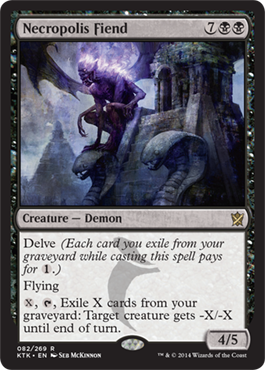
Necropolis Fiend
1 Month: Bulk
Fate Reforged: Bulk – $2
Is this the next Desecration Demon? Maybe. A 6/6 body was pretty legit because it was bigger than nearly every other creature in the format. A 4/5 is nothing to shake a stick at, but he loses to Polukranos straight up. You also can’t just slam him on T4 and run away with the game. On the flip side he can come down on turn five or six for two or three mana while easily leaving removal up, and he’ll let you Avatar of Woe a relevant creature about once a game.
Perhaps Fiend is bulk for the next eighteen months. Perhaps he’s bulk until 5/5s for four mana rotate and suddenly he becomes way more playable. I’m honestly not sure. I know that I want him on our radar though.
Red
Bulk:
Crater’s Claws
Dragon-Style Twins
Howl of the Horde
Jeering Instigator
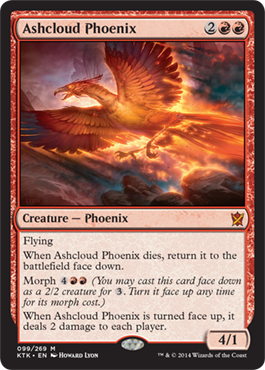
Ashcloud Phoenix
1 Month: $3-$4
Fate Reforged: $1-$3
I’ve been bullish on four-drop red mythics once or twice in the past few years and they haven’t panned out a single time. While Hellrider and Hero of Oxid ridge saw gigantic spikes in price in their day, we haven’t seen anything of that sort since Innistrad. Whether we just haven’t had the right card or the right format I’m not sure. What I do know is that Ashcloud Phoenix will not be that card.
A 4/1 flyer for four is about on par with what to expect out of red’s aggressive deck curve-topper so long as it has lots of other good text. Unfortunately, Ashcloud doesn’t. When it returns to the battlefield it’s as a morph that will be easily blocked or killed. If it hasn’t been unmorphed it will stay dead the second time. Meanwhile the unmorph cost is prohibitively expensive at six. Any deck reasonably interested in Ashcloud is not going to be getting excited about getting to six mana to be able to unmorph this. Even if you do, it’s trigger is good but not necessarily game-winning. The end result is that it’s a weak-ish creature whose condition for repetition is too difficult or costly to satisfy. We won’t be seeing this one’s prices rise from inevitable ashes.
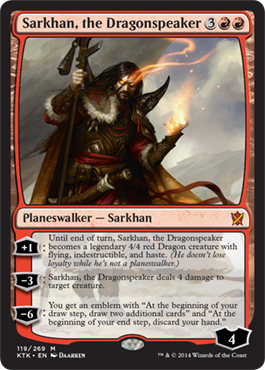
Sarkhan, the Dragonspeaker
1 Month: $15-$20
Fate Reforged: $12-$18
Chandra, Pyromaster was the best red Planeswalker ever when she first hit the scene last year. This year it appears Sarkhan is wresting that trophy away from her. The turn he comes down he has two choices: become a 4/4 flying indestructible haste dragon, or do four damage to something on the other side of the table. Given that he shares a mana cost with Stormbreath Dragon, his first ability is right on curve. Both Sarkhan and Stormbreath come down on five and attack for four in the air. If you’re not in the market to swing immediately, perhaps because you’re being pressured by an opposing creature, Sarkhan is capable of blowing that up instead of attacking. Four damage is a serious chunk of damage. It won’t kill Polukranos, but it will nail most other creatures, including your opponent’s Nissa’d land.
There are a few factors that are working against Sarkhan. One roadblock will be the glut at four and five in red and green. With so many options, it’s unlikely that people will be in the market for four Sarkhans. Off the top of my head you’ve got Polukranos, Xenagos, Nissa, and Stormbreath Dragon. I’m sure there are more that will be viable options as well. With so many cards all filling similar roles, most decks will want to vary their choices instead of going all-in on one or two. As for more casual formats I don’t’ see Sarkhan causing much of a stir. He’s bad in EDH, and while dragons tend to be quite popular, he doesn’t actually have “dragon” written on his typeline. The demand here should be mostly limited to Standard with perhaps some spilling over into Cube.
Overall I anticipate Sarkhan seeing moderate to heavy amounts of play. Assuming that some form of RG deck is in the top five of the format, and each one has two to three copies of Sarkhan, he should hang around north of $15 for awhile. While he is unlikely to be as pervasive as Elspeth, he should do well for himself. When Elspeth released along with Theros she was over $30. By the time January rolled around she was under $20. Even now she is only barely over $20. When Elspeth has trouble maintaining a price tag close to $25, it’s unlikely any could manage better.
Green
Bulk:
Meandering Towershell
Trail of Mystery
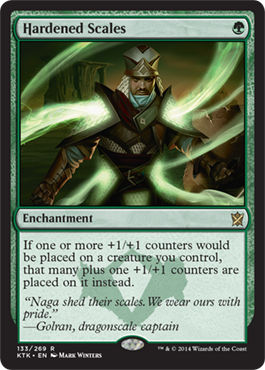
Hardened Scales
1 Month: Bulk – $1
Fate Reforged: Bulk
Ordinarily this would be unquestionable bulk but for two items. First, it’s aggressively costed. At any other mana cost I want nothing to do with this, but one is exactly where a card of this sort needs to be to have shot. The second is James’ entire article on the topic. While I’m not as much on board with the card as he is, I do see room for potential. This may pull a Parallel Lives while still in Standard, climbing to $2-$4, although Bayes tells us it’s unlikely. Rather it seems like it may be good to snag in as a throw-in once it hits real bulk because not only will it have the casual token demand at some point, it could also end up becoming part of some tier two strategies.
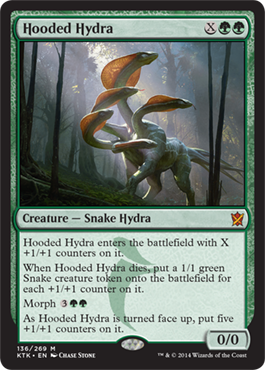
Hooded Hydra
1 Month: $2-$3
Fate Reforged: $1-$3
This is another one of those cards that I would have believed you if you told me it was rare. The fair cost on this card is unappealing, especially with Genesis Hydra and Hornet Queen running around. You can really only put this in your deck if your plan is to be unmorphing it. The cost to play it as a morph then flip it is a total of eight spread over two turns. That’s rather expensive. You end up getting paid on the back end when this finally dies with five 1/1s, but how much do we care? It’s obviously excellent insurance against End Hostilities. Beyond that I’m not sure how exciting this is in a color that also has Nissa at five.
Wizards keeps throwing these hydras at us and they have a real poor track record going so far. Polukranos is good, and Genesis Hydra is nifty, but take a look back at the other eight hydras currently in Standard and see how many others you remember. Mistcutter maybe? Here’s hoping they change “green’s creature.”
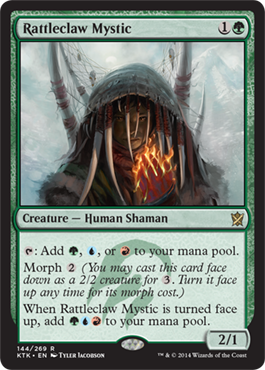
Rattleclaw Mystic
1 Month: $2-$4
Fate Reforged: $3-$7
As the Buy-a-Box promo for Khans, Rattleclaw deserves extra scrutiny. We’ve seen time and time again that BaB promos have a strong tendency to be Standard staples.
When Sylvan Caryatid was spoiled I was a bit bearish on it because it cost two mana and I like my dorks to cost one. I ended up coming around on Caryatid once it was clear that the 0/3 hexproof body was so powerful. Your opponent couldn’t kill him and he blocked 2-power creatures reliably.
Rattleclaw is two mana as well, but instead of dodging removal and blocking he dies to everything and can’t block a thing. The phrase “always bolt the bird” remains just as relevant today as it was some twenty years ago when it was coined, meaning that savvy opponents are not going to let this live if they have a choice.
What makes Rattleclaw unique is the morph ability. Playing Rattleclaw face-down on T3 means that on T4 you ramp to six mana. (Unmorph for 2 adding RUG with two lands left open, tap Rattleclaw for one.) This sets up a plethora of plays. You could run out double Savage Knuckleblade, Temur Ascendancy + Knuckleblade, a Scuttling Doom Engine, Sagu Mauler, the RUG Khan, or one of any multiple planeswalkers available to you. With Elvish Mystic on T1 this is all sped up a turn, which means six mana on T3. I think the last time we had six mana on T3 was Lotus Cobra, which Bant Mythic put to good use by attacking with a trampling 12/11 annihilator 2.
As a normal mana dork Rattleclaw is weak. With the shenanigans the morph ability promises, his outlook becomes much more promising. I anticipate we’ll see an immediate drop off following the release of the set. The price shouldn’t drop too low, and I’d expect growth by the time we hit Fate Reforged. For comparison, Sylvan Caryatid hung around the $5-$6 range until mid-to-late summer this year when it spiked to $10. It’s quite possible Rattleclaw follows a similar trajectory.
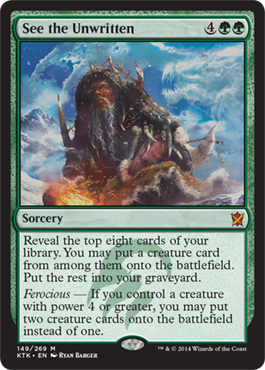
See the Unwritten
1 Month: $2-3
Fate Reforged: Bulk Mythic
In every format other than Standard Summoning Trap is preferable. As for Standard, there’s currently nothing in the format I really care about cheating into play at sorcery speed. Maybe if the Eldrazi show up later in the block this spikes, but unless that happens this is a bulk mythic.
Multicolor
Bulk:
Abzan Ascendancy
Ankle Shanker
Avalanche Tusker
Deflecting Blast
Duneblast
Crackling Doom
Flying Crane Technique
Ivorytusk Fortress (Intro Deck)
Jeskai Ascendancy
Kheru Lich Lord
Mardu Ascendancy
Mindswipe
Rakshasa Vizier
Sage of the Inward Eye
Temur Ascendancy
Trap Essence
Villainous Wealth
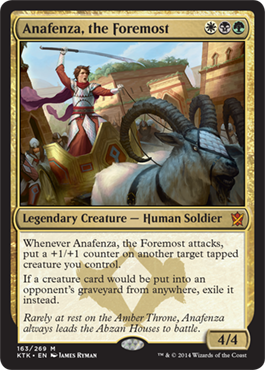
Anafenza, the Foremost
1 Month: $3-$5
Fate Reforged: $2-$4
We’ve got a three mana 4/4 in GW leaving the format right now which provides us a good idea of how much play Anafenza can manage. Loxodon Smiter got around in Standard for sure, although only being two colors instead of three is a huge boon. His counter clause is overall weaker than Anafenza’s two special abilities though. Her first ability will be decent, but won’t come up until at least turn five. If you cast her on turn three she won’t be able to put the counter on the creature you play turn four. That means you get your first +1/+1 counter a whole two turns later, assuming you even attack with your four-drop.
The more appealing text on here is the Rest in Peace, I believe. Keeping cards out of opponent’s graveyards is one of those things that doesn’t feel like it matters that much but surprises you with its utility in many situations. This is especially noticeable in Modern, when you realize just how much damage Leyline of the Void or Rest in Peace do to so many different opponents.
My concern with Anafenza is that CDE casting cost. Not only is she going to be tough to get down on turn three, it means only exactly decks playing those colors will want in. Compare that to a card like Loxodon Smiter which can be played in GW, Naya, or Bant.
Anafenza is a reasonably strong card that could see mild to moderate Standard play, and even possibly some Modern play alongside Doran. Unless she makes a big impact in that format though, I expect her price to remain fairly low. With Sarkhan and Sorin running around alongside all those fetches the other mythics are going to have a lot of work to do to keep their prices up.
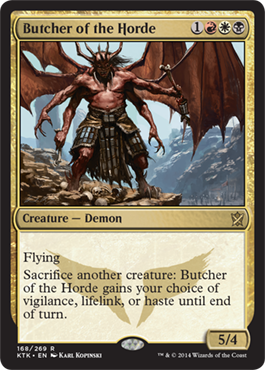
Butcher of the Horde
1 Month: $3-$7
Fate Reforged: ???
Butcher of the Horde is looking to be the breakout card in the set. When I first saw it in the spoiler I shrugged my shoulders and kept scrolling. Apparently I was alone in this. Both Sam Black and BBD have spoken about how good the card seems to be in Standard. If it was just Sam Black I may not care too much since he’ll play anything with the word ‘sacrifice’ on it, but two players speaking about it’s strength is not something to handwave away. While I’m personally not wild about the card, I’ll respect the opinion of those that know better than me.
Apparently Butcher can and probably will be a real thing in Standard. His immediately floor should be $2 or $3 since so many people think he’s the real deal, and his ceiling will be in the $6-$8 range. It will be tough for him to pull a full-fledged Boros Reckoner and break $20 because of the fetches. He’s going to have to see a lot of play to even break $10; enough that you should see it coming before it happens.
In the short term I wouldn’t hesitate to pick up a set if it looks like a card you’d want to play. The worst case scenario is you lose two or three bucks a copy, but you’re also protecting against it doubling within two to three weeks. Watch tournament results, listen to what the good players have to say about him, and remember that we shouldn’t see him go full-on Reckoner but that double digits isn’t out of the question.
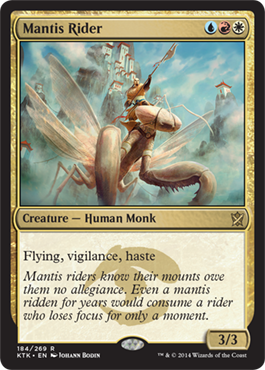
Mantis Rider
1 Month: Bulk – $2
Fate Reforged: Bulk – $2
I almost put this in the bulk section but it’s just slightly better than that. I really doubt that Mantis Rider can get there, but stranger things have happened I guess. Mantis Rider is pretty strictly a Standard card. I doubt anyone in Modern needs it, and even if they do the demand won’t be great enough to push the price much. I’m 98% this is a bulk card.
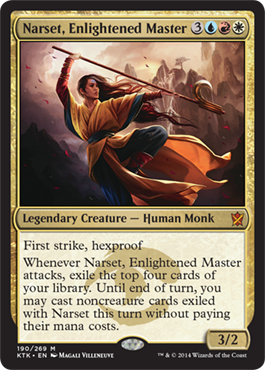
Narset, Enlightened Master
1 Month: $3-$5
Fate Reforged: $2-$4
Supposedly Narset had her cost bumped up from five to six in development because she was too good at five. I believe it. First strike is a great combat ability that makes blocking much more miserable than it would be otherwise. Hexproof has proven time and time again to be miserable to put up with. It forces interaction with the creature to occur on the battlefield, where her FS will shine. Her triggered ability is patently absurd. It has the potential to buy you up to four (!) free spells. We know most of the time that won’t happen, and that on average you’ll flip a little less than two lands each time. The spells also have to be non-creatures, but that seems easy to mitigate. Flipping Divinations, Banishing Lights, Lightning Strikes, or Planeswalkers for free can pay you for casting Narset even if you only get to attack once. Can you imagine flipping an Elspeth with Narset? Hooo boy.
Even though her triggered ability means business, there’s still some serious downsides. Not casting lands or creatures means you can’t just go hog wild with her. She’s on the slightly more expensive side of things, and is vulnerable to any number of sweepers. She’s also a CDE spell, meaning there won’t be many decks that can take advantage of her. There will be demand for Narset, but it won’t be intense. That demand should keep her slightly above bulk mythic, but not much higher. As a long term spec I think she’s got legs, because EDH and casual players will be a big fan. In the meantime though, I wouldn’t mind shipping her if you don’t plan on playing with her.
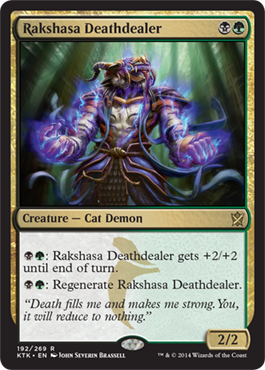
Rakshasa Deathdealer
1 Month: Bulk – $1
Fate Reforged: Bulk – $2
While I pegged Butcher of the Horde as the breakout card of the set, Rakshasa Deathdealer may be the sleeper of the set.
Those of you that were playing several years ago may remember a little zombie leech that was integral to the success of Standard Jund: Putrid Leech. The ability of that card to come down on turn two and start threatening four damage a turn was instrumental in Jund applying heavy pressure with nearly every permanent. Deathdealer is going to play a similar role, although with a slightly different feature set. One of the things that made Leech so powerful was that pumping it didn’t require mana. On turn two you could pay the two life to hit for four and still cast a Sprouting Thrinax. Deathdealer won’t give you quite the same option but the game will be similar. A common play with Deathdealer will be attacking into a Sylvan Caryatid. If they choose to block you can trade two mana to kill their Caryatid in a 0-for-1. If they don’t block, you simply skip paying the two and proceed to cast your spells on curve. Later in the game Deathdealer can remain a threatening attacker or blocker, play defense against giant Polukranosi, or an act as a wrath deterrent. That’s a lot of options for a two-drop that can hit for four on turn three.
I’d be more excited to buy into Deathdealer if this wasn’t the fall set of what will assuredly be the most widely-opened set in history. If he hits it big and becomes a staple in a tier one BG list I don’t think $3-$6 or more is out of the question, but it would have to be a solid tier one list akin to Mono-Black or Mono-Blue. If he only sees mild play he won’t be able to climb out of bulk status. Rakshasa Deathdealer has the chops to make it big, and while the format won’t necessarily shake out in such a way that he’s able to shine, it would be wise to pay close attention.
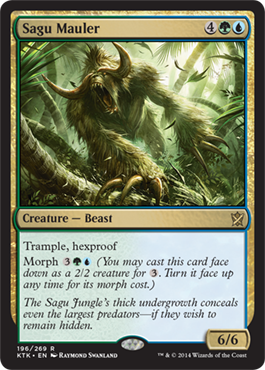
Sagu Mauler
1 Month: Bulk – $2
Fate Reforged: Bulk – $5
These are wide margins but bear with me a moment. Let’s talk about what Sagu Mauler does well. He’s got trample, which is one of the best combat keywords. He’s got hexproof, the most frustrating and possibly broken keyword since storm. He’s got morph, which means you get to cheat on his mana cost and sneak him into play underneath counterspells. (Morph is especially savage here, since you can blow people out if they try to kill him. Unmorph in response to Hero’s Downfall and it fizzles.) Mauler has a giant body, exactly the combat ability you want on a 6/6, and total immunity to removal. There’s definitely a lot of competition at the six-drop slot in the upcoming Standard but Mauler has a threatening body that demands the opponent interact with it on the board.
Is Sagu Mauler going to break out and become a defining card of the format? Unlikely. Things would have to shake very specifically for him to be a legitimate contender. Chances are best that he’ll hit bulk and stay there. However there is a possibility, admittedly rather slim, that he becomes a major component of Standard and his price reflects that. I wouldn’t expect him to break out, but I’ll be keeping an eye on him either way.
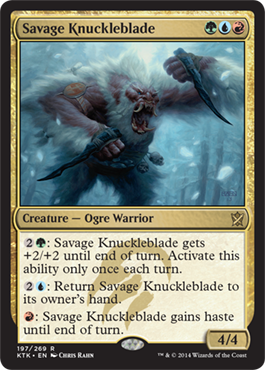
Savage Knuckleblade
1 Month: $3-$6
Fate Reforged: $1-$4
When Ravnica came out I was definitively Simic. When Khans was released, there was no question I was looking forward to the Temur cards. RUG is my probably my most-played color combination of constructed decks. I played RUG in Standard with Kiora and Xenagos for months and I play it in Modern with Scapeshift. I like the colors and it’s awesome that RUG is getting a card everyone thinks is great.
That said, I’m not entirely convinced Knuckleblade can cut it. Perhaps it’s because I’ve been burned so many times before. When was the last time a really playable Simic card was printed? Kiora is solid I guess. The guild was one of the worst in Ravnica block. Before that, the last time I remember UG being playable was the turboland deck back in Zendikar Standard, and even that was short-lived. I’m worried that if I get my hopes up for Knuckleblade and RUG to actually be a tier one strategy in Standard they’re just going to get dashed once more. After all, RUG is cut from playing the two best cards in the format; Thoughtseize and Elspeth. How good can it really be?
Knuckleblade is clearly pushed, and the power level is there. The question is whether there will be enough support in the format for the colors. The good news for Knuckleblade is that Courser and Caryatid are in the same wedge, and those are both going to be bonkers. The bad news is that you can go play Abzan and still get Caryatid and Courser, as well as all the best black and white spells. Or even just Sultai, where you trade the damage of red in for the firm removal and hand disruption of black. The silver lining here is that red happens to contain Goblin Rabblemaster, currently one of the top ten creatures in the format. It’s been a long, long time since a RUG deck played the red for a creature, but hey maybe it’s finally time.
I can be optimistic about Sagu Mauler because it’s so likely to be bulk. It’s a fun looking card and if it hits it big then great. With nobody else rooting for him I get to feel like I’m championing the underdog. I’m not deluding myself about his chances though. He’ll probably be trash. Knuckleblade is much more on the map right now, with SCG sold out at $6 and eBay sets finishing at about $4 a copy. People will try him for awhile, and the power level is present, so his price shouldn’t tank too hard too fast. My guess is that Knuckleblade, and RUG in general are just not going to have enough raw power to be competitive. If that happens Knuckleblade will be doomed to bulk, a powerful card a victim of his colors.
It’s entirely possible RUG ends up being excellent and Savage Knuckblade is at the center of the deck. In that situation he’s $4-$10+, depending on just how excellent he and the deck are. A more realist approach is that it’s been forever since RUG has been good in Standard and that history repeats itself. In that eventuality, Knuckleblade hits bulk – $2.
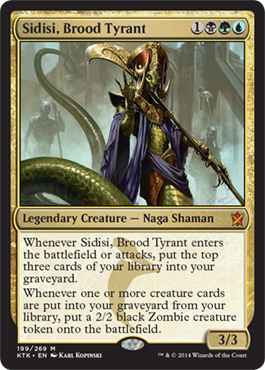
Sidsi, Brood Tyrant
1 Month: $3-$6
Fate Reforged: $3 or $10
BUG was possibly the best deck in Theros block so we know that Sidisi is coming in with a strong precedent. When he enters the battlefield you’re getting a creature more often than not, and if Sidisi is in your deck you’ll be playing cards that set up additional triggers. Sultai Ascendancy, a card already possibly playable, gives you another trigger. Cards like Satyr Wayfinder and Pharika help a good bit too. Maybe there’s a deck with Wayfinder, Caryatid, Courser, Ascendancy, Eidolon of Blossoms, and Sidisi? Nyx Weaver even? I don’t know but it sure sounds fun.
Sidisi is a solid card that will have cross-format appeal. This alone will keep the price in the $3-$4 range for awhile. If he doesn’t materialize in Standard I wouldn’t expect his price to move much from there. However if it turns out some sort of BUG mill deck is real he’ll jump to $10+. In that situation Pharikas will also be a great buy. See how things shake out and be ready to pounce of Sidsi comes out strong.
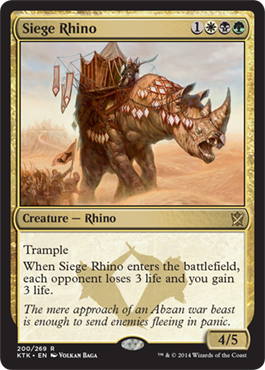
Siege Rhino
1 Month: $2-$4
Fate Reforged: $3-$6+
Siege Rhino is seriously strong. Four mana for a 4/5 is a reasonable rate to begin with. Trample is exactly what you want on fat creatures and that ETB trigger is fantastic. You immediately dome your opponent and pad your life total while putting a sizeable threat on the board that can attack through opposing Coursers. He even survives combat with Knuckleblade when your opponent is tapped down. The biggest challenge to Rhino that I can see from here is Polukranos. Polukranos will be cheaper to cast and is slightly bigger. Anyone that’s played with him is aware that it’s tough to attack through sometimes because of chump blocks, so maybe the trample and trigger push Rhino into the lead.
I don’t see Rhino cratering too hard unless it turns out Abzan is just junk (heh) in the new format. That seems unlikely to pass given it’s in the same colors as Courser, Thoughtseize and Elspeth. Rhino is on the short list to be one of the most expensive rares in the set. If early lists come out with three or four copies don’t hesitate to at least pick up your own playset. It will be tough to make actual cash flipping these since the preorder price is already $4+, but you can always trade for them aggressively if he’s looking to be a real contender.
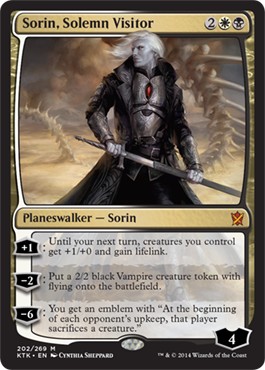
Sorin, Solemn Visitor
1 Month: $9-$14
Fate Reforged: $11-$16
This may be the first time in a long while that a Planeswalker actually rises from his preorder price. SCG has copies in stock at $15 and eBay sets are finishing for about $10-$11 a card. This is surprising to me because Sorin is so solid.
First things first, he’s a four-drop four-loyalty Planeswalker. Second, he’s in both black and white, two colors with some of the strongest cards in the format. Third, he is capable of putting a token down that can not only chump on the ground but also in the air, protecting him from any hasty airborne threats. If you’re worried that his protection mode is a minus instead of a plus, remember that JtMS lost a loyalty when he bounced creatures. Fourth, Sorin’s +1 is going to make attacking into Sorin a nightmare for your opponent if you have any creatures in play at all. It also makes winning races against him a impossible. Fifth, that emblem is fairly easy to obtain and has the potential to completely shut some opponents out of the game. It isn’t as strong as other emblems are but you sure can get to ultimate loyalty quickly.
I never spent much time casting Senor de Innistrad, but I have a good bit of experience playing against him. I was almost always more concerned with the +1/+0 emblem he created rather than the piddly token he was putting into play. In this situation the roles are reversed. Sorin is buffing your whole team with a plus ability every turn, and only dropping the token into play when you’re short on bodies.
Sorin has a competitive mana cost, three strong abilities, and is in two great colors. Senor de Innistrad was quite popular and was reasonably pricey until the duel deck was announced. Solemn Visitor may creep down a bit from his current price, but I don’t think we see him much below $9 or $10. If he does get that low, trade aggressively. He’s good enough to warrant $15-$20 if he sees any real play in the format.
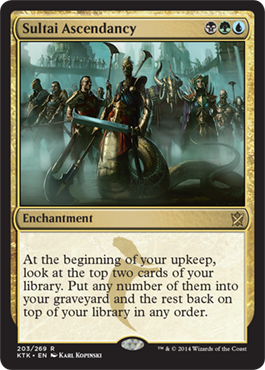
Sultai Ascendancy
1 Month: Bulk – $1
Fate Reforged: Bulk – $3
I’m pretty confident all of the Ascendancies are bulk for quite some time, even if they’re playable. Still, Sultai is looking to be the best of the bunch and I’d be remiss not to mention it. It probably joins its brethren in the sub-$1.50 category, but it seems the most likely to reach a few bucks. It’s no Sylvan Library but what is? Thassa has shown us the power of repeated upkeep card selection, and the fact that it works so well with Sidsi certainly doesn’t hurt.
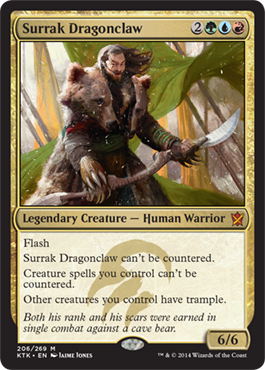
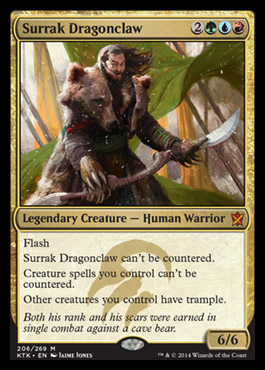
Surrak Dragonclaw
1 Month: $3-$6
Fate Reforged: Bulk Mythic
I did a double take when I looked up his preorder price. $15 on SCG and $9+ on eBay? Are you all reading a different card than I am?
He’s a five-mana 6/6. That’s fine I guess. Flash is good, sure. It let’s you leave up Knuckleblade mana or Temur Charm and flash him down if you don’t need them. The fact that he can’t be countered is wildly situational at best. Unless Temur Charm becomes a 4-of format staple I don’t think the uncounterable clause will matter much. Same with making your other guys uncounterable. Giving the rest of your team trample is certainly solid, as Nylea has shown, but without having it himself it can be totally useless in a lot of board states.
Surrak will be a reasonable threat against control decks for sure. Not only does he blank all their counterspells but he allows your other threats to trample over Elspeth tokens. Unfortunately, I don’t see him having much of a role outside of this. Other formats won’t really want him. Maybe some Riku decks will run him since more casual-oriented players are so drawn to “can’t be countered.”
Overall demand here should be low across the board. The “can’t be countered” clause tends to drive the price of pre-order cards to absurd highs (Savage Summoning was preordering at $6), but I fully expect a crash here over the next month or two. Get out and stay out.
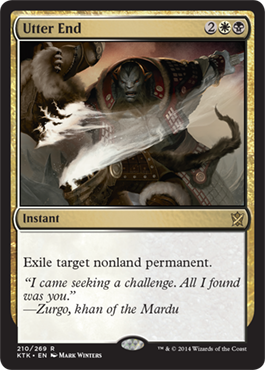
Utter End
1 Month: $1-$3
Fate Reforged: $1-$4
While I’m not wild about this card being more than two or three bucks, it would be shortsighted of me to forget what happened with Hero’s Downfall. Everything went right in the case of Downfall – black was the best color in the format, it was relatively cheap, there were no enchantments or artifacts it really needed to kill – so of course the price was high. Utter end is more expensive and harder to cast, although it hits much harder than Downfall does. The biggest strike against End is that it’s four mana instead of three. When it comes to staple removal you really want to cast it as fast as possible. Each extra mana makes it much tougher to run as a full playset instead of as a one or two-of.
Given that it’s in two colors instead of one it seems much tougher for Utter End to climb towards double digits the way Downfall did. Still, there’s a lot of room between $1 and $10. I anticipate it hanging out on the lower end of things, but I could see it climbing towards $4-$5 if the format is slow enough to allow four mana removal spells.
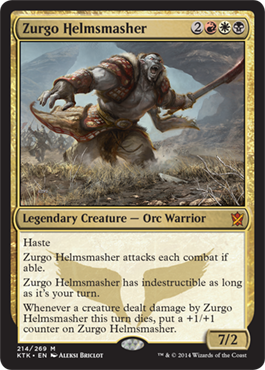
Zurgo Helmsmasher
1 Month: $2-$3
Fate Reforged: Mythic Bulk
Zurgo is one of the two headlining cards of the upcoming Speed vs Cunning product, just as Polukranos was last year. Polukranos would be $15 today if not for that duel deck because he’s so playable. Zurgo…is less playable.
Zurgo of course absolutely has a dangerous front end, and I’m sure I’ll be taking seven damage on turn five multiple times in the future because I don’t want to block with anything I have in play. If you do decide to block to save yourself one-third of your life, Zurgo grows.
My issue with Zurgo is that he’s so easy to chump. Toss a spare Elvish Mystic or Caryatid or Xenagos satyr in front of him to buy yourself the turn or two you need to assemble a reasonable answer. Even if you chump him on turn five and turn him into an 8/3, there are still a plethora of effects that can kill him on the next turn. Lightning Strike picks off an 8/3 Zurgo. Polukranos and seven mana can eat an 8/3. If you decide to take the damage, a lowly Magma Spray will get him. While Zurgo applies a lot of pressure unanswered, he happens to be very answerable.
A CDE mana cost will hurt his value in competitive formats. He’s not particularly noteworthy in EDH. Any demand he has will be squelched by the Duel Deck printing. I think Zurgo is headed right for bulk mythic.
Artifact
Bulk:
Dragon Throne of Tarkir
Ghostfire Blade
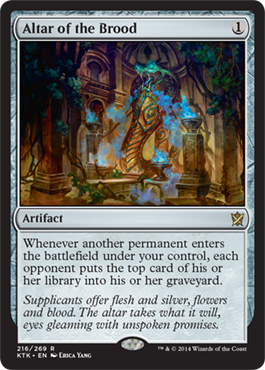
Altar of the Brood
1 Month: Bulk – $1
Fate Reforged: Bulk – $2
This is a sneaky little artifact here. It triggers for any permanent, which means it includes lands. Fetchlands even get to trigger it twice. The mana cost is as pushed as you can get, which is exactly what you need on a card like this. Only milling one is sort of a bummer. If it milled two, or allowed you to target yourself, it would be even more exciting.
We know the casual crowd loves mill to an extent that is difficult to understand, so there’s already going to be a base of people looking to snatch this up. What really excites me is the possibility that it breaks out in Legacy or Modern to create a combo. Even if it’s part of a tier two combo deck in Modern out of the gate we won’t see the price rise too much because there will be too many in rotation, but down the road this will have real potential to jump from bulk to $5. It’s a long term play – two years at least – but there’s the chance someone could make a killing on these if they have hundreds (or thousands) of copies.
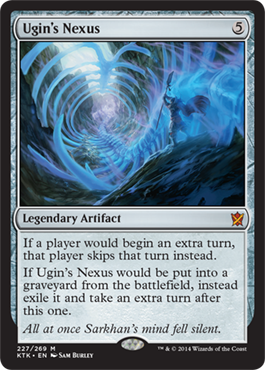
Ugin’s Nexus
1 Month: Mythic Bulk
Fate Reforged: Mythic Bulk
This card is exciting mostly because it references Ugin. Are we getting another colorless Planeswalker this block? Ghostfire Blade certainly sets up Ugin bringing a horde of colorless creatures with him.
Financially this card is a bulk mythic. Very clearly designed for the EDH crowd, the foils should hold value pretty well. There may be a day down the road where someone figures out how to break this, or the EDH demand ends up pushing it close to double digits, but that is at least a year or two away.
Land
The Fetchlands
1 Month: $10-$15
Fate Reforged: $8-$13
I wrote an entire article about these! Go look!