Reflection in the Doldrums

By: Jared Yost

Currently we appear to be in the doldrums of the Magic finance sea. The trade winds haven’t yet guided our course towards buying into Theros staples, as the floor on most cards hasn’t been found yet. The winds also aren’t quite right yet to pursue other avenues of Magic financial interest, such as starting to acquire recently rotated Innistrad block staples or future Modern prospects. (Seriously Wizards, you stuck Modern season in the middle of summer?) Nothing is at the point where I feel comfortable acquiring or selling. It seems no matter which way I hold my compass I can’t find my way back to shore.

At times like these, some retrospection is a good idea. Looking back on past successes and failures may be a great way to find a path forward.


Success!

Jace, Architect of Thought

Jace, Architect of Thought

Some background – I started to seriously get into Magic finance back when Return to Ravnica first hit Standard. I wanted to know what was up with the crazy price swings of cards that at the time I didn’t fully understand.

Earlier in my Magic career, I never kept track of prices very closely – I just picked up cards when I needed them for decks. Over the years, due to dumb luck and the massive influx of players, the demand for the old cards that I never got around to trading away skyrocketed. I suddenly found myself with many cards that were two, three, sometimes four times more than what I originally bought them for. I found myself asking “What is this wizardry?”

I started researching Magic finance more earnestly because I wanted to understand what was going on and why these newer cards that I owned seemed to be going through such large price swings in such a short period of time, and also why my older staples seemed to always be trending upwards. Ever since, I’ve always kept up with the most recent trends on card prices because it fascinates me to no end. I stumbled upon a few websites like MTGPrice, and the rest is history.

Back to Jace – This is one of the first cards that I decided to acquire as many copies as I could rather than just one or two for collection purposes. I was able to pick up several Jace’s back when they were as low as $8.

After Jace’s huge crash, nobody wanted him – I was able to pick up copy after copy. I recently cashed out on half my stock for $23 each. I didn’t pull the trigger on selling off all of them because I felt that maybe I could get more for the remaining Jaces if they became really popular. I still may yet have that chance, however the recent duel deck announcement certainly makes that less likely. I’ll be looking to move the rest in the near future.


Blood Baron of Vizkopa

Blood Baron of Vizkopa

I also did well when I decided to target this card. I got in on Blood Baron when it was $8 this summer, and recently buylisted all my copies for $14 each. That is $6 profit per, which is fantastic as far as I’m concerned. I used the same logic here as I did with Jace, and this card also payed out welcome dividends.


Deathrite Shaman Abrupt Decay

Deathrite Shaman & Abrupt Decay

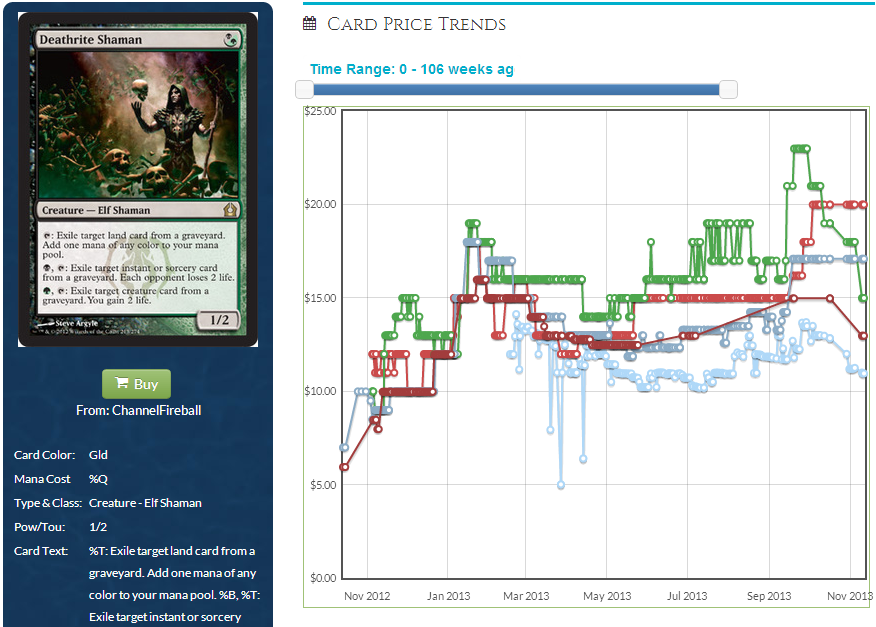
Both of these cards screamed “LEGACY!!!” to me, and I started grabbing them up as soon as they were spoiled. I was very bullish on Deathrite Shaman – so bullish, in fact, that I was preordering Deathrite Shamans at $4. I liked Deathrite so much that I was still picking them up when they already doubled to $7-$8 each. Both decisions turned out positive for me. As for Abrupt Decay, I waited for it to drop in price after the initial hype died down and then became bullish on it when it was $3-$4. My only regret is not picking up foil copies of either card when they were low.


Other Notables

Ash Zealot Wurmcoil Engine Batterskull Burning Earth

Ash Zealot – Buy in $1.25, Buylist @ $2.45
Wurmcoil Engine – Buy in $7.00, Buylist @ $10.50
Batterskull – Buy in $6.00, Buylist @ $9.50
Burning Earth – Buy in $1.00, Buylist @ $3.00

I wasn’t as bullish on these picks but they still paid out pretty well for me. I was able to get fairly good cash prices for these cards when they spiked (Ash Zealot & Burning Earth), or I held onto them for a while and then decided to buylist for a profit when it came time to liquidate (Wurmcoil Engine, Batterskull).


Failures, Misses, and Bad Calls

Nykthos, Shrine to Nyx

I had an idea about the power of this card because it reminded me of Cabal Coffers and how good that card is in a black deck. I decided to hold off because I didn’t know if devotion would be a thing or not in Standard.

Well, it was. I missed big with this land. I might still be able to buy in later after more product is opened, though I can’t foresee Nykthos ever dipping as low as $4 again.


Heliod, God of the Sun Underworld Cerberus

Heliod, God of the Sun & Underworld Cerberus

I was bullish on both of these cards shortly after the release of Theros. They have both gone down since I bought into them, and so far I am in the hole. At this point, I think my best bet is to continue sitting on them and hope they spike.


Voice of Resurgence

Voice of Resurgence

I thought that there was a lot of potential when Voice was first spoiled, and I spent a lot of time thinking about at least picking up a play set. I talked myself out of it, and suffice to say missed out.


Beck // Call

Beck & Call

I was bullish on this card when it was $4. I started picking them up at that price, was astounded when they continued to drop, and started picking up even more once they hit $2. They are now less than $1, making this my biggest flop.


Epic Experiment

Epic Experiment

I started picking up a lot of these at $2 each because I felt that it had a lot of potential in Modern, with a possibility of also being good in Standard later on. My prediction so far has not come to pass, and I’m sitting on a lot of copies that are lower than what I got them for.


Niv-Mizzet, Dracogenius

Niv-Mizzet, Dracogenius

Now at a measly $2, I was very bullish on Niv-Miz when Return to Ravnica prices had bottomed out. I bought in when they were $2.50, so I haven’t lost too much. At the end of the day they’re all still sitting in a box though, making this a loss, even if it isn’t a big one.


Lessons Learned

So, what have I learned about my endeavors with a year of experience? I’ll try to summarize for you:

Success Lessons

  • The common theme of my successes is that I carefully studied each of the cards and made notes of all the potential upside and downside that each had. Once I felt that I understood the pros and cons, I made an informed decision that each had a positive outlook and started picking them up accordingly.

  • One thing I want to be doing in the future is paying more attention to mythics rather than rares. Mythics provide the largest gains over time when their peak has been reached. I made some decent profits from Deathrite Shaman and Abrupt Decay, but those types of success are harder to realize.

  • When looking at rares, the card’s eternal playability is an important factor. When I saw Deathrite Shaman and Abrupt Decay, I knew that they could be good Standard cards and at the same time they would be even more amazing in other formats. I now take this heavily into consideration.

  • Capitalizing on format shakeups – When a format is being “shaken and stirred” so to speak, I’ve relied on my research and past experiences to help make the most of a changing format. This is why I recommended targeting aggro cards right before Theros released, because I knew cards like Ash Zealot would likely see an uptick in price due to the typical increase in aggressive strategies shortly after rotation.

Mistake Lessons

  • More research is required before diving too deeply into any given card. I bought into a lot of cards that weren’t proven and that didn’t have a power level that, in retrospect, I’ve noticed is clearly lacking.

  • While occasionally missed calls end up working out for other reasons, in the meantime I am stuck with cards that no one wants. I was taking on quite a bit of risk with some of my picks. I’m going to stay with more liquid cards in the future to try to mitigate risk.

  • I’ve learned the hard way about which factors actually make a card well-positioned. that isn’t to say that I won’t ever miss again, as surely there will be other errors in judgment in the future. Today though, I can say I am a much better evaluator of a card and its potential.

  • Crowdsourcing is a powerful tool. I need to learn how to better realize the many tools that are available for Magic finance in order to understand card trends and what the community chatter is about a card. It can be good to pick up a few copies on the advice of others who have much more experience with Magic finance, you know?

Still stuck at sea with my sails unfurled hoping for a breeze, I’ve used the time to learn about myself and a bit more about the workings of Magic finance. I hope that my personal musings on my own successes and failures will provide some guidance for you as you set your own course.

*Correction – In the comments for my article last week, it was noted that I incorrectly associated Hasbro with Wizards of the Coast in respect to my writing of Chronicles. Hasbro acquired Wizards in 1999 (from the Wikipedia page), whereas Chronicles was released in 1995. My reference to Hasbro was only in passing however it was an oversight on my part and I wanted to make sure I set the record straight. Sorry for any confusion! Hasbro did not influence Wizards choices in regards to Chronicles.

Commander 2013

It’s finally here; what was promised to us way back in 2011. A new set of Commander decks has arrived, complete with new toys to play with and to spend a lot more money on.

Commander has really taken off, enjoying a growth period that Wizards really wants to encourage. They’ve shown their eagerness to push Commander by releasing cards in each expansion, such as Theros, that are perfect for the format. If you’re new to 100-card decks, buy any of these new product and have a blast.

For more experienced players, the retail price of $150 for all five decks is a big cost. Is it worth it?

Before I get to the discussion, let’s see if I did well in some of my predictions a few weeks back.

I never would have thought Sol Ring would come around again, but I’m strongly in favor of Swiftfoot Boots being reprinted over and over. I’m impressed that they gave us new Zombie and Bird legends, and enable new strategies using the Command Zone. Derevi, Empyrial Tactician

I was right about a Naya beast legend, wrong about Angels and Sphinxes (ugh, Sharuum *again*?) and totally wrong about fetchlands. C’est la vie.

Perhaps the big surprise is the Portal:Three Kingdoms reprints. These cards have popped up before: Cao Cao and Sun Quan in FTV: Legends, Xiahou Dun as a judge foil, Loyal Retainers and Diaochan, Artful Beauty in Commander’s Arsenal, and now three legends (Hua Tuo, Honored Physician, Kongming, “Sleeping Dragon”, and Lu Xun, Scholar General) plus three spells (Spoils of Victory, Strategic Planning, Borrowing 100,000 Arrows). None of these are overpowered legends, though I can easily see someone building a control deck around Lu Xun.

I would expect the prices of these reprints to stay reasonably low. Their original incarnations won’t budge much (see Loyal Retainers,) but these will be available.

As I mentioned last time, the price spikes in the sealed Commander sets from 2011 is due to both the Legacy playability of the cards as well as the sheer value of the rest of the cards. For example, in the 2011 Heavenly Inferno deck, Kaalia of the Vast, Sol Ring, and the Command Tower make up the MSRP, while everything else is a bonus. True-Name Nemesis

There is a lot of value in the five 2013 decks, and the flag bearer is the Grixis deck, since True-Name Nemesis and Baleful Strix are in there. Those, plus Thraximundar and Sol Ring, easily put you over MSRP.

True-Name Nemesis alone is pre-ordering for around $40. That is more than the MSRP. More than any other card in this set. I can’t see it holding this price for long, not when big box stores like Target get product. Scavenging Ooze is the historical example, and that hit a high around $40 before tapering off and getting reprinted.

It doesn’t seem like you can go wrong buying the Grixis deck and moving the singles, especially while the hype and demand is at its peak. With the price of Nemesis and Strix being so high, this looks to be the chase deck and might well depress the price of everything else inside. I’d get rid of everything I could immediately. Sell into the hype, as Jason Alt likes to say.

Again, everything is gravy… if you can move it.

As someone who bought eight of the first decks, allow me to toss this stone from my glass house: I will be trading for specific singles this time around, not buying complete decks. The reason is because aside from some of the brand new cards, I don’t need anything from these sets. I’ve still got most of those cards sitting in a box.

I know, I know. I could buy the deck that has what I want and trade away everything else.

The problem is that it took me 18 months to find someone who wanted to trade for my Commander Sol Ring. It sat in my binder forever! I preach patience but really, that drove me crazy. It is possible to extract the value from the decks, but the process is not a fast one. Keep in mind that lots of other people will be trying to do the exact same thing, and Wizards has indicated that they will reprint these decks if the demand is there. Unexpectedly Absent

So this weekend I’m going to start trying to trade for a few select cards. I suspect that the Legacy chase cards will be True-Name Nemesis, Unexpectedly Absent, and Sudden Demise. Unexpectedly Absent is fantastic if you have WW open and they use a shuffle effect; cast it for zero in response and put whatever on top of their library, which results in them being forced to shuffle it away. Keep an eye on Angel of Finality, because it’s cheaply costed, an effective beater, and has a very relevant ability. You’re paying two colorless more than Rest In Peace and getting a 3/4 flyer!

If you don’t want to spend the cash on the decks, you’ll be fine. If you’re a Curse player, you’ll be able to trade for the new ones cheaply. If you want one of the new legends, you’ll found one before too long. If it’s the last two 8-drop forces you crave, they won’t be difficult to find.

Before you run out and spend your cash for the value stuffed into these decks (and there’s good value!), do yourself a favor and evaluate which cards you want. Singles may be the better path for you.

What Good is Money if You Can’t Spend it?

This past week I realized I had no good winter footwear, and given that I live in Buffalo, this was a problem that needed solving. I set out on a search with a pretty good idea of what I was looking to purchase. After viewing somewhere in the ballpark of 7,000 shoes (thanks Zappos!), I hadn’t found anything I liked for an amount of money I was comfortable laying out. I did find one pair that was exactly what I wanted, but they were about two to three times more than the budget I had set for myself. It was while I was moving some cards around and thinking about the shoes that I skimmed past some duals in my trade binder. Suddenly, the answer was clear. Within two days I had sold a few duals and purchased the shoes. Shoe Tree

My experience refreshed in me the idea that it was sometimes completely ok to take cash out of my collection sometimes, not just always roll profits over into more stock. I am not alone in this practice. Cliff Daigle, the writer of Casual Fridays here on mtgprice.com, just sold several Ulamogs in order to subsidize washing machine repairs. After all, what is the point of squeezing value out of these cards if we can’t make use of it every once and a while?

It’s very easy to get caught up in the process of expanding your collection. We focus on making good trades, searching for the next bubble that’s about to burst, flipping collections, buying low, and selling high. The entire activity can feel rather insulated if you never step back and consider it in the grander scheme of things. There’s an interesting cognitive dissonance that occurs with some players with regards to how they treat Magic money and real money.

You may haggle in trades over $1 worth of value on a $40 trade, but blow cash on lottery tickets every week. Maybe you go out to the bars every Saturday and drop $100 on $20 worth of alcohol. Perhaps your financial vise is a $6 cup of coffee every morning that you could easily make at home or work. Whatever the case, it’s not inconceivable for one to be fastidiously stringent with regards to their Magic transactions, but sloppy with actual currency elsewhere in life. The expression “Penny wise, pound poor” comes to mind.

This mental compartmentalization of types of assets is what occasionally prevents some Magic players from being aware of their ability to cash parts of their collection out to finance real life activity. Has there ever been a time in which you told yourself you couldn’t buy a new game and chose to pirate it instead, all while sitting four feet from $10,000 worth of Magic cards? Don’t be afraid to capitalize on some of that value you’ve accumulated through shrewd trading and speculating. 

Tropical Island

I don’t feel bad about selling duals in particular either. To begin with, there aren’t many players in my area that will even trade for them. My local scene is very Standard heavy, as I’m sure many these days are, with 95% of my trade partners restricting themselves to the roughly 25 Standard pages of my trade binder and ignoring the 200 non-Standard pages. I also don’t feel bad about the lands possibly appreciating in value. In the next two years, how much more could they be worth? $20, $30 maybe? I am in essence paying myself $20 not to buy shoes that I need. That seems silly.

Remember also that Magic cards are a commodity in nature. While that carries with it a great deal of implications, how does it matter in this context? It means that this Tarmogoyf is no different than that Tarmogoyf. Just because you sell a currently-unused goyf today for $100, that does not mean that you can’t own the card again down the road. (Nearly) all Magic cards are completely replaceable. When you remove emotion from the equation and understand objectively that selling a card doesn’t mean it is gone forever, you’ll find yourself far more able to occasionally let go.

To be clear, I’m not claiming that you should be looking to ship cardboard every time you want to buy a sandwich. I was comfortable selling what I did because they represented a small portion of my total inventory. If a few duals were 10% of my Magic assets, I wouldn’t be making that type of move. When what you’re selling won’t even be missed from your collection though, don’t feel bad about letting the cards provide something for you that you actually need. Nykthos, Shrine to Nyx

Your takeaway from all this should be that your Magic collection represents what can be a considerable amount of real value. Cards that are collecting dust and taking up space in trade binders can easily be a good chunk of the cost of whatever it is you’ve been eyeing recently, whether it’s a new mattress, car repairs, fancy jeans, or the latest video game. While I’d recommend you avoid doing it frequently if you want to continue growing your collection, don’t be afraid to dip in occasionally. 

Mid-Week Card Watch

  • Nykthos was seen splashing around GP Antwerp this weekend. It didn’t manage to Top 16, but I doubt this is the last we’ve seen of it in the format. You know what was in 10 of the top 16 decks? Spellskite.
  • Zur the Enchanter saw a huge spike a week or two ago. His price hasn’t settled yet, but it looks like he will be somewhere between $7-$15.
  • Mutavault started climbing from it’s low of ~$12 and hasn’t stopped yet. It’s currently pushing $20, and $25 is not a far cry.

Modern Masters – Current Trends and Future Prospects

This week I would like to delve into a topic that I feel hasn’t been discussed much lately – Modern Masters.

History

Modern Masters was released June 7th of this year and was a special edition set similar to Chronicles. Unlike Chronicles, this time Wizards wanted to get it right and provide us with a set of all reprints without tanking the prices of the cards. The reprints chosen not only resulted in a great limited environment where players were eager to buy boxes to draft, but also released into the world more copies of Modern staples like Vendilion Clique, Tarmogoyf, Dark Confidant, and other powerful cards that are the backbone of the Modern format.

Chronicles had a much bigger impact on the game than many of us realize. Not all players may recall exactly what happened (or have been around for it), so I will try to lay out the basic events that helped shape many decisions Wizards would make regarding Modern Masters.

In 1995, Wizards was succeeding greatly with marketing and selling their Magic: The Gathering CCG product. They realized that a lot of newer players existed that wanted to be able to play with cards from the early releases on since 1993. Unfortunately, the print runs for the first sets were very small because Hasbro and Wizards of the Coast did not know if Magic would be a successful card game or not. In order to appeal to this ever growing market of the game, Wizards decided to release another set with a considerably larger print run.

Chronicles only appealed to newer players because it did not have cards such as Mana Drain, The Tabernacle at Pendrell Vale, Maze of Ith, or Mishra’s Workshop – imagine if it had! The price of these cards would be VERY different today if they had been included with Chronicles. They did not want to include Alpha or Beta cards with this release either – those sets were strictly for collectors who bought into the first run of the game and helped to get the game off the ground. Only specific cards from Arabian Nights, Antiquities, Legends, and The Dark were included.

Following Chronicles release, there was a huge backlash from collectors. The secondary market value of cards reprinted in Chronicles was severely impacted. Many of the cards saw their value drop 60%-90% because they were reprinted in such large quantities. This upset quite a few collectors who had accumulated a great deal of the original printings, and consequently saw the value of their collections dashed.

In order to prevent further PR disasters like this from happening in the future, and to placate collectors who had lost a great deal with the printing of Chronicles, Wizards released the now-infamous reserved list as a promise to never again print certain cards in later expansions or core sets. A few years ago, the loophole was closed when the policy was expanded to include never printing these cards in any shape or form that is tournament legal (promos, duel decks, archenemy, etc.) To this day, Wizards hasn’t shown any sign of changing the policy, with staunch promises from several high-level employees that the reserved list is here to stay.

A common opinion is that the reserve List is a mistake, as Legacy will never be able to grow with it in place. Unfortunately, Wizards as a company cannot abolish the reserved list. There are many within the company’s walls that would like to change or remove it altogether, but their hands are tied.

Wizards created the Modern format as a panacea, which is free from the tyranny of the reserve list. Now they can go ahead and reprint any card in Modern-legal sets to resupply the market and make sure that there are enough copies of the cards floating around, since the reserve list only covers cards through Urza’s Destiny.

Modern Masters is the second experiment with reprints for Wizards. This time around, they wanted to make sure they got it right by establishing a few restrictions for how the set would be distributed, and at what price it would retail for.

Modern Masters was designed to have a limited print run to avoid a second coming of Chronicles, while still trying to appeal to both tournament and casual players by reprinting older cards that were beginning to increase in price due to their scarcity. The goal was to at least keep prices stable, or possibly even reduce prices slightly without completely cratering their secondary market value. Wizards did this by both limiting the availability of the set, as well as setting a higher-than-normal MSRP for boxes and packs.

I believe that we can all learn a lot about how mass reprints like Modern Masters will affect the market moving forward. The product was very popular and well-received, with the only public outcry being that there wasn’t enough product to go around (and also a few complaints about the sealed format).

I wanted to outline my longer term expectations for MM and which cards we should all look out for moving forward. I will delve into which cards Wizards was specifically targeting for price suppression, and see how Modern Masters has affected their prices. Let’s see if Wizards managed to accomplish their goal.


The Big Ones

TarmogoyfTarmogoyf

Before Modern Masters release: $120
Four months After Modern Masters: $120

Tarmogoyf, the most iconic card from Modern Masters, has not seen a price decrease since Modern Masters has been released. Tarmogoyf never dropped in price – after the set was released, it even went up for a little while but has since leveled off to pre-MM levels. I think the price is an accurate reflection of the demand because Tarmogoyf is both a Modern and Legacy staple.

The reason that Tarmogoyf has not dropped in price is twofold. First, Tarmogoyf was reprinted as a mythic rather than a rare. This meant that it saw the least amount of new copies entering the market of any card in the set, on top of Modern Masters being a limited print run to begin with.

The second reason is that the player base of Magic as a whole, and the players getting into Modern and Legacy specifically, has only increased since Modern Masters was released. Wizards intended to not only reprint Modern staples for existing players, but increase the number of players in the format as a whole. This strategy appears to be working, as the price of other Modern staples like fetchlands have increased in price significantly. Tarmogoyf would undoubtedly have also followed this path if it was not reprinted.

The Future: Outside of a second Modern Masters or similar product, I don’t see Tarmogoyf getting any cheaper. They will retain their value and possibly even go up as Modern season approaches. They aren’t a target I would put cash towards unless you need to complete a playset, but if you can trade into extras with surplus stock it would definitely be a good idea.


Dark ConfidantDark Confidant

Before Modern Masters release: ~$50
Four months After Modern Masters: $75

Dark Confidant is an interesting case study from Modern Masters. It is the only reprint card to firmly rise in value! This is because those same factors that helped buoy Tarmogoyf’s price actually managed to increase the price of Confidant.

The Future: Since the reprint, his price has spiked to $75 and I’m not sure if this is the ceiling. Could Confidant hit $100 by next Modern season? Ravnica was opened a fair amount, much more than Future Sight, so there are more Confidants floating around than Tarmogoyfs. This will help to temper Skillrex’s price, but I could still see Confidant rising even further as more players enter the Modern scene.


Vendilion Clique

Before Modern Masters release: $50
Four months After Modern Masters release: $45

Due to the scarcity of Morningtide paired with heavy usage in Modern and Legacy, right off the bat Vendilion Clique commands a price much higher than is normal for a legend. In the time following MM, the price has indeed managed to drop a little bit because it does not see quite as much play as Tarmogoyf, Fetchlands, or other Modern staples. However the combination of rarity and the influx of players has prevented Clique from dropping too far. Demand remains high.

The Future: Similar to Tarmogoyf, I don’t see Clique getting much cheaper than it currently stands until the next reprint. A lot of people underestimated the amount of players that Modern Masters would draw towards Modern, so as the season approaches I can see these slowly ticking up in price.


The Swords

Sword of Fire and IceSword of Light and Shadow

Before Modern Masters release: Fire and Ice $50, Light and Shadow $35
Four months After Modern Masters release: $30 and $25, respectively

Even though the swords still command a solid price of $25+, they are the first reprints I’ve mentioned to have a taken a significant hit from being reprinted. The Sword of Fire and Ice reprint is 40% less than prior to Modern Masters, and Sword of Light and Shadow is about 30% less if you pick up the latest printing.

Originally, the sword’s prices were mainly kept up by casual demand since Darksteel was a hard-to-find set. Sword of Feast and Famine and Sword of War and Peace are in my opinion better tournament-worthy cards than the original swords, though based on a particular metagame any sword could be favored over another for a period.

The Future: I don’t really see a big change in the price of the swords unless there is a demand in Modern for protection from particular colors. Green is an important color to have protection from due to Jund, so Sword of Feast and Famine will probably be the sword to watch out for moving forward. The only copies of Feast and Famine that exist are those from Mirrodin Besieged, so they could be a good pickup ahead of next Modern season.


The Rest

This next section is a list of cards that are worth watching, as they all have strong potential to see an increase during next Modern season due to their playability in the format.

Cryptic Command

Before Modern Masters release: $35
Four months After Modern Masters release: $22

The Future: What a drop! Almost a 40% decrease in price since the Lorwyn high, Cryptic Command could see a jump next Modern season. The cost to pick up Cryptic isn’t too high right now, and it is a good trade target. Any blue control deck wants them, and some slower combo decks like Scapeshift are in the market as well.


Arcbound RavagerArcbound Ravager

Arcbound Ravager didn’t see quite as big of a drop as Cryptic Command, and he is the cornerstone of the Affinity deck. This is another one to watch because as Modern season approaches this card could see an uptick in demand and therefore an uptick in price. This card also occasionally makes a strong showing in Legacy, which will help to keep the price moving upwards over time.


Blinkmoth NexusMaelstrom PulseBlood MoonEngineered Explosives

Blinkmoth Nexus, Maelstrom Pulse, Blood Moon, Engineered Explosives

I’m keeping my eye on all four of these cards because not only are they played in Modern but they also make an appearance from time to time in Legacy as well. Having the support of two formats is no joke, as Tarmogoyf and Dark Confidant can attest to. Being rare does limit the upper bound, but I expect all three of these cards to eventually crest $10 again, and possibly even more.


Academy RuinsGlen Elendra ArchmageKira, Great Glass-SpinnerSummoner's Pact

Academy Ruins, Glen Elendra Archmage, Kira, Great Glass-Spinner, Summoner’s Pact

These are another set of cards I will be keeping my eyes on that have dropped in price significantly but for a different reason. They are all strong causal cards in addition to being tournament playable. Casual demand has become a big part of predicting the price of a card. Kalonian Hydra and Archangel of Thune are good examples of this – they really aren’t even played in Standard and yet they are $20 mythics. I think the same could be true for several Modern Masters cards, since nearly every rare and mythic was $15 or higher at one point in their original printings. If I start seeing any movement in these cards as Modern season approaches I won’t hesitate to pick them up.


Path to ExileKitchen FinksSpell SnareLightning Helix

Path to Exile, Kitchen Finks, Spell Snare, Lightning Helix

I like speculating on uncommons from Modern Masters because I feel like these are the types of cards that have a lot of room to grow during Modern season next year. They’ve all experienced big drops from their original highs and can be acquired in trades as extra throw ins. Even purchasing extra copies of these for the right price could be a good call. Once Modern season gets going, they will all be seen across a variety of decks in the format. Any one of the uncommons could definitely spike. You won’t see a huge return on any individual copy, but doubling and tripling in price isn’t unfathomable. Jumping from $1 to $3 doesn’t sound impressive, but when you have 30 copies it will be. I’ve been grabbing extras anywhere I can.

Conclusion

It has been four months since Modern Masters was released. According to the raw numbers it looks like Wizards has achieved its goal of reducing prices overall while not crashing the market. Even though Tier 1 staples like Tarmogoyf and Dark Confidant have leveled off or increased in price, many of the other staples have taken quite a hit from the set’s release, especially uncommons and rares that derived part of their price from casual play and just plain scarcity.

Over the next six months and as Modern season approaches, I expect many of the cards I mentioned to start ticking up in price as they become harder to find and more players need them for Modern tournaments. Eventually, Modern will become the new Legacy. This won’t happen for quite a few years because the reserved list exists – it is basically unavoidable. Wizards now knows that they can create sets like Modern Masters in order to keep a successful eternal format alive by reprinting scarce cards every so often. Luckily for us, these sets also open up plenty of financial opportunities to gather reprints once they hit their low points in anticipation of the following Modern season.

MAGIC: THE GATHERING FINANCE ARTICLES AND COMMUNITY