By: Travis Allen
You guys like Dragons, right? Dragons? DRAGONS?? DDRAGONSFSFFFFF
I’ve never been a devout dragon follower so there’s no special excitement in Dragons of Tarkir for me. It does strike me as a bit saturated though. It’s not special if you have it every day, right?
From our current vantage point, DTK appears to be at least a reasonable set. There’s no shortage of casual and Commander cards while there’s also enough muscle in the set to impact Standard, especially with two seemingly very playable Planeswalkers. I’m not sure there’s any meaningful Modern or Legacy impact here, but time will tell. That doesn’t mean it isn’t challenging to review though.
It’s important to remember when reading any set review that we are forced to evaluate cards in a pseudo-vacuum, but they never exist as such. When I look at Sidisi, Undead Vizier I have to consider the card individually, free of whatever the metagame looks like that particular month. Sidisi’s text box isn’t going to change, but the cards other people are playing will. I need to focus on what concrete information I have available to me. Because of this, set reviews are especially challenging. I have to look at Sidisi and make an evaluation based strictly on the words printed on the card, but her true worth will be dependent on the cards around him, a pool that will change significantly over time. Cards that are excellent right now may have been trash in an alternate timeline. It would be easy to construct a Standard environment where Desecration Demon is crap (such as he was in INN-RTR when Lingering Souls was legal,) or where Prime Speaker Zegana is a chase mythic. Even the hallowed Jace, the Mind Sculptor was nigh unplayable at release since there wasn’t a single other playable blue card in the format and Bloodbraid Elf + Blightning threatened to shut him down as soon as he resolved.
You’ll notice in bulk sections that some cards have an asterisk (*) next to them. These are cards that basically all have the same review: they’re quite likely bulk, but there’s a world in which they’re quite good. These are the types of cards that if they ever hit the $.15 – $.25 range, I will probably buy a few sets just in case.
My price predictions are where the cards will be in one month, and where they will be as Origins arrives.
White
Bulk
Anafenza, Spirit of the Family Tree
Gleam of Authority
Hidden Dragonslayer
Profound Journey
Radiant Purge
Sunscorch Regent
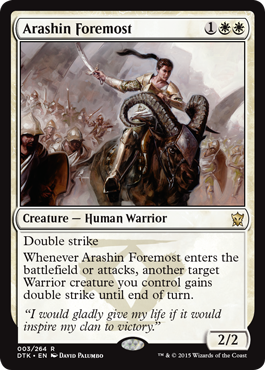
Arashin Foremost
One Month: $1-$2
Origins: Bulk or $3-$5
The future of Arashin Foremost depends heavily on the fate of Warriors. If the tools provided in this set are strong enough to push the deck into tier one status, I can see Foremost being a part of that strategy. Coming down on turn three turns your Chief of the Edge into a six power threat, and each turn after that she gives your most threatening body double strike. Silverblade Paladin was over $12 at one point, and his effect was very similar. Theoretically, Foremost’s would be better in a dedicated warrior deck.
If warriors can’t make it though, it’s bulk. This outcome is more likely. Keep an eye on early tournament results – if people are getting work done with the tribe, don’t be afraid to scoop up copies at $1 apiece.
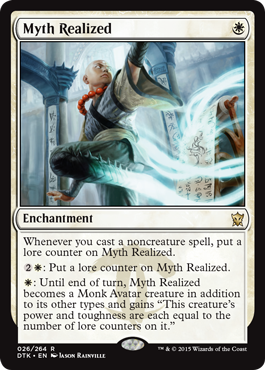
Myth Realized
One Month: Bulk – $2
Origins: Bulk or $4
Myth Realized reminds me of Mastery of the Unseen. Both are capable of being absurd in particular decks, and subsequently carrying price tags of several dollars. Both also may go completely unplayed, reaching absolute bulk in a matter of days after release. These are the cards that make me want to stop doing set reviews.
There’s an outside chance Myth Realized could find a home in some control-esque decks. Landing one of these on turn one and then eventually swinging for seven or eight quite a few turns later is entirely plausible, although the lack of indestructibility when activated means that it will never be truly safe.
While an excellent choice on turn one, these still aren’t dead late in the game. The ability to put counters on with spare mana means that a few turns of draw-go once you’ve got six or nine mana in play means this can turn threatening quickly, even when drawn many turns in. Overall a control path seems less viable currently, with the amount of enchantments running around, and thus enchantment hate, but we could see a big drop off in those types of cards after October.
I’m also wondering if it has a home elsewhere. It would be interesting to see some sort of GWX deck pop up that uses Eidolon of Blossoms and a boatload of enchantments to build gigantic Myths, while leaning on cards like Suppression Field, Silkwrap, Banishing Light, Chained to the Rocks, Monastery Siege, and Skybind to disrupt your opponent’s board presence.
It’s really tough to tell you whether this card is real or not, just as it was for Mastery of the Unseen. You’ve really got to just make this call with your gut and watch tournament results like a hawk if you’re considering buying in.
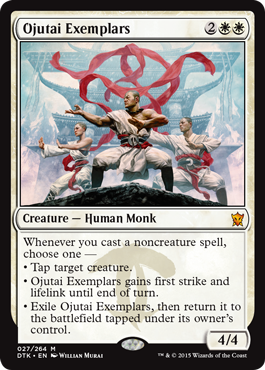
Ojutai Exemplars
One Month: $2-$4
Origins: $2-$4
Exemplars are going to be a pain in the ass to both play with and against. If your opponent has Exemplars in play and open mana, there are an unreasonable amount of lines to consider. Not only do you have to think about playing around the variety of spells they could be representing – Valorous Stance, Ojutai’s Command, whatever – you also have to think about how each one of those could interact with Exemplars. “If he’s got Stance, what mode does he use? And then does he tap this guy, or does he let me swing with both, and then choose the lifelink? What if it’s Murderous Cut instead?” The problem exists on the other side of the table as well. Piloting this card is going to be difficult with a single spell in your hand, much less multiple.
Difficulty of play aside, the power level is there. A player can play protect the queen with a threat of this nature and proceed to win on the back of it. The multiple modes allow you to get troublesome blockers out of the way, gain life to race or regain lost ground, dodge removal, or neutralize threatening attackers. They really are capable of nearly everything so long as you can do a decent job keeping moderate control of the game. Exemplars also pairs very well with Monastery Mentor, as both are capable of winning the game on their own when backed up with a grip of spells. I can certainly imagine a UW list that plays four of each and no other creatures.
Exemplars is the type of card I see taking some time to work out. People will play one copy in the board or the main, and over a few weeks slowly increase the quantity they’re playing, until it’s a major component of the format, similar to perhaps Whisperwood Elemental. Out of the gate Exemplars should slip into the few dollar range from the $10 they’re currently preordering at. After that it’s a question of whether things shake out in a way that the sort of deck they’re in is good. If so, then they could easily rebound to double digits. If not, they’ll languish in the two or three dollar range. The power level is there, it’s just a question of what the rest of the room looks like.
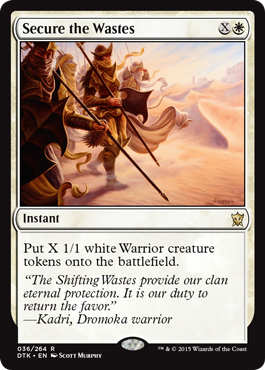
Secure the Wastes
One Month: Bulk – $2
Origins: Bulk – $2
I can’t decide how I feel about this card, so rather than shove it in the bulk section, I’ll let you know what I’m thinking.
We’ve never had an X token producer this efficient before, especially at instant speed. If your opponent stabilizes and then casts an otherwise-irrelevant spell after clearing your board, you can drop this at end of turn and suddenly be attacking for four or five damage. It’s worse than Raise the Alarm at two and Hordeling Outburst at three, but it’s better than anything else above that, and it’s also playable at any point on the curve.
What drove me to pull it out of the bulk section is that the tokens are warriors. With Chief of the Edge, those 1/1s get threatening real fast. It’s also obscene with Purphoros, who is legal for another few months.
It’s unlikely that this sees enough play in enough places to drag itself above $2, but I didn’t want to skip talking about it entirely.
Blue
Bulk
Blessed Reincarnation
Dragonlord’s Prerogative
Illusory Gains
Living Lore
Mirror Mockery*
Profaner of the Dead
Stratus Dancer*
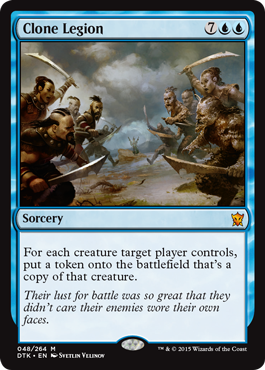
Clone Legion
One Month: Bulk
Origins: Bulk
This is the type of card that makes my policy of “include text about every mythic” feel silly.
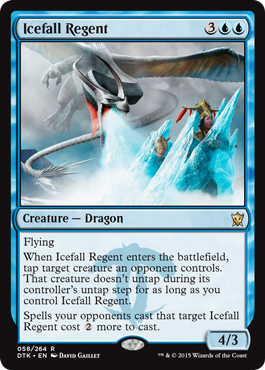
Icefall Regent
One Month: Bulk – $3
Origins: Bulk or $3-$5
Here are the two obvious comparisons: For one mana more than Dungeon Geists, you get an extra power and a two-mana tax to remove it. For one more mana than Icefall, you get Frost Titan. Hrmm. Dungeon Geists won a Pro Tour, but otherwise didn’t light Standard on fire. Frost Titan spent some time as the best titan in Standard. Hrmm.
Four power is a bit better than it would be in other sets due to Ferocious floating around. Can you imagine untapping with this, casting a Ferocious See the Unwritten, and putting two more Icefalls in play? Hah. Three toughness is sort of a beating, but if our opponent’s are spending four mana to kill it with Lightning Strike, I probably can’t complain.
What I like about this is how much of a tempo loss it is for your opponents in a color, in a clan, in a set that is on board with tempo plays. Playing an early Savage Knuckleblade allows you to begin applying pressure, and when they resolve a Siege Rhino or Tasigur in an attempt to stabilize, you can follow up with Icefall to tap it down and continue serving with the Knuckleblade. Your opponent is now in the unenviable position of either having to cast another stabilizing creature, which means they’re going to eat the Icefall’s attack next turn, or they can take their entire turn off to kill Icefall, which means you get to attack with the Knuckleblade again while following it up with some other threat.
Cards like Icefall Regent need support and opportunities. While Siege Rhinos create metagames, Icefall Regents prey on them. Is this an Icefall meta? No way to know. The card is definitely capable of terrorizing at least a few potential Standard formats though.
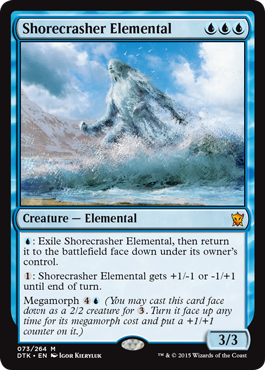
Shorecrasher Elemental
One Month: $2-$5
Origins: $1-$3
People are jazzed about Shorecrasher heralding the return of Master of Waves and Thassa. I’m not sure why; people complained non-stop when Mono-Blue was crushing FNMs everywhere. Whatever.
There are two futures here: Mono-Blue is good again, and in that case, Shorecrasher is probably a four-of, and one where Master, Thassa and Shorecrasher can’t keep up with Siege Rhinos and Hornet Queens. My money’s on the latter. Siege Rhino is just a savage beating for everything in that deck except for Thassa, which decks playing Rhino can keep deactivated. Perhaps more importantly is the lack of Mutavault, which was a key player in the strength of both Mono-Blue and Mono-Black.
I will say this – I wasn’t on board with Mono-Blue, and then two things happened: Chapin wrote an article saying the deck was coming back in a real way, and they spoiled Silumgar’s Sorcerer. Chapin can be a bit over zealous at times, though it’s still always worth listening to him. Meanwhile Sorcerer looks busted in this deck – it counters your opponent’s stabilizing creature while pressuring in the air and providing devotion. With all the one-drops this deck usually needs to run, you shouldn’t even have a problem sacrificing a Gudul Lurker or something.
If the surf ninjas do turn up in force this summer, remember that Master of Waves was only over $10 for for about four months, and that was as the uncontested best deck in the format. A more likely price for Shorecrasher is between $5 and $10, although a spike above that range could occur. With both Master of Waves and Thassa in the deck, there’s plenty of mythics to spread value across. Shorecrasher’s window is also very small – his relevancy is likely only until Theros rotates, at which point he loses the devotion angle, and his cost suddenly becomes a liability. Without any Standard demand, he drops towards bulk mythic.
Black
Bulk
Damnable Pact
Deathbringer Regent
Foul Renewal
Hedonist’s Trove
Pitiless Horde
Silumgar Assassin
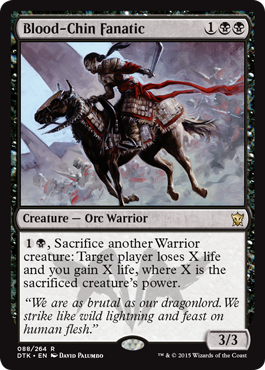
Blood-Chin Fanatic
One Month: $1-$2
Origins: Bulk or $3-$5
Blood-Chin is in the same boat as Arashin Foremost. For an aggressive tribal deck, he’s an excellent finisher. His stats are reasonable and he allows you to burn out wounded opponents, much in the same way Kalastria Highborn used to. I’m not exactly sure whether warriors would rather have him or Foremost, or both, but I imagine either one is viable depending on the shape the deck takes in response to the format.
Of course if warriors doesn’t pan out he’s bulk.
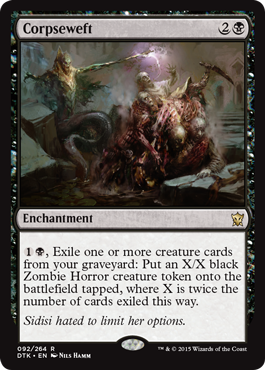
Corpseweft
One Month: Bulk – $2
Origins: Bulk
This was in the bulk column until I realized it says “twice.” Knowing that it makes at minimum 2/2s, I’ve got to include at least something here.
Three is certainly more for an enchantment that doesn’t actually do anything than you’d like to pay, but the fact that you aren’t doing a lot with this until the later turns of the game ameliorates that concern, since there’s no need to ever cast this on curve. Two is a fair price for the activated ability at least.
Only eating creature cards from your graveyard is sort of a bummer for sure, but a deck built with that in mind won’t be too inconvenienced by it. At twenty creatures this isn’t completely unreasonable. What is perhaps most alluring about this is the flexibility of the token you create. If your opponent has one large blocker, you can go wide with several 2/2s. If you need a haymaker to crash through, exile all your creatures at once and get in with an 8/8. Heck, you could even live the dream and exile Torrent Elementals. Considering that the fodder for this is creatures that already spent their time in service, that’s not a bad rate. Corpseweft could end up drawing you quite a few virtual cards in a matchup, which most three mana enchantments can’t claim.
My biggest qualm is that it uses cards in your graveyard as a resource, something we’re already doing a lot of with Tasigur, Dig Through Time, Treasure Cruise, and Murderous Cut. Do you want to be going through this much work to make some 2/2s and 4/4 tokens when you could be casting Tasigur or Dig? I’m not so sure. This is a Mastery of the Unseen card – it could hit pure bulk and never rise again, unlike the horrors it creates, or it could smash a GP one weekend and jump to $6. I’ll pass for now, but if I can buy a bunch of copies for $.20 or less each at some point, I probably will.
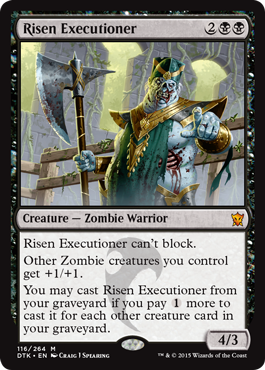
Risen Executioner
One Month: $3-5
Origins: $2-$4
Risen Executioner is one of two creatures with power greater than two that can return from the graveyard this set. I’m not sure why Wizards decided we needed them both right now, but hey, there you go.
Pumping zombies feels a bit EDHish, but the old Sidisi will still be legal, and putting 3/3s into play instead of 2/2s would be quite the upgrade. He also makes your Empty the Pits lethal far faster, while Pits clears out all the creatures that make casting him from the graveyard too expensive. An end-of-turn Pits for four or five bodies followed by untapping and casting Executioner puts a lot of damage on the board from zero.
His return clause is a tad strange, but most other creatures with reasonable power that can infinitely recur from the graveyard have conditions. Vengevine requires two creature spells, the Raptor needs you to unmorph guys, Demigod required casting Demigod, and Skaab Ruinator required exiling bodies from the yard. While Executioner’s cost may feel high, it’s actually quite cheap. All the other creatures listed require you to have more gas in some capacity. If you delve away all your other bodies, with maybe Tasigur or Angler, Executioner is just 2BB: join the party. If you find yourself with a boatload of mana and a value-adding sacrifice outlet, go hog wild.
With the undead Sidisi looking to knock people off as he comes into play, and being a zombie himself, Executioner looks like he may play well in some form of mono-black or heavy black control. He’s a great target to sac to Sidisi, and the BB in his cost pays the grey merchant.
I anticipate his price will dwindle in the near future, as it may take time to figure out how best to use him. Torrent Elemental, a card I felt similarly of while reviewing Fate Reforged is still $3.50. I’d expect that to be Executioner’s floor a month from now, and he’ll hang out around $2 if he doesn’t see any play at all. If he’s the real deal, double digits is entirely possible.
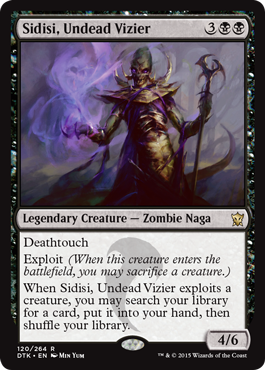
Sidisi, Undead Vizier
One Month: $3-$5
Origins: Bulk or $2-$4
One of the earliest spoilers, Sidisi has been the subject of some debate amongst my sort on Twitter. A 4/6 blocks almost everything on the ground right now, and Deathtouch means she stonewalls Rhinos and Tasigurs. In the meantime, the Demonic Tutor trigger allows you to find your appropriate answer for the game state at hand, whether it’s a Crux of Fate, a Downfall, a Drown in Sorrow, or a Grey Merchant.
Five mana isn’t cheap though, and the Exploit trigger isn’t free. Sure, oftentimes you’ll be able to throw a Wayfinder under the bus, but that won’t always be an option. In general you’ll be searching your library, but we need to recognize it isn’t 100% guaranteed. Is a slowish conditional Tutor good enough for Standard?
Sidisi feels a bit like Tasigur did, in that you can see where the power in the card lies, but it’s tough to tell whether or not the work is worth it. I’m moderately bullish on Sidisi. Tutoring for specific answers is strong, her body is relevant, and she’s not miserable to cast. What’s this mean for her price? Probably in the low single digits, at least for awhile. Tasigur is just under $10, and he rapidly became a multi-format all-star. I don’t see Sidisi breaking into Modern or Legacy anytime soon, which severely hampers her price outlook for the near future. It doesn’t help that there are a lot of cards in this set has two playable Planeswalkers and a boatload of cards that could break out into the $10 range.
Red
Bulk
Berserker’s Onslaught
Crater Elemental
Commune with Lava
Dragon Tempest*
Ire Shaman
Volcanic Vision
Zurgo Bellstriker
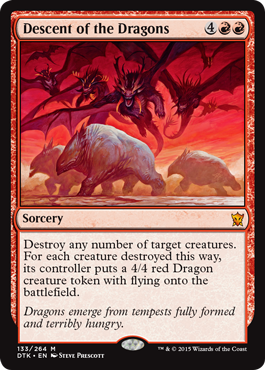
Descent of the Dragons
One Month: $2-$4
Origins: $1-$3 or $4-$10+
Why do I think this “lol EDH” card could be over $10 in a few months? Let me remind you of three cards that will be legal:
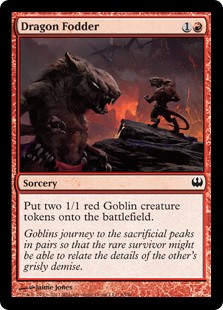
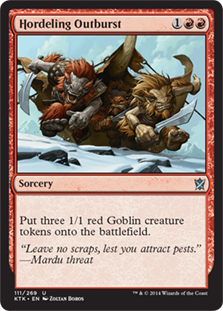
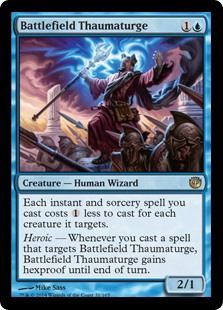
Those three cards represent a plethora of bodies to turn into 4/4 dragons, and the tool to make it happen very quickly. Here’s an admittedly above-average game:
Turn 2: Dragon Tempest
Turn 3: Hordeling Outburst
Turn 4: Cast Battlefield Thaumaturge for 1U, then cast Descent targeting all four of your guys for RR. Put four 4/4s into play, dealing sixteen to your opponent’s face, then swing with sixteen hasty flying power.
That’s obviously a best-case scenario, and includes you having Dragon Tempest in your deck, but it’s not terribly unreasonable to see four cards over four turns. Substitute Dragon Fodder for Tempest on turn two and you’ve still got a turn five kill.
People will be quick to point out that Hour of Need has existed for some time, and that’s fair. The difference is that Hour of Need is ok with Thamaturge in play, and atrocious without him. Descent is unreal with Thamaturge in play, and still completely castable if you don’t draw him. With a straight cost of 4RR, it’s never going to be unbelievably expensive to transmute your whole board, as it would be with Hour of Need.
When you aren’t making swarms of dragons, you’re playing a regular UR game with Hordeling Outburst, Goblin Rabblemaster, Anticipate, and other solid cards. Lightning Strike, Stoke the Flames, Hordeling Outburst, and Goblin Rabblemaster have all proven that they’re completely real cards on their own, and Thaumaturge and Descent just give the deck an obscene top end. How convinced am I that the deck will land?

You can see I have some vested interest in the deck succeeding. I’m not talking up Descent because I bought 121 Thaumaturges though, I bought 121 Thaumaturges because I see a real contender forming.
Perhaps the Magic world spins in a way that a swarm of 4/4 dragons isn’t good enough, but I’m convinced that it’s a real enough possibility that I chose to buy in.
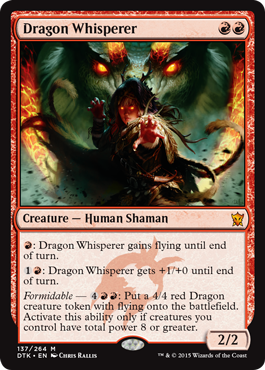
Dragon Whisperer
One Month: $3-$6
Origins: $3-$6
Whisperer looks real to me. Whenever you’ve got a spare mana you can send her into the air to score for two, adding late-game relevancy to a two-drop. Being able to gain evasion as needed for only a single mana is going to help apply pressure in situations where your other small aggressive guys are getting stonewalled. Being able to add to the damage when your opponent can’t answer a flyer is also very useful. For five mana you can serve for four in the air, which won’t take long to finish your opponent off. Both of these abilities are exactly what these sorts of decks want – a way to get extra damage in past bodies clogging up the ground. The Formidable ability is icing on the cake, and it’s sweet icing to boot. In games where you’re having trouble pushing through you can begin pooping out dragons. This will be excellent in the RG monster decks that often lack card draw but not powerful creatures. Just as you run them out of cards in hand and you think you can start to gain control of the board, they’ll simply start generating dragons until you kill everything or you’re dead, with the latter much more likely.
Dragon Whisperer could even herald the return of a red devotion deck. That RR casting cost helps enable Nykthos shenanigans, and she provides you a mana outlet to boot. Purphorous would love another shot at Standard.
It looks like Whisperer is preordering for about $6 on eBay right now, which doesn’t seem far from where her price will land in the short term. I’m unsure if she can climb above $5 or $6 before the fall, although anything is possible. If she’s seeing some play in decks that don’t all involve Nykthos over the summer and her price stays low, it may be worth picking up copies for what would be a probable jump in October. In the meantime, if this is the type of card you want to play, A. you’re a monster, and B. feel free to pick up a set at retail.
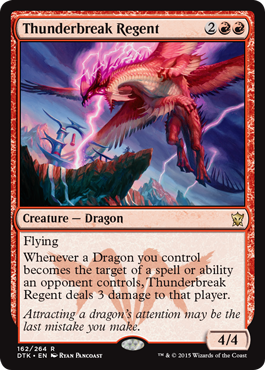
Thunderbreak Regent
One Month: Bulk
Origins: Bulk – $5
The last time we had a playable Gameday full-art rare was Dungrove Elder back in M12, and there were only a handful before that as well. We did get a full Kalastria Highborn though, so sometimes tier one Standard staples show up in this slot. I’m not sure if Wizards just keeps missing the mark with what they expect to impact the format, or if they just choose the cards with a dartboard.
2RR for a 4/4 flyer is mediocre, but one that bolts the opponent when they try to remove it is a another matter altogether. The reason a card like this would generally be unexciting is because it’s so vulnerable to removal and doesn’t accomplish anything if they kill him before he attacks. With that clause on there, you’re at least getting three out of the deal. He’s also in a great spot on the curve, in that he comes down ahead of all your other big nasty threats. If he was five I’d be much less interested, but at four you still have room above him for cards like Atarka or Stormbreath. You even have a shot of getting him down on turn three between Elvish Mystic and Dragonlord’s Servant.
Non-foil pack copies will be between bulk and maybe $4 if he’s a four-of in some sort of dragon stompy deck. Those gameday promos will be a bare minimum of $3, and could be upwards of $15 or $20.
Green
Bulk
Assault Formation*
Collected Company*
Den Protector
Foe-Razer Regent
Obscuring Aether
Sunbringer’s Touch
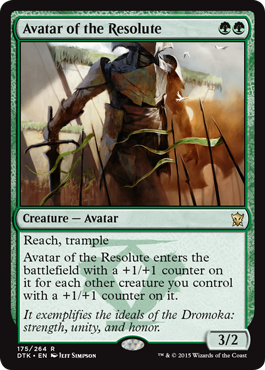
Avatar of Resolute
One Month: Bulk – $2
Origins: Bulk – $2
GG for a 3/2 is usually fringe playable. Add in Reach and Trample and you’ve got yourself a bona fide beatstick. No chump blocking for you, goblin token! Add in the extra +1/+1 counters you’ll occasionally get and it’s clear WotC is pushing this pretty hard. Honestly, this is not far from being a mythic.
Right now Fleecemane Lion is less than $2.50, and spent all of two months at $4. I would be surprised if Avatar manages to see more play than Fleecemane, especially given how tough GG as a cost is. That gives us a good feel for what Avatar’s price trajectory looks like.
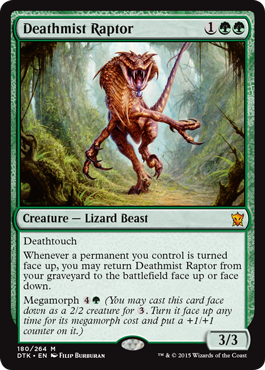
Deathmist Raptor
One Month: $3-$6+
Origins: $2-$5+
Deathmist is a tough card to evaluate. Cards that can return from the graveyard are always tricky, because sometimes they’re incredibly powerful (Vengevine), and other times they’re complete duds (Skaab Ruinator). With two of them in this set, Wizards is setting out to test me apparently.
What makes Deathmist particularly appealing is that he’s free, in a way. The price is turning a permanent face up, but no extra mana is required to bring him and his pals with him. This is noteworthy in the same way Vengevine is; you can return multiple copies for the same cost. Note that $19 Vengevine works the same way, while $.93 Skaab Ruinator only returns one at a time.
Having just watched the finals of GP Miami, it seems to me that Deathmist will slot directly into the GW Devotion/Mastery of the Unseen list that took the top two slots. I can’t say for sure whether this deck will still be a thing by the time Deathmist actually hits the streets, but if Mastery continues to perform alongside Whisperwood Elemental, Deathmist seems great. Deathtouch means he can freely attack into your opponents because he either gets in for three or trades, at which point you’re free to bring back his whole pack with your manifests. Deathtouch doubles as an excellent defensive keyword when you’re on the back foot, and he’s also great face down, as he’s a superb surprise blocker. Double G in his mana cost even plays well with Nykthos.
His preorder price is hanging around $10 right now which is high for an unknown element, but I don’t think it’s wildly out of line. I anticipate that he’ll drop into the $5ish range, but I’ll be surprised if he makes it down to $2 bulk mythic pricing. I suspect he’ll always be hanging around Standard, and during the periods where Whisperwood and Mastery are strong cards, he’ll be right there with them, with a price tag nearing $10 to boot.
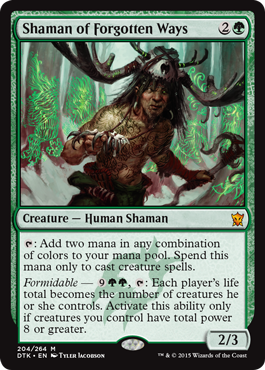
Shaman of the Forgotten Ways
One Month: $2-$4
Origins: $1-$3
I really, really want to say this card is terrible. He adds less mana than Somberwald Sage, which is his entire reason for existence, and his Formidable ability costs a million mana. Three toughness is better than one, but when people are casting Lightning Strike and Stoke the Flames, does it matter? I guess he dodges Wild Slash. Does that matter? Does anything matter? Is life meaningless? Or is it just my life?
I suppose it’s worth remembering that Generator Servant is still legal. Those are the types of effects that need to hit a critical mass to matter, but when they do, they can prove to be real contenders. With four Servants and four Shamans, along with Caryatids, You could be dropping Kolaghans and Atarkas quite quickly. If ever there’s been a set with plenty of fat to ramp into, this is it.
While Sage was under $1 for most of her lifespan, she did show up as a four-of in a few Craterhoof decks, which jumped her into the $3 range. We may not have Craterhoof, but we do have Hornet Queen and a pile of pushed dragons. My guess is that we forget about his ways, but the type of deck he’s good in has been tier one in Standard before. If he makes it, we’ll see numbers in the $5 to $9+ range. Like Arashin Foremost, you should be able to see it coming if the stars align.
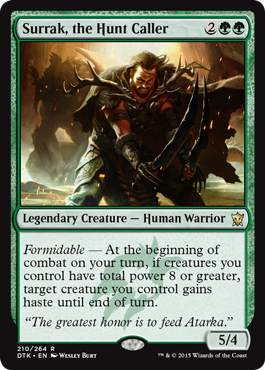
Surrak, the Hunt Caller
One Month: $1 – $3
Origins: Bulk – $4
Remember that scenario earlier with Savage Knuckleblade and Icefall Regent? What if you put a Surrak in between? He gets haste with the Knuckleblade in play, and then gives the Icefall haste next turn. Pretty nasty, huh?
Surrak is definitely on the radar. Like Knuckleblade, and Icefall, and Shaman of the Great Hunt, and so many other Temur-oriented cards, he’s in this “is tempo good enough?” limbo. Four mana creatures don’t typically give your creatures haste each turn, which means we’ve got a lot of potential power in Surrak. On the other hand, it won’t matter if our opponents constantly have grips of removal and counters. You’ll never hit Formidable, and your Surrak will spend the whole game staring at a Siege Rhino.
I will say I am looking forward to casting See the Unwritten the turn after Surrak, triggering Ferocious, dumping two Eldrazi into play, and then giving one of them Haste with his Formidable trigger. Yes. Yes I am.
In any case, the probably ceiling here is low-ish. Even best case scenario, I think Surrak is under $5. That’s still a hell of a lot better than when he was a Khan though.
Multicolor
Bulk
Arashin Sovereign (Intro)
Boltwing Marauder (Intro)
Harbinger of the Hunt (Intro)
Kolaghan’s Command
Necromaster Dragon (Intro)
Pristine Skywise (Intro)
Silumgar’s Command
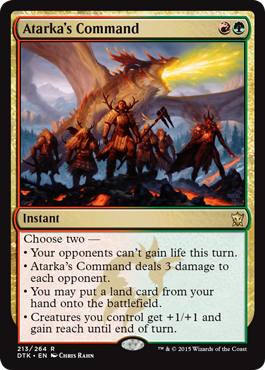
Atarka’s Command
One Month: $1-$3
Origins: $1-$3
I’m deferring to Sam Black and a few other pros on Twitter who are of the opinion that Atarka’s Command is so far the second best of the bunch, to the point that it embarasses Ojutai’s. It’s easy to look at the card and say that it doesn’t do much, but it’s important to remember how cheap it is to cast. It does a reasonable Skullcrack impression, with the missing component the “damage can’t be prevented clause.” That’s certainly a useful component of Skullcrack, but I imagine most would argue that stopping large chunks of lifegain that would get the opponent back into the game is more relevant.
Being able to dome for three and pump the team puts a lot of pressure on quickly with a spread of attackers. Similarly, swinging in and then casting this for the life gain prevention and pump lets you neutralize the utility of lifelink creatures. Being able to make one last alpha strike into their blockers while turning off the lifelink guys can be the difference between winning and losing.
Even if this does turn out to be the best command, I have trouble imagining it at more than a few bucks. I doubt it hits actual bulk prices, but I can’t imagine it being worth more than $5 for longer than a weekend.
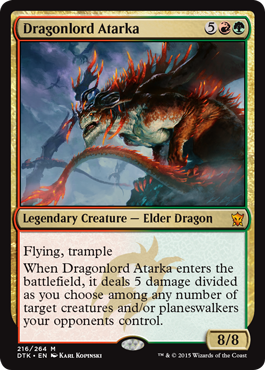
Dragonlord Atarka
One Month: $2-$4
Origins: $2-$3
Atarka is quite reasonable as a finisher in big GR decks. An 8/8 flying trampler threatens to put the game away the turn you swing, and seven mana is one less than I would have expected to see on a creature with these stats. We’ve seen the “split five” before on Bogardan Hellkite, and it was quite good in the games you managed to resolve him. Atarka coming down on turn five or six cleaning up a Siege Rhino or some other assorted trash is powerful.
The biggest problem with Atarka, and all the elder dragons, is that it’s very unlikely anyone is going to need full playsets, especially ones that cost seven. Atarka is cool, and could definitely see some Standard play, but when she’s in a set with Sarkhan, Narset, and several other decent mythics, she’s going to have a hard time keeping a price tag in line with her mana cost.
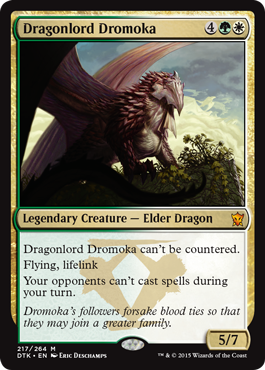
Dragonlord Dromoka
One Month: $2-$4
Origins: $2-$4
Assume you aren’t playing against a control deck, and what is Dromoka then? A 5/7 flying lifelink for six. That’s good enough to win some games I guess. You wouldn’t put a creature with just that text on it in your starting sixty though. She’s clearly great against control decks with her two additional clauses. Is she good enough elsewhere to warrant main deck play, especially in a format full of giant curve-topping haymakers? I doubt it. She’s sideboard material only, although she’s good at what she does there. Two or three copies in the board won’t be enough to push this out of the “bulk mythic dragon” tier of pricing.
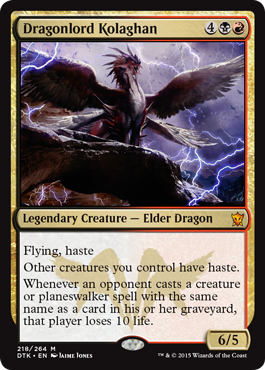
Dragonlord Kolaghan
One Month: $2-$5
Origins: $2-$5
A 6/5 flying haste for six isn’t shabby. There is currently no Modern legal card with six hasty power that doesn’t cost at least seven or come with a drawback, so she’s setting a bar on that metric. If you untap and your opponent isn’t dead yet, she gives whatever other creatures you can throw at the board haste too. Alright, that’s all quite reasonable. Probably not format defining, but definitely reasonable.
How about the other ability? This is very Ob Nixilis rules text. “Wow, ten damage! That’s absurd!” Sure. How often do you think your opponent is activating this unless it practically wins them the game? I’ll take ten if it means I get to resolve a Hornet Queen and roadblock you until I can draw an answer. Other than that, don’t count on this to do damage, but rather prevent people from doing things. Just like Ob Nixilis basically shuts off shuffle effects, and Voice of Resurgence shuts off counterspells, Kolaghan makes your opponent play a Leyline of Singularity game by stranding cards in their hand. Is that good? I’m inclined to say only very situationally. It will certainly crush your Sidisi Whip opponent, but I’m unsure how much your Abzan Control or RW Tokens matchup is going to care.
I need to make a point of noting, since I’ve seen it wrong multiple times in multiple places – Kolaghan only counts for creatures and Planeswalkers, not instants and sorceries. There is no punishment for them Downfalling her as soon as she resolves.
It would be interesting to see Kolaghan as part of some sort of Jund Crushinator deck that plays Atarka’s Command, Caryatid, Rattleclaw and Servant as ways to ramp into Kolaghan and a fleet of hasty dragons. Kolaghan may not kill them the turn she comes down, but how about the Dragonlord Atarka behind her?
I imagine Kolaghan, like the other Dragonlords, will float around the few dollar range. Above bulk mythic, but unlikely to have enough copies in enough decks to push above $5.
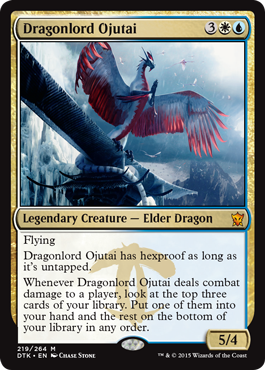
Dragonlord Ojutai
One Month: $2-$4
Origins: $1-$3
Ojutai hangs out and watches the action unfold until you’re in a position to protect him when you turn him sideways. That means he’s either coming down very late, or he’s going to be on defense for awhile. As a 5/4, he’s really not great at blocking, which is what you’ll want him to be doing half the time. When you finally do manage to get in with him, he casts Anticipate, which we know to be worth two mana. Silumgar, on the other hand, casts a better Mind Control when he enters the battlefield, which costs at least five. I am underwhelmed by Ojutai.
If any deck actually wants copies of Ojutai, they’re only going to want one, maybe two. UW decks are much more likely to want Elspeth or Pearl Lake or Ugin as a closer due to their versatility. Meanwhile, on the casual side of things, Ojutai is in the third and fourth worst dragon colors, and is hilariously terrible as a commander. What we’ve got here is another Isperia, i.e., bulk mythic.
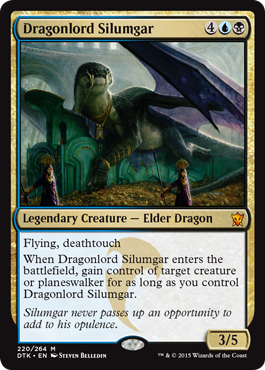
Dragonlord Silumgar
One Month: $3-$6
Origins: $2-$5
Thus far Silumgar looks like the most playable of the Dragonlords. At six mana you get a body that doesn’t die to Stoke the Flames, blocks most anything and wins, and can serve for three in the air. On top of that, you get to steal the most relevant permanent on the board. Siege Rhino? Tasigur? Stormbreath Dragon? Whisperwood Elemental? Take ‘em all! Even more savage is stealing Elspeths, Ugins, or perhaps most savage of all, an Ashiok that just ticked over ten counters. A topdecked Silumgar, moreso than any other Dragonlord, can immediately swing the game from a heavy loss to a nearly-guaranteed win.
Even still, his price outlook isn’t the hottest. I do like him more than any of the others. He’s much less contextually good than his peers, and you are unlikely to be afraid to have three in your deck. That said, he’s still not going to make a great commander, and there are plenty of huge game-ending threats in this Standard formats. He’s also terribly embarrassing against Hornet Queen, for what that matters. I wouldn’t be surprised to see him hang out in the near fiveish range, but I can’t imagine he’s capable of sustaining double digits for more than a week.
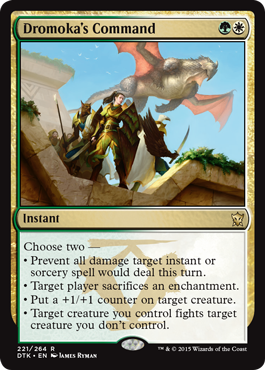
Dromoka’s Command
One Month: $1-$4
Origins: $1-$5
Whoa. Is this the best rare in Dragons of Tarkir? A few friends and I were conjecturing about what the Selesnya charm would be, and not a single person had a friendly outlook. We anticipated some sort of Healing Salve, a half-assed Rampant Growth, and a universal agreement that the card costs two mana more than it needs to. Karametra’s foul taste lingers still.
Imagine my surprise when this popped up. At a converted cost of two, already this was far ahead of what was expected. Five and six mana charms have to do an incredible amount of work, but at two mana and a guaranteed four modes, any charm is going to have a real chance of being relevant to someone, somewhere.
Right off the bat this card is playable based on modes three and four. Make my dude bigger and kill your Rabblemaster or Mentor is going to happen time and time again. My Siege Rhino eats yours, or my Tasigur eats your Rhino, or heck even my Elvish Mystic trades with your Rabblemaster. This is some excellent (and cheap!) removal for a color combination that is not known for doing that frequently.
Mode two is especially relevant right now, eating Coursers, Whips, Dragon Tempests, and Ascendancies. This seems like it’s over performing right now, and I anticipate this mode’s usefulness will scale back after October when we lose the enchantment set. Still though, it’s going to matter a lot between now and then, and maindeckable enchantment hate is not going to go unnoticed down the road.
“Counter Stoke the Flame” is going to be awesome all summer, as RW decks can no longer rain down fire without fear of reprisal. This explains the lack of a “can’t be prevented” clause on Roast or Rending Volley – WotC apparently wants them Drommandable.
Dromoka’s Command will be an interesting case study in the coming year. How much can a two-color utility rare be worth? Hero’s Downfall broke $15 at one point as a fall-set rare, so there’s certainly precedent for high prices on useful spells. It’s highly unlikely Command will see the requisite price to reach that level, but it’s worth knowing it’s not unheard of.
For the most part, I’m anticipating this hangs around in the sub-$5 range. It will be played in some number in nearly any deck that can cast it, although I’m not convinced it’s an auto-four-of. Perhaps time will remember this outlook poorly. In any case, you’ve still got to be making both green and white mana, which provides a real constraint on the number of decks capable of running it. Should some GW list become uncontested tier one and this is major component we could see the price rise above $5, but mostly expect to pay around $2 to $5 for this in the meantime, with sub-$2 prices possible if other cards end up suppressing values elsewhere.
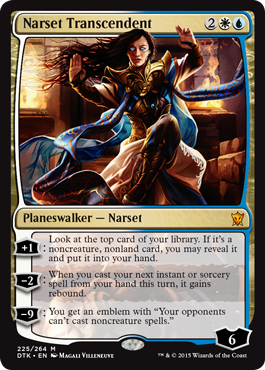
Narset Transcendent
One Month: $20-$30
Origins: $12-$18
I don’t really want to ramble about how good Planeswalkers may or may not be, because a lot of individuals who are much better at Magic and more in touch with the competitive scene than I am tend to write a lot about them, so I’d rather just defer to their opinions.
What we do know about Narset is that she’s two colors, which is already a strike against her. Planeswalkers of a single color will find themselves in a wide variety of decks, as we saw with Jace, Architect of Thought and Elspeth, Sun’s Champion. Two color walkers have many less potential homes just by virtue of needing more types of mana. This doesn’t mean that two color Planeswalkers can’t be successful, just that there is a lower theoretical ceiling on them, as there is with any card that is more than one color.
From a slightly more subjective standpoint, I doubt that Narset is a Modern or Legacy playable walker. So few four mana walkers see in play in Modern, and in Legacy it seems much more likely that you’d rather just cast Jace most of the time. I can’t say for sure that she’ll never show up in either format, but I’m definitely not expecting her to make a big impression on either.
Narset is a two-color, Standard only Planeswalker. She’ll have to be outstanding to hold a price north of $20 after a few weeks. My guess is that she’ll frequently hang out in the $14 – $24 range, with brief ventures outside of that range. Over the summer I expect her to hit her floor at around $10 – $12, and that is when it will be time to buy in. Post-rotation, as with most Planeswalkers, she’s likely to climb some from there. In the meantime, I’m a seller, and I wouldn’t be looking to pick up personal copies until she’s $20 or lower.
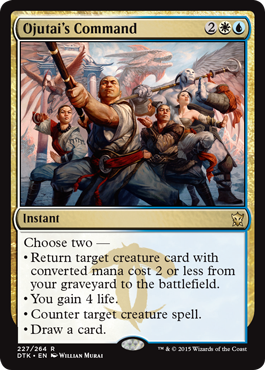
Ojutai’s Command
One Month: $1-$3
Origins: Bulk – $2
Abilities two, three, and four are obviously useful. Essence Scatter isn’t legal, but if it were, I’m sure people would be playing it. With a format that includes Siege Rhino, Tasigur, Rabblemaster, Mentor, and Whisperwood, creatures are a big deal. Four life is unexciting if at least useful. It will win games that should have been lost. And finally, drawing cards is something any UW deck is happy to be doing.
How good is the first ability? This is a little trickier to nail down. There are two immediately obvious options in Seeker of the Way and Soulfire Grand Master. Both are very playable in the sort of deck that would like Ojutai’s Command. Less conventional options do exist as well. Fleecemane Lion is a legal target. Using him to trade early is completely fine if you know that you can later buy him back and immediately monstrous him. Heir of the Wilds or Frost Walker are also not what you may think of when returning two-drop threats, though both could certainly fit into decks that run command.
Even with four very usable modes, the drawback here is likely the cost. At three this would be unreal, so as is it can’t be any cheaper. The addition of that one colorless mana hurts though. The difference between three and four is the difference between whether you can stop Rhino on the draw or not.
I’m inclined to think this will be a fairly cheap card for the most part. It’s not going to be a $.10 rare, but unless UW is suddenly better than UB, which I’m dubious of, this will be relegated to tier two and three play. Without other formats to really prop it up, the price should drag for the most part.
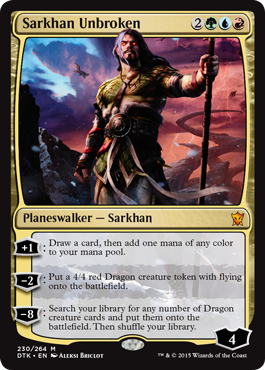
Sarkhan Unbroken
One Month: $12 – $17
Origins: $9 – $14
Sarkhan is a lot more powerful than Narset. He’s guaranteed to draw you a card instead of maybe possibly if-this-is-the-right-card-type drawing you one, and he even tosses a free mana in on the deal. Making a 4/4 dragon is an excellent minus ability, as he not only protects himself, he does so in a way that isn’t just chump blocking. Those 4/4’s are legitimate threats. His ultimate is mostly crap, but you can’t have everything.
Even though he’s stronger than Narset, that three-color mana cost is brutal. A two color Planeswalker has restricted options, but a three color has basically one. Unless we start venturing into four color decks, which Standard mana bases don’t support, he’s really only going to have one home. With only a single viable shell, regardless of how strong Sarkhan is, he’ll fall victim to the metagame if RUG ends up poorly positioned at any given time. Even if he’s hands down the best card in that deck, it’s still only a single deck to drive his price. And like Narset, I don’t see him breaking out of Standard.
Where does that leave his price? The last three eBay auctions for Sarkhan ended at $19 a copy, while the latest Narset auctions are over $30 each, to give you an idea of where the public is on them. Even if Sarkhan is solid it seems like sustaining a price tag north of $15 will be tough. Look for him to slip towards $10 as we get into summer.
Lands
Bulk
Haven of the Spirit Dragon