All posts by Travis Allen

Travis Allen has been playing Magic on and off since 1994, and got sucked into the financial side of the game after he started playing competitively during Zendikar. You can find his daily Magic chat on Twitter at @wizardbumpin. He currently resides in upstate NY, where he is a graduate student in applied ontology.

A Planeswalker Abroad

By: Travis Allen

She wanted to leave for the airport by 7am. I preferred 9. After modest debate at her parent’s dinner table, I acquiesced.

As I put my watch back on, having removed it for the security check, I saw that we had three hours to kill in the terminal before boarding would begin. I took the opportunity to bring this to her attention. She said something unpleasant.

After firing off a run of Binding of Isaac, I closed my laptop while I used the airplane bathroom. Upon returning, Steam asked for my login credentials, apparently having decided to forget that just an hour before it started in offline mode. Without internet access to reauthenticate, all of the games I had downloaded to pass the time with were walled in behind Steam’s authentication process, a lock temporarily without a key. 

There were eleven hours left of a thirteen hour plane ride. Stowing the laptop with the inflight magazines on the back of the seat ahead of me, the occupant turned around. “Please don’t shake my seat, thanks.” Ten hours, fifty-nine minutes to go.

I’m not sure exactly what I was expecting when I stepped off the plane and into the hallway. There obviously wasn’t going to be a torii (one of those traditional red Japanese shrine gates) and a cherry blossom tree in the middle of the terminal. Yet somehow I expected it to feel more Japanese. I can’t tell you what that actually means.

While waiting for her to use the restroom, the wall started speaking to me. Things felt a little more Japanese.

Arriving at our friend’s place, it was all we had not to just crash right there on the floor in the middle of his modest 8th floor apartment, nestled inconspicuously in a unexceptional apartment building, on an unexceptional block, in Itabashi, an unexceptional ward of Tokyo.

Tokyo isn’t just a city, by the way. It was described to me sort of like New York state and New York City, except moreso. There’s the Tokyo prefecture, but also the Tokyo Metropolis, not to be confused with the Tokyo Metropolitan Area. It’s possible there’s more distinctions as well, I’m not sure. I didn’t quite follow it all. The metropolitan area has more people than Canada.

Hunger begins to set in. It’s hard to eat much on a plane. Our local hostess suggests an unassuming restaurant across the street. One of us says “at this point, I’ll be happy with anything.” Tokyo wasted no time setting out to challenge that claim.

Food is delivered via a conveyor belt that snakes around the restaurant. Patrons take the small dishes off as they pass, each containing two bites of various sushi, or a small bowl of soup, or green tea covered mochi. Colored rims on the small plates indicate the cost of that particular dish, with prices ranging between one dollar and five. Raw fish after a long plane ride is probably not one of our wisest choices, but when in Rome, right? Our host converses with the chef quickly, then tells us we’re really going to enjoy what he ordered for us. Shortly thereafter we’re each presented with two slabs of raw horse meat laid over rice. Just in case people may find that unappealing, there’s a dash of garlic spread on top to finish the presentation. She and I exchange looks, our stomachs protesting before even having it balanced tenuously on our chopsticks. We agreed before arriving that we’d try any food set before us.

In his defense, it was not unenjoyable. Repeated exposures would almost certainly render the meal pleasurable. Now, tonight, it’s simply tolerable.

Mount Fuji is visible on the horizon the next morning. Living in central and western New York most of my life, this is unfamiliar terrain. I’m reminded of a trip to Seattle two years ago, which affords its populace a similar experience. Fuji fades behind the clouds as the morning progresses, but it returns each morning.


Kawagoe feels a bit like a quaint town, although it’s actually a city located in the Saitama prefecture, which is of course located in Tokyo. Aged buildings line the major street, sidewalks nonexistent. Most of the buildings have small shops on the first floor. We wander into a knife store so I can pick up a gift for my father; a chef in a past life. I have to double check with our host that I’m not reading the price of a cleaver wrong. It’s more than four times the cost of my plane ticket. I don’t buy anything in that shop.

I didn’t realize it at the time, but our trip to Kawagoe that first day is one of only two times in eleven days I’ll see pre-war buildings. US firebombing of Tokyo during WWII lasted nine months. Operation Meetinghouse, conducted over two days in March of 1945, was the single most destructive bombing raid in history. As a result,Tokyo is glaringly, frustratingly modern.

Our second full day, a drizzly grey morning, finds us headed towards Chiyoda, the location of TokyoMTG. I’m hoping to meet up with Heiko Sonoda. We converse occasionally on Twitter, his insight into the Japanese Magic scene valuable and intriguing. Most recently he told me that Whisperwood Elemental had skyrocketed from ~$5 preorders to ~$15. That night I bought several playsets on eBay at a little less than $6 a copy. A week later they were $12 here in the states. Foreign markets occasionally provide indicators of where a local market will move next.

His store is reasonably spacious for Tokyo, a luxury I will find very few other stores to possess. Rather than sacrifice extensive and expensive square footage to large, mostly-empty glass cases, Heiko has adopted the system put into place by Saito’s shop. On a small table in the corner are three computers, each with a browser open to the TokyoMTG website. I require assistance switching the keyboard from Japanese to English. Rather than browse glass cases, customers simply browse the site’s inventory, and after placing an order, walk four steps across the room to pick it up from an employee that fetches it from the back. It’s effective for sure, although I can’t say I’m not a bit disappointed. For someone looking to browse inventory, with no clear desired product in mind, cases are perfect. A website is excellent for finding a specific card, but hardly appealing for the window shopper.

A brief discussion with Heiko sets the stage for my Magic related experiences for the next nine days. Right off the bat he tells me that Japanese players tend to engage with Magic in a very different way than Americans. Tier one staples such as Force of Will or Tarmogoyf are at least as expensive as they are in the states, if not considerably more expensive, for any language. Days later I have every reason to believe him. Every Force of Will I encounter in Tokyo falls within the $130 to $150 range. Dual lands are similarly expensive.

Perhaps most distressing is something he told me months before my arrival, but which I was unwilling to believe. The Japanese are not unaware of the demand their product enjoys overseas. While free Wi-Fi is far less common there than it is in the states, most citizens are in fact capable of accessing the internet, and are not unaware of eBay. English comprehension is lower in Japan than some European countries, but many are still completely capable of utilizing English web services. Since many players are competitive, they’re also more in tune with pricing – which means nearly every player knows how much foil Japanese cards are worth overseas, or at least is aware that they’re more expensive than most. In fact, Heiko tells me that at one point he pulled his Japanese foils from international sale and relisted them in Japan, since the prices were actually higher locally than America or Europe.

None of this really makes sense to me. He ends up being right, of course. Hearing it strikes me as nonsensical though. Isn’t sealed product still roughly the same price? If the average card coming out of a Japanese box has a multiplier of 1.1x to 5x over its English counterpart, isn’t the value wildly better when opening a Japanese box? How isn’t it lucrative to just crack Japanese boxes all day and sell them internationally? The first question sticks with me the rest of the trip. I never do get a clear answer on the second one. I’m guessing it has something to do with the effort and overhead involved in shipping internationally.

Even being told all this, you hold out hope. He must be wrong. There’s got to be stores that are just goldmines for JP foils. I’ll show him.

Later that day a shop has a foil Japanese Monastery Swiftspear on display for around $40. Dream’s time of death, 1:47pm.

While I’ve been almost immediately locked out of shopping for awesome JP foils to later trade away at infinite value at large events, all hope is not lost. While competitive format staples are noticeably more expensive, the opposite is true for most casual product. EDH and kitchen table cards tend to be cheaper than in America by enough of a margin that they’re worth the arbitrage. My trip ends up bearing this out, as I end up with nearly no competitive cards in my possession when leaving the country.

Hobby stores in America typically focus on some combination of Magic, tabletop gaming such as Warhammer, and board games. Yu-Gi-Oh is the next most popular card game, although its presence in every shop I’ve ever visited ranges from “we sell it, but Magic is more popular” to “Yu-what?” Card games other than those two are relegated almost exclusively to online orders and the clearance section at Target. I’m not sure I’ve ever seen someone, in any store anywhere, buy or play a card game that isn’t one of those two.

One will find that here in Tokyo that couldn’t be further from the truth. A seemingly infinite number of other card games exist, many more popular than Magic, if case real estate, signage, and register exposure is any indication. I never catch the name of any them. Visually the cards are gaudy and of low production values. Most remind me of DeviantArt. Some remind me of the worst parts of DeviantArt. I’m pretty sure at least one had artwork that consisted solely of exactly the type of material people are publicly shamed for having on their basic lands when they show up to Magic events in the states.

No shortage of alternative TCGs exist in the Japanese market, and with many of them seemingly more popular than Magic, it’s no surprise the casual scene of our favorite game is far less robust. A dazzling variety of TCGs means that the pool of Magic players is shallower. Those that would play casually are easily drawn towards any number of other TCGs, or even other activities altogether, such as the arcades that seem as common as Starbucks does in the states. The end result is card prices falling quickly once they leave the competitive stratosphere. Perhaps best illustrating this point is my purchase at Saito’s store later that week. The order contained thirty-eight Black Markets. Clocking in at $12 on MTGPrice, it’s a black EDH staple. I paid under three dollars each in Japan. If TCGPlayer ever starts allowing the listing of foreign cards, I’m in business.

black markets

Before we leave Heiko’s shop, I purchase a pack for her to open. Even though she knows only as much as is required by someone who happens to sit in the same room as shelves of cards, she enjoys the process, the thrill, the gamble. At about 300 yen, two dollars and change, it isn’t even expensive. She sniffs the pack as she opens it, a behavior learned from watching me. Savor the experience. Pausing on the third uncommon to let the suspense build, she rips it away to reveal a Sage of the Inward Eye. I say something unpleasant.

I thank Heiko for his time and explanation of the Japanese market, and he gives us a set of custom tokens as a gift. Though my obstinance holds strong and I have yet to ingrain everything he’s been kind of enough to share with me, it will only be a few more days before it becomes evident he was entirely truthful. Our conversation foreshadows perhaps the most poignant lesson I will learn during the trip. Globalization revitalized national economies, pulled entire countries out of poverty, and dramatically changed the world in ways that none could have predicted. Globalization has also partly ruined the experience of international travel.


Packed window to window, we board the rail line. It’s the busiest car we’re in all trip. It would pale in comparison to the crowds we’d see later that day. A quarter of the people on the train have with them rolling hard suitcases. Upon inquiry, I’m informed that that’s where cosplay outfits are stored until the individual reaches Comiket, at which point they change in a large communal changing area, one for each sex. “Why don’t they just put the costume on at home and wear it on the train?” “They’d look ridiculous!” I can see a fifty-foot-tall Gundam statue out the window of the train car. Something tells me nobody would care.

Have you ever been to Times Square for New Years? Seen the masses packed in, shoulder to shoulder, huddling in the freezing temperatures to be a part of what I assume is the largest and most famous NYE celebration in the world? Upwards of a million people show up each year to cram into a few city blocks worth of space. It’s lunacy. Somehow Comiket manages to be worse.

We’re over a quarter mile from the entrance and have already instituted a “hang on” policy. Spacious courtyards outside the building are packed, elbow to elbow. All except for the space saved for cosplayers, in front of which lines snake back and forth, with no one exactly sure where it actually stops. At the end of each line is a cosplayer, most of them women, and most definitely freezing in the chilly December air. Photographers wait their turn to take photos of the cosplayer, and the cosplayer hands out business cards with the intent of selling DVDs of photos of themselves. It’s a practiced affair for everyone involved, completely obtuse to an outsider. Strict rules of pageantry and etiquette are involved, although I’ve no clue what any of them are. The whole thing feels sleazy, mildly abusive, and generally makes me uncomfortable. We haven’t even made it inside yet.

Seething is the best description I can come up with, although that still doesn’t do it justice. I’ve never stood in a crowd like this before. I imagine that this is what escaping a burning building with inadequate safety standards must feel like. I have to wait for a lull in the mass before I can get my arm up from my waist in order to scratch my nose.

Our host’s friend wants to go check a particular booth. As we head in that direction, the various booth signage on display rapidly turns from “anime,” to “hentai,” to “why is Hitler a bare-breasted woman,” to “incontrovertible hardcore pedophilia.” She handles it quite well. Probably better than I do. By the time we leave this portion of the hall, my distaste for anime and its fans has only grown deeper. I’m thankful I didn’t see anything Magic related. Two hours later we depart. I’m glad to have had the experience, but like several things that will occur on this trip, it’s not something I’d do again.


Akihabara, if you are unfamiliar, is sort of the nerd mecca of Tokyo. Buildings are adorned, from ground to roof, with anime and video game advertisements. Arcades are everywhere. You can’t find a spot in the street where there isn’t one visible. Video games and anime and every facet of nerdom smashes together here, all dripping with the saccharine facade of moe.

Of every subway station we will pass through, Akihabara’s is the only one with posters on the escalator warning women of attempted upskirt photos.

“How many Magic shops are in Akihabara?” “There are four. On this block alone.” We see a lot of Magic cards.

Days go by in a blur. Itabashi, Nakano, Shibuya, Shinagawa, Shinjuku. Ginza, Odaiba, Shinbashi, Harajuku, Takadanobaba, Ueno, Ikebukuro, Akihabara. Tokyo Skytree, Disney Sea, Daiwa Sushi, Robot Restaurant, Comiket. Our attempts to canvas the city only serve to prove how futile the effort is. If the term “urban sprawl” wasn’t invented for Tokyo, it should have been. Standing in the middle of Shibuya crossing one night, an intersection reminiscent of Times Square, famous for its pedestrian-scramble crossing in which all traffic stops and people pour into the intersection headed every which way through the crux of five major roads, one is reminded of Blade Runner’s dystopian cityscape, a valley of buildings, brilliantly lit screens disembodied against the dark night rapidly flipping through advertisements like a bored teenager suffering the ennui of life. Riding those trains as much as we did, the landscape never changing, you sometimes wonder if the city ever ends.

We lose track of how many Magic stores we visit over the course of the trip. Nearly all are claustrophobia-inducing. Crouched down or bent over, peering into the back row of one case, your back is pressed to another. I must have muttered “sumimasen” – roughly “pardon me” – more times in eleven days than I’ve spoken her name aloud in all of the last year. It doesn’t take long to start noticing patterns in pricing and keeping an eye out for specific cards.

Aside from Black Market, Avacyn, Angel of Hope and Rhys the Redeemed are probably the two cards of which I bring the most copies home. EDH and casual all-stars here in the states, it seems that nobody in Japan has any use for them. I find Avacyns for 1700 yen, which with the exchange rate is about $14. I found a few Rhys at under $5, and most were under $7. Sliver Legions are usually worth buying if the store has any in stock. I grab a few piles of Marchesa, It That Betrays, and Nirkana Revenants. Most everything is under 50% of what I would pay in the states.

cards

Finding deals on Japanese foils doesn’t come easily, but I find a few. An Odyssey Decimate for $5. A playset of Ashioks for around $38 a copy. (Still trying to sell those.) Cogwork Librarian. Four copies of Plea for Power. Rounding out the top end is a Rofellos, a Marchesa, and an Academy Rector I picked up outside of Saito’s shop after stepping outside with a local whose binder may have been the most impressive I’ve ever seen in person. (If you live in a house right now, there’s a good chance his binder could have paid off the entire mortgage. I wondered how it was safe to carry that around. “Japan.”)

Did you know you can’t trade in stores over there? Continuing in the trend of my arrogant obstinance, I had heard this but for some reason decided it wasn’t true. Turns out, it is. Here in Buffalo there’s a store that doesn’t allow trading. People at GPs don’t believe me when I tell them. “How could a store not allow trading? How does that work?” I don’t know buddy, but there’s an entire country that subscribes to that theory.

Rector has already found a place in my EDH binder. I’m pretending I haven’t already decided to keep Rofellos and Marchesa. Both were under $70. There’s good profit to be made, but if I sell them, I’ll have ended up with almost nothing for myself. Keeping at least a few cards should be allowed, right?

foils

Any English copies of cards I picked up are by now basically all gone some three weeks later. Everything Japanese is sitting on my desk, waiting for someplace better than eBay to sell them.

Boxes end up the bulk of my Magic expenses. Seven JP Khans of Tarkir and six JP Conspiracy. Every single store I walked into I asked about Khans, hoping to find just one that would give me a great price. About half the time the employee would scan a single Khans pack and start multiplying it by thirty-six. Saito’s shop was reasonable, and after offering to buy a case they said they’d knock $20 off, but it still wasn’t cheap enough. For ten days I held out for a 9,000 yen box. I never did find one, although I’ve no doubt they exist somewhere. 10,500 is how much I end up paying for each of all seven Khans boxes. Just about $90 after my credit card’s 3% international fee. There is no world in which I have a right to complain about paying $90 for Japanese Khans boxes, but I still find a way. She doesn’t care.

Conspiracy boxes were a “oh, well, yeah I guess I have to.” One store’s singles collection was paltry at best, a single half-case amongst ten full display cases, and it was getting late. Heading past the register towards the door, the price of a Conspiracy booster caught my eye. I forget exactly how much it was, but it was cheap enough to give me pause. Remember, Conspiracy is a purely casual product. Geared entirely for the crowd that enjoys the kitchen table, EDH, and maybe cubing. Aside from the very small handful of overlap with competitive players on Council’s Judgment and one or two others, Conspiracy is aimed squarely at a demographic that barely exists here. I inquire as to the cost of a box. 9,000 yen, or about $74. Checking eBay, I see that there are sold listings in the $130 range. This portable Wi-Fi spot I’m carrying around has earned its keep multiple times over during our trip. I buy them out of their three boxes. I thought I was done with Conspiracy until I wandered into one last store, our second-to-last day. Six boxes of Khans are being wrangled into a bag by the cashier when I notice the Conspiracy box on the shelf behind her. Given the reasonable price on the Khans boxes, I ask about the Conspiracy. 8,000 yen. $66. “You’ve got three more? San? Hai hai hai. Arigato.”

spread

Between my thirteen boxes and her diabetic shock worth of candy, we had to pick up another cheap suitcase to get it all home. It was worth it.


After several days there I’m able to put my finger on what it is about Japan that is underwhelming. Years ago while she was studying abroad in Italy for a semester, I found a double-layover, twenty-hour round-trip ticket for $550 to Rome over spring break. After begging my parents to shell out, I was on my way. You’ve seen The Colosseum, and the Fountain of Trevi, and whatever other ancient italian landmark the discovery channel is blabbering about when you flip by. Let me tell you, dear reader, the images on your television or computer screen do not do those structures justice. One of the subway stops lets out right in front of The Colosseum – you walk up a flight of stairs, and there, right there, it towers over you, destroying all preconceptions and notions you may have thought you had. History bears down on you with weighty significance, rendering you breathless at the magnificence and size of the structure. Days of exploring the city and being exposed to history through such a living and breathing medium leaves a deep impression, and not for one second, not for one second on those winding stone streets that lead surreptitiously across a city whose history seeps from every porous brick, do you forget that you’re in Italy.

One random afternoon in Japan we’re on the street, and I’m looking around. A beef noodle place, a tanning salon, a bookst-wait, how am I reading all these signs? English is everywhere. No kidding, there’s more English in Japan than there is in Montreal. With English subtext on so many signs, and unreasonably often the only text on signs, and a cityscape all built in a post-war rebirth of the city, with virtually no buildings old enough to remind you of the millennia of history that exists here, the American visitor is struck with the unmistakable sensation of standing in New York City. It’s an always lingering, nagging thought that chases you along their ridiculously clean streets and into the massive shopping centers that span ten floors. You’re just a few extra white people, a lot more darker-skinned people, (seriously I think we saw maybe twenty black people in eleven days, out of what had to be tens of thousands of faces), and much worse candy away from being in New York City.

This is it. This is the globalization that afforded me the opportunity to be here, and it’s the same globalization that’s making it impossible to find an authentic Japanese gift for my parents. I can’t find anything of substance that feels native because it seems there is so little left – or at least, so little that can’t be obtained in America one way or another.

Heiko told me that several years ago, the arbitrage between the Magic markets was good enough that you could probably have paid for your entire trip with money to spare. Magic hadn’t experienced its renaissance quite yet, and large gaps still existed. Japanese foils were dirt cheap locally, and American cards sold for bundles. A savvy traveller could have brought $10,000 in English foils to Japan, turned that into God knows how much in Japanese foils, and then outed that for even more back in America. Today though? Today you pick up Rhys the Redeemed for $6 and you’re pleased with that.

In descending order of time spent on them, the two activities that consumed the largest portion of our trip were standing in line and shopping. Not just for Magic cards, but anything, anywhere. Local shops that the owner lived above. Street vendors. Tourist traps. Department stores. We stepped inside every category of shop imaginable. My litmus test for determining whether I should buy something was simple – “can I get this on Amazon?” A question whose answer was affirmative so frequently that my luggage was 65% Magic cards and 30% the clothes I brought over.

“Join the Army, See the World” was the slogan for the Army at one point. Decades ago, poor American kids knew that the only way they’d ever be able to see other countries was on the government’s dime. Commercial flight was still far too expensive for the average citizen. Enlistment benefitted both parties. The Army got a soldier for a few years, and the soldier got an experience he’d never be able to afford on his own.

Listening to the radio a few years back, someone was talking about how they had to change that iconic slogan. With flights as cheap as they were, any schmuck could hop on a plane and see any country in the world. Why would someone volunteer four years of their life in order to get the chance to visit Europe when they could just plunk down $1,000 and go on their own? “See the World” was no longer the powerful motivator it once was. 

Globalization has given us opportunities our grandparents never had. Any one of us can travel to any country in the world, almost on a whim. Seeing Spain or Egypt or Thailand or Brazil isn’t some decadent dream with no hope of reality, it’s just a question of budget. With accessibility has come homogenization, though. I love Amazon. I love what it does for me. I don’t go to actual brick and mortar stores anymore. My Prime account is well worn. And at the same time, it has spoiled a component of travel. Wandering the streets and stores of Tokyo, little strikes me as inaccessible. Nearly every department store has an international presence, which means any of this can be purchased from the comfort of my home office. Browsing wares in smaller shops doesn’t afford a much better experience. Most is made in China or Taiwan, and none of it is something I’d be excited to gift to another. I don’t return home with wild stories about a far-off country with exotic customs. I say things like “we couldn’t get any great photos from SkyTree, just Google it and you’ll get a better view.”

Magic has suffered the same fate here. Small edges do exists – the $90 Japanese Khans boxes – but there’s hardly anything awe-inspiring. There’s the good prices on casual cards, and you can bring over in-demand Force of Wills. But overall, Magic is no different than sweaters or silverware. Certain pieces are cheaper in Tokyo than they are in America, but nothing is unattainable. Everything that we bring back could be purchased at home. Sure, we got a slightly better price on some of it, but none of it is exotic to the point of remarkability. Even the Japanese merchandise isn’t necessarily cheaper than it is in the states. I saw a lot of $45 foil Japanese Swiftspears.

The lesson here is one oft repeated in many aspects of life. Ignore the material goods. Avoid spending too much of your money on material things. Take photos – but not too many. Pay for experiences. Eat well. See sights. Now more than ever, those are the souvenirs you will savor most in the years after.


Travel between Toronto and Buffalo defies any navigation service to produce useful directions. Leaving Toronto Pearson airport, it only takes two or three minutes before we’ve gotten on the wrong road, forcing us into a Tim Horton’s parking lot in search of Wi-Fi. We both say something unpleasant.


Return to Normalcy: 1/19/15 Banned List Update

EDITOR’S NOTE: Help us build the world’s best MTG Trading app! Support us on Kickstarter HERE.

There’s a single refrain going through my head Monday morning.

At 10:52 am EST the new banned and restricted list went up, and here’s what went down:

Modern
Banned: Treasure Cruise, Dig Through Time, Birthing Pod
Unbanned: Golgari Grave-Troll

Legacy
Banned: Treasure Cruise
Unbanned: Worldgorger Dragon

Vintage
Restricted: Treasure Cruise
Unrestricted: Gifts Ungiven

Before we discuss changes at all, let’s get one thing straight: sell all Golgari Grave-Trolls and Worldgorger Dragons now and don’t look back.

Now that Ancestral Recall, Demonic Tutor, and Survival of the Fittest are finally banned in Legacy, we can star…oh, they were banned in Modern? Huh.

Immediately obvious is that Wizards realized that reprinting Recall was probably a bad idea. Anyone that has played with the card outside of Standard certainly would have had no doubts about this. Drawing three cards on turn two is unsurprisingly powerful. Dig Through Time is similarly busted. DTT’s strength was muted in the face of Cruise, but it was quietly showing up in combo decks all over the place. Had DTT been allowed to stay, it would have replaced Cruise everywhere, and I’m guessing some combo deck would have become insurmountable eventually. Finally, Pod is exiting Modern amidst the joyous revelry of many. It was the industry standard best deck in the format for a very long time, and the recent addition of Siege Rhino made the deck even stronger. Survival of the Fittest was banned in Legacy many years ago, and all that did was tutor the creature. Pod tutored and gave you a big discount on mana. How was it ever fair?

A good bit of grumbling is going on in the community right now that Pod, a major pillar of the format, has been erased. Some are complaining that their favorite deck is gone with no clear replacement, and others are just walking into stores and selling the whole seventy-five. If we’re being completely honest, I don’t feel too bad for anyone that ate a loss on this. Wizards has made it clear, time and time again, that this is a format they are going to shake up often with frequent bans. Birthing Pod has clearly been on the watch list for well over a year at this point. Discussion about it being banned came up every three months like clockwork. This announcement shouldn’t have caught anyone with their pants down. In fact, aside from the Pods themselves, what have you really lost here? One Orzhov Pontiff? The deck is value creatures that are good anyways. That’s the point of Pod, isn’t it? It’s not like they’re all useless cards today. Cut the pods, move up to four Siege Rhinos if you haven’t already, and head off to your LGS’s weekly modern event. This stands for those that foiled the deck as well. “Oh no, I have a bunch of foil Birds of Paradise and Kitchen Finks. I’m ruined!”

Moving on, our goal is to figure out what the post-announcement landscape looks like for Modern and Legacy in order to identify cards whose play value has risen dramatically. If we can find cards that quietly get much stronger with this change, we can sink our money into them and watch them rise in price.

We’ll start unpacking Modern. The TC and DTT ban is actually reasonably easy to understand. Both are very new additions to the format, and if we rewind back to September of 2014 we can see what a pre-KTK Modern looks like. If this was the only change we’d know exactly what to expect. We’d take pre-KTK, add Monastery Swiftspear, and that would be your format. It’s not quite that simple though, because the change isn’t just TC and DTT. We also have to account for banning Pod (big change) and tossing GGT in (small change).

What has risen dramatically since TC and DTT hit the scene? Chalice of the Void certainly has. It’s tripled in value, mostly as a way to combat all the cheap spells that were used to fuel TC. While Chalice was a reasonable card before KTK, and will continue to be so afterwards, the supervillain he’s been chasing was just put in jail. With a lot less work to do, we should see prices slowly settle closer to $10.

Other than CotV, there haven’t been a lot of dramatic Modern risers. TC and DTT pushed small spells such as Gitaxian Probe, Forked Bolt, and Serum Visions. Fatestitcher jumped a few bucks I guess, but that’s a niche card. Orzhov Pontiff has risen hard just recently, although he hasn’t even unpacked in his new office and already he’s out of a job.

Jeskai Ascendancy was a card I expected to be banned this time around if both TC and DTT didn’t eat it. They did, and so it didn’t. I suppose Wizards is hoping it won’t be degenerate enough, while still providing gas for Young Pyromancer and the soon-to-be-legal Monastery Mentor. Both major JA lists ran TC and/or DTT, so the deck definitely has to change. Thankfully Wizards has seen fit to provide us with a humble little card drawer. He’s not as cleanly powerful as TC or DTT, but the ceiling on how many cards Humble Defector can draw is much higher. Just keep responding to the triggers at instant speed and you can go bananas. Yes, you don’t get the cards from any of the Humble triggers until you lose control of him, but instant speed cantrips and JA looting means that you can easily trigger him two, three, or six+ times in one shot. I just drew twelve cards, here’s your Humble Defector idiot.

Financially, foil Jeskai Ascendancies are more appealing now, as they’ve survived their most tenuous ban window. Other than that it’s tough to say. Foil Humble Defectors for sure, but we already knew that. Without seeing some lists it’s hard to know exactly what could rise. Pay close attention to sleeper rares in any successful JA lists.

Let’s try going the other direction. What has taken a beating since the printing of TC and DTT? Thoughtseize and Liliana of the Veil stand out to me as cards most directly benefiting from these bans. Each plays an attrition game that is attempting to strip their opponent of cards and then grind them down with Tarmogoyfs. An opponent topdecking Cruise meant that all the work Thoughtseize had done was irrelevant. GBx has all but disappeared with TC and DTT going way over the top of discard. With those card drawing powerhouses now absent, both Thoughtseize and Liliana are much better positioned. It also turns out that both have pretty depressed prices at the moment. Liliana was between $70 and $90 last year up until late October, but has since crashed towards $50. We’ll almost definitely be seeing her climb back up towards $60 at least. Dark Confidant is also part of that trio, and his price on MTGO has doubled or so since the announcement. The paper copy won’t see that type of movement, especially with the threat of a reprint hanging on the horizon, but I could see him getting $10 back.

Losing TC and DTT isn’t the only reason Thoughtseize and Liliana get better either. Siege Rhino has proven itself in Modern as a powerful, game-ending threat that is nearly impossible to race. Up until now it’s been a growing Pod staple, but with that deck out the door as well, Rhino will be looking for somewhere to go. A return of GBw is nigh-inevitable, with Thoughtseize, Liliana, and Rhino leading the crash. Here, I’ll define the first week of post-ban Modern for you: Thoughtseize, Murderous Cut, Tasigur, Dark Confidant, Abrupt Decay, Tarmogoyf, Liliana of the Veil, Siege Rhino, Restoration Angel.

Another archetype that seems to have fallen off the map in recent months is UWR variants. It still pops up from time to time, but seemingly far less than it did. UWR mainstays such as Celestial Colonnade, Snapcaster Mage, and Restoration Angel all gain some traction with the loss of TC and DTT as well. Restoration Angel is appealing with Siege Rhino leaving his hoofprint on Modern in a big way. Snapcaster is also as close to a slam dunk as you can get. He’s been quiet the last few months with everyone eating their own graveyard seven cards at a time, but with TC and DDT gone, he’ll be back in a big way. Just as important is the fact that Innistrad won’t be in MM2. I don’t see how Snapcaster doesn’t hit at least $50 this year.

How about the loss of Pod though? What’s that do to Modern? This is a much more complex question, since we don’t have a recent save file without Pod.

Right off the bat a few cards lose steam. We already talked about Orzhov Pontiff. Voice of Resurgence doesn’t really have any other homes in Modern outside of Pod right now, so we’ll see the price slide on that in the short term. Voice is still an objectively powerful card though, so don’t count it out entirely. As the format shifts around, it’s entirely possible he pops back up as a four-of in a different top tier deck. Snagging a playset from a dejected Pod player wouldn’t be a bad idea if you don’t own any. After all, if that GBw list picks up steam, he’s a great counter to the UWR lists I also expect to grow in popularity.

On a metagame scale, Pod tended to prey on other creature decks. Trying to beat Pod with dudes was nigh impossible between Voice, Finks, Rhino, Linvala, and finally the ability to occasionally combo out and win on the spot. With Pod out of the format, we may see an increase in creature based decks. Is the banning of Pod the actual unbanning of Wild Nacatl? It certainly may be. We haven’t seen traditional Zoo in a while, which would probably come to the party with Knight of the Reliquary and Baneslayer Angel. What I’m more interested in is Domain Zoo. Most notably Domain Zoo brings with it Wild Nacatl and Geist of Saint Traft. Domain Zoo lists are typically quite powerful, being able to curve Nacatl into Tarmogoyf into Geist, and they pack plenty of removal to make sure they’re getting through. Even better is that they’re technically able to play any card they need since all five colors are represented in their manabase. Geist of Saint Traft has been low for quite some time, and this may be his chance to shine. Most likely to stand in his way is that as the new elbow room in the format that Geist occupies is the same space Liliana of the Veil is in. Will the loss of Birthing Pod put Scotty Mac on the Pro Tour? Time will tell.

Scapeshift and Tron picked on Pod, so with their main prey suddenly absent from the food chain, life is more difficult for them. The rise of Thoughtseize and Liliana will be especially hard on those two decks. Even worse for Scapeshift is the loss of DTT. After casting DTT for UU, going back to Peer Through Depths for 1U is going to be a bitter pill to swallow indeed. While Tron is fairly resilient, wasn’t affected directly by the bannings, and is about to gain access to Ugin, Scapeshift just got a lot softer. It may be time to step away from that list for the time being if discard and attrition comes back in a big way.

How about Golgari Grave-Troll? Does that bring anything to the table that didn’t exist before? He certainly makes Vengevine look a lot more tempting. Vengevine has taken a beating in price the last year, and is now hanging around south of $15. A breakout performance would change that rapidly though, so if that’s the type of card you like to play, a personal playset may not be the worst idea. I was recently thinking about Sidisi, Mesmeric Orb, and Vengevine. GGT would be a welcome addition. Other cards that play well with Vengevine are graveyard heros Bloodghast and Gravecrawler, which are both quite reasonable right now. Those two pop up from time to time in Modern anyways, so if you’ve been on the fence, now is the time. Life from the Loam is always on the table as well, although with three printings under its belt, I’m not buying in.

In all honest, GGT doesn’t really do that much for us. Stinkweed Imp and Golgari Thug both exist already, so what does GGT give us that we didn’t already have? It’s a better dredge rate than we had before, sure, but is that what was holding back dredge-based decks? I’m guessing it wasn’t, but time will tell. Dread Return is still banned but Unburial Rites is legal. Maybe with more and better dredgers we see a more dedicated Unburial Rites/Goryo’s Vengeance list? It’s certainly possible. Goryo’s has always felt like it’s on the cusp. A turn two EoT Grisly Salvage flipping any one of GGT, Imp, or Thug, then untapping, dredging, and going off with Goryo’s, Griselbrand, and Fury of the Horde may be the new hotness.

While writing my Fate Reforged set review I discussed the possibility that if both TC and DTT are banned in Modern, Temporal Trespass becomes a bit more real. It’s now the only relevant blue delve spell in the format, which means there may in fact be a place for it. That turboturn deck would almost definitely play it as a four-of, and I could see any Cryptic Command deck considering a copy. After all, Scapeshift loves a good Explore.

I can’t talk about Modern without touching on Affinity. With the format in flux, Affinity will be well-positioned for a few weeks. There may be some growth on key players like Mox Opal, but the impending Modern Masters 2 will and it’s inclusion of Metalcraft as a mechanic means a lot of those cards are capped on growth until a spoiler list is out. I’m not going near any of that right now. After the MM2 spoiler hits watch for cards not on it to spike though. This should also be a warning bell for Affinity. Cranial Plating may be the strongest card in Modern right now, and the deck has always floated near “too good.”

Over in Legacy, things are a bit simpler. Again, we know exactly what the format looked like pre-TC. Just like in Modern, expect to see a lot more attrition come back in week one. Suddenly Shardless Bug and some of the *Blade decks are relevant again. Shardless Agent will likely see a rise in price after having gotten soft over the last two months. Wasteland gets better.

Of note is the fact that Dig Through Time didn’t go. Up until now it’s been much quieter in Legacy than Modern and Standard. While any Cruise deck may choose to play DTT instead, I have a sneaking suspicion that the real winner here is Omnitell. The deck has been doing well lately, as DTT provides the deck a huge amount of gas. DTT also plays well against the incoming onslaught of attrition decks. Omniscience and Show and Tell stand to gain from this announcement, and this may be what pushes S&T to the brink of bannability. That, or they just kill DTT two updates from now.

More obviously, the Worldgorger unban has some impact. For those that don’t understand why it was banned in the first place, it’s because of the interaction with Animate Dead. Without any other creatures in any graveyard, casting Animate Dead on Worldgorger results in an infinite loop. Animate brings Worldgorger back, who then exiles Animate, so Worldgorger dies, causing Animate to come back into play, animating Worldgorger, who then…you see where this is going. This loop is capable of acting as a win condition too. All your lands constantly being exiled and put back into play allows you to make infinite mana, so any instants in your and possibly your opponent’s hand are live. An instant-speed fireball is a simple kill, or if Nephalia Drownyard is one of your lands in play you can mill your opponent out and then stop the combo on one of the creatures that ended up in their graveyard.

Aside from Worldgorger Dragon himself rising in price, it’s unlikely this will do a lot for anything else in the format. Reanimator is already very clearly a deck. Unless Worldgorger ends up pushing the power level of the deck way higher than before, which is rather unlikely, nothing much changes. Worth noting though is that Show & Tell is usually in Reanimator lists, which already stands to profit from these changes.

Between now and the end of February there will be a great deal of flux in Modern, especially with the Pro tour not far away. What we’re seeing now is only the first few ripples of what will be a long causal chain with impacts that are hidden to us behind the veil of time. Will Abzan Attrition rise to top dog? RUG Twin? Is Amulet Bloom the future? Will popular opinion be that Griselbrand should be banned by this summer? What do you think will happen?


Fate Reforged, Prices Engorged – Full FRF Finance Review

By: Travis Allen

We can all pretty much agree that Wizards hit Khans of Tarkir out of the park. Before packs even hit the shelves players were excited about the return of fetchlands, opening the door for many players to Modern. Once the cardboard was in sleeves it turned out that Khans was even better than expected. Standard has been robust and skill-intensive since basically week one, with the top decks changing every weekend. Not only is there no de facto best deck, players are free to pick up nearly any strategy they like and as long as it’s coherent, they’re capable of posting solid results. Between the fetches, a Standard format that rewards both grinders and brewers, and a bucket of eternal cards including honest-to-God Ancestral Recall, Khans of Tarkir will be remembered as one of the best fall sets in the NWO.

Fate Reforged has a lot to live up to, but early press is that it does a damn good job. Only a single card really stands out as unquestionably powerful and format-changing, while the entire rest of the set is full of conditionally strong cards that will reward careful deck building and studied application. It seems like FRF will have ripple effects in many decks in many formats, but for the most part won’t dramatically alter anything. (Except Monastery Mentor.)

It’s important to remember when reading any set review that we are forced to evaluate cards in a pseudo-vacuum, but they never exist as such. When I look at Brimaz, King of Oreskos I have to consider the card individually, free of whatever the metagame looks like that particular month. Brimaz’s text box isn’t going to change, but the cards other people are playing will. I need to focus on what concrete information I have available to me. Because of this, set reviews are especially challenging. I have to look at Brimaz and make an evaluation based strictly on the words printed on the card, but his true worth will be dependent on the cards around him, a pool that will change significantly over time. Cards that are excellent right now may have been trash in an alternate timeline. It would be easy to construct a Standard environment where Desecration Demon is crap (such as he was in INN-RTR when Lingering Souls was legal,) or where Prime Speaker Zegana is a chase mythic. Even the hallowedJace, the Mind Sculptor was nigh unplayable at release since there wasn’t a single other playable blue card in the format andBloodbraid Elf + Blightning threatened to shut him down as soon as he resolved.

With that in mind, FRF is the toughest set I’ve ever reviewed. The complexity level is through the roof. Text boxes on everything from mythics to commons are packed this time through, and even cards that aren’t wordy, like Humble Defector, have the ability to spawn entire new decks. Delve was difficult to understand in Khans and will continue to be tricky to evaluate here, and Manifest could land anywhere between “Chroma” and “Devotion.” Never before have I listed so many cards in the bulk section while wondering if it’s actually a $7 card. Those of you reading this with the luxury of hindsight, please be kind to me. That said, let’s jump in!

Prices listed are where I expect the card to be one month from now, and at the release of Dragons of Tarkir.

White

Bulk
Citadel Siege
Daghatar the Adamant
Dragonscale General
Mastery of the Unseen
Rally the Ancestors
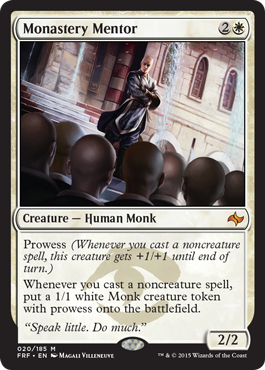


Monastery Mentor
1 Month: $23-$35
Dragons of Tarkir: $20-$30

The screams you hear in the streets are from people being bludgeoned to death by Wizards employees wielding wooden clubs with “Monastery Mentor is good” primitively etched into them.

Monastery Mentor is quite clearly going to be a Standard pillar, and probably also a role-player in both Modern and Legacy. It’s not surprising when you consider the damage output on this guy. A Mentor on turn three leads to a turn five kill in several different ways, and orchestrating a turn six kill is trivial. That’s potentially as fast as Pack Rat, and faster than Goblin Rabblemaster. Before I get too far down this path though, I’ll just point you in the direction of Chapin. Many will discuss the quality of the card, so I’ll focus on what to expect price-wise.

We can be damn near positive this is going to be one of the absolute best cards in Standard, and will typically show up as a full playset in any deck that runs it. Our best approximation is Goblin Rabblemaster, a rare, which was over $20 at his peak and is still $15 today. If Mentor sees play in Standard exactly as Rabblemaster has with zero play in additional formats, the price would easily hang at $20 or more. Once you start adding additional demand, the price rises with it.

While Rabblemaster gives us a great profile of what to expect in Standard, we need only look back a single core set to find another similar threat for larger formats. Young Pyromancer is one of the best two-drop threats in Modern and Legacy, resulting in a $3 uncommon (and $40 foil) whose demand is solely those two formats. Mentor isn’t the same card as YP, and at a higher cost won’t necessarily land in the same decks, but I have no doubt he’ll break into both formats in much the same way. Not only does he easily slot in alongside YP in many of the same lists, he is a more robust stand-alone threat than YP is. A single YP may be capable of winning a game, but a single Mentor will do it faster and more reliably, even though he comes down a full turn later.

I will be surprised if Mentor finds himself much below $20 at any point he’s Standard legal, and I don’t think it’s unrealistic that he’s usually in the $25-$30 range, with prices yet higher than that possible if many of the other cards in Fate Reforged don’t pan out.

Mentor is expensive, but if you want to play with him, don’t feel bad about just ordering a set. You don’t stand to lose much at all, and even if he drops to $20 a copy, your loss is small relative to the overall cost of the playset.
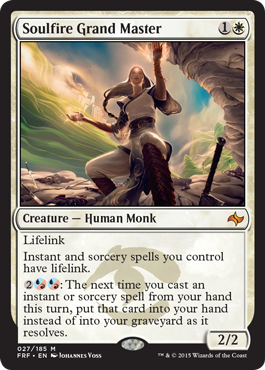
 

Soulfire Grand Master
1 Month: $15-$20
Dragons of Tarkir: $7-$15

White may only have two cards worth talking about this set, but they sure are powerful.

By now you’ve probably read a lot about how good Soulfire may or may not be from people better qualified to do that sort of thing. Rather than rehash what they’ve discussed, I’ll keep to strict money chat.

Soulfire is a splashy card with a several moving parts that are not often seen in Magic. Giving your spells lifelink has happened before, as has rebuying your spells. Neither were on the same card though, and one is nine years old while the other is a Planeswalker emblem. Such a unique set of abilities on a very competitively costed creature will surely get people testing in every major format. On top of that, the more moving parts the harder it is to figure out how good a card really is. Because of that, it may take some time before the community at large really has a grip on how well Soulfire is going to perform in each respective format.

Preorders are going for $25 on SCG and eBay sets are finishing just a bit below that. Not a lot of creatures can hold prices north of $20, especially when they’re in the same set as Monastery Mentor. It’s not reasonable to expect Soulfire to stay that high. What we’re most likely to see is a slow decline in price, regardless of how playable Soulfire actually is. Because of how complex and novel the abilities are, even without immediate results people will want to try it out themselves. Demand will taper off slowly, independent of tournament results. A price free-fall won’t take place, at least for a few weeks.

Unless she wins an Open the first weekend she’s legal, I think Soulfire spends the first month slipping into the $15 to $20 range. If tournament success comes quickly there may be a spike to $40+, but Soulfire will still drop dramatically afterwards.

After the first month it becomes a question of playability across the spectrum. If it turns out she’s good in any combination of Modern/Legacy/EDH that will buoy her price reasonably well, but won’t keep her much above $10. If she’s a solid role-player in Standard, that’s what will keep her up towards $15. If she’s mildly playable to completely unplayable (which is unlikely) in all formats, we’ll see her down towards $5-$7.

Soulfire Grand Master is a cool card with definite potential power, but I see a downward trajectory for the price for at least a few months at this point.


Blue

Bulk
Jeskai Infiltraitor
Monastery Siege
Sage-Eye Avengers
Supplant Form
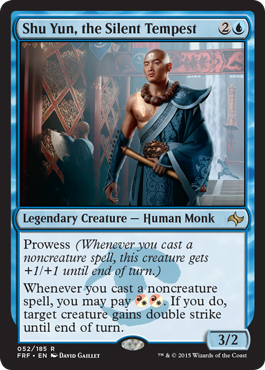
 

Shu Yun, the Silent Tempest
1 Month: Bulk
Dragons of Tarkir: Bulk

Why am I writing about Shu Yun if I think he’s bulk all the way down? Far and away the most probable path is that he’s $.25, but I’d be doing you a disservice if I ignored the possibility that Shu Yun could actually be disgusting. A Shu Yun on T3 sets up a T4 Titan’s Strength, Aqueous Form for sixteen unblockable damage. Even when you aren’t living the dream, he can output some insane damage pretty quickly.

Will it be good enough for Standard? I doubt it. Anything is possible though, and the potential damage output on this card is real.
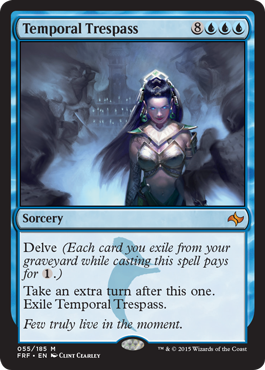
 

Temporal Trespass
1 Month: $2-$3
Dragons of Tarkir: $1-$2

We got a delve Ancestral Recall in Khans, and now we’re getting a (sort of) delve Time Walk in Fate Reforged. Are we getting a delve Timetwister in Dragons of Tarkir? Maybe even a 6cmc artifact delve Black Lotus? With contraptions??

As an overall community, we undervalued delve across the board. When Treasure Cruise was spoiled people weren’t quite sure if it was busted in half or if it was Shared Discovery. It took some actual games being played (and Jeskai Ascendancy casting it on turn two) before it became clear it was the real deal. Dig Through Time similarly was underrated.

I don’t think Temporal Trespass is on the same level as either Cruise or DTT. First of all, it costs more to cast than both, no matter what. Not only is the CMC higher than the other two, UUU is no small hoop to jump through. Once you’re trying to cast CCC spells, an overwhelming majority of your lands need to tap for that color. This means no “splashing” Trespass – it’s only going to fit in Cryptic Command manabases.

Another issue is that your graveyard is a finite resource, and two pieces of serious competition were printed in the last set that eat from the same plate. Extra turns are obscene in EDH, but in most other formats, Ancestral Recall is probably better than Time Walk. We only need to look at Temporal Mastery’s limited success to see that. Even Miracles, the deck best situated to take advantage Temporal Mastery, doesn’t run it. It’s possible that Temporal Trespass ends up in a combo deck somewhere – the eleven mana converted mana cost may actually help with that in some ways – but I think it’s likely this doesn’t manage to break into any of the three major formats in a meaningful way.

One alternate future timeline for this is one in which Treasure Cruise and DTT get banned in some number of formats. Trespass suddenly looks a lot more desirable when it’s the only thing vacuuming up your graveyard. I don’t think this outcome is likely, but I’d be remiss to ignore it.

For the Travis Woos out there, this does give Narset a Time Walk effect in Standard. Worth being aware of at least. If that somehow is good enough, Narset is probably the best target in the deck.

All things considered, we shouldn’t entirely discount Trespass. Temporal Mastery has climbed 50% since its low a little over a year ago, and I wouldn’t be surprised to see it break $10 in the not-too-distant future. Time Walk effects are always popular with a particular subset, and this one should be no different. Once this drops towards the $1 range it will be a solid pickup for long-term growth. As for the foils, well, I’ll let this price graph of the Temporal Mastery foil do all the talking.
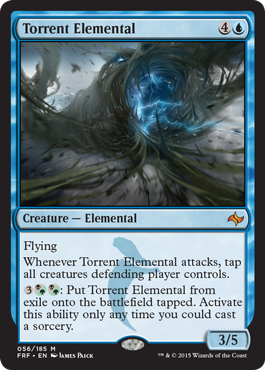
 

Torrent Elemental
1 Month: $2-$4
Dragons of Tarkir: $2-$4

What an odd card. Every aspect of this feels a bit…forced. The power and toughness seem custom built to answer the format. Three power sneaks in under Elspeth’s board wipe, and five toughness means it can block a Siege Rhino. The attack trigger stops token decks from chump blocking you into oblivion. Is this just designed to fill every hole in the set?

Torrent Elemental is watermarked as a Sultai card, which the activated ability certainly reinforces. The idea here is that you delve away Torrent while casting Treasure Cruise or Tasigur, and then you can still put it back into play afterwards. I guess the question is whether that’s something people actually want to spend cards and mana on.

Looking at Misthollow Griffin, I see that there’s little casual demand for the “cast from exile” mechanic. Griffin is under $1, so I don’t think Torrent is going to be earning a price tag from the casual market. If this card is worth anything, it will be from the competitive scene.

I can certainly see a world in which Delve and self-mill decks are happy to play a few of these. Two copies are “free,” insomuch as any card taking a spot in your sixty is “free.” Flipping this over with Satyr Wayfinder and eating it with Tasigur is basically all upside, since once you Delve Torrent you’ve effectively drawn it. That’s pretty juicy, as virtual draw effects are always welcome, but do we care about drawing a 3/5 that taps things when it attacks? I’m honestly not sure.

SCG is sold out at $2, and eBay is finishing around $3 a copy. I think that is a pretty fair price, and could easily turn out to be way under market. Bulk mythics are typically in the $1-$3 range, so even if Torrent is a complete flop you don’t stand to lose much. The upside is double digits, although that’s a long ways from $2.

I can’t fault you for picking up a playset at prerelease weekend so long as you can get them for $3. The risk is tiny and there’s real upside. After a playset I’m not a buyer, but I am a keen watcher. A card like Alesha will go from $.50 to $5.00 in a single event, but Torrent elemental is the type of card that will keep showing up as a two-of in various decks for multiple weeks, adding a little bit of value to it’s price tag each time. Watch for results, and if it’s making waves on the SCG circuit, don’t hesitate to buy in at $2.


Black

Bulk
Archfiend of Depravity
Mardu Strike Leader
Palace Siege
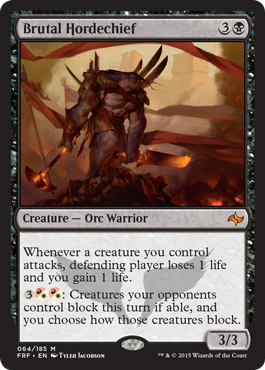


Brutal Hordechief
1 Month: $2-$4
Dragons of Tarkir: $2-$8

Brutal Hordechief is pretty aptly named, and I’m not the only one who thinks so. Hellrider showed us just how strong that drain on attack can be, and Hordechief makes the trigger even better by adding some lifelink just to be sure that racing is going to be a nightmare. Resolving Hordechief on T4 and immediately swinging with three tokens bolts your opponent immediately, and still has them facing down three more damage. The very next turn you can start activating Hordechief to force them into using all their dudes to block a 1/1 while you swing in for 7-8+ damage. If you swing with three tokens along with Hordechief while making all their guys block a single token, they take nine damage. It adds up fast!

There are admittedly distinct differences between Hordechief and Hellrider. Part of what made Hellrider so dangerous was that he had haste, often killing the opponent outright or putting them within range of a Lightning Strike the next turn. Hordechief is slower, and lacks the ability to put the game away on the spot. Hordechief isn’t as fast, but he is a little stronger as the game goes longer.

Where Hordechief lacks haste, he has the secret ability to protect himself. Hellrider may have had haste, but if your opponent had a few blockers, you couldn’t swing without fear of losing him. There were times where Hellrider had to stay at home to avoid dying in combat. Hordechief’s activated ability not only allows you to alpha strike the snot out of your opponent’s face, but in situations where you can’t kill them outright, it means that you can attack with impunity. Just make sure nothing blocks Hordechief and you get to do it again next turn. Where Hellrider had haste, Hordechief has the ability to attack at will and never fear dying in combat.

Remember as well that even if Hordechief is strictly worse than Hellrider, that doesn’t actually matter – Hordechief isn’t competing against Hellrider, because Hellrider isn’t legal. There’s room for a card to be worse than Hellrider and still be a Standard staple.

He’s preordering in the $6-$10 range right now, which is where his price would be in the nearly-best-case scenario. What is much more reasonable is a price tag in the $3-$5 range. If after that he doesn’t manage to put up strong results expect him to fall towards bulk mythic. If tokens takes off in this direction and ends up Mardu, he could push back towards $10. I can’t say for sure which path he’ll take, but just watch tournament results and you’ll be able to see it coming.
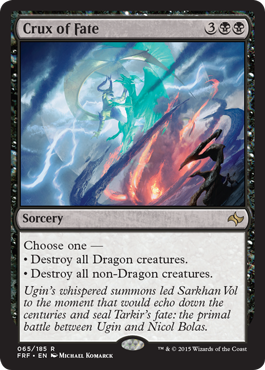
 

Crux of Fate
1 Month: $2-$3
Dragons of Tarkir: $1-$2 or $3-$6

Crux of Fate should do better than End Hostilities in both price and play because it’s much better positioned. UB is the de-facto control colors right now, for the first time since Sphinx’s Revelation was printed. With a control deck already in place and just waiting for this effect, the reception for Crux will be much warmer than it was for EH. Ugin being printed makes life even better for Crux, since UB control will be getting such a powerful card at the same time. Most expect UB control to be a serious player in the meta after Fate Reforged, and Crux is going to be a four-of in every list to start. It even has a not-so-secret Plague Wind mode just as icing on the cake.

People assume this is going to be the same price as Hostilities because they’re so similar. While that’s a possible outcome, I’m not convinced. I wouldn’t be surprised to see Crux live it’s life at two to three times more than EH, since the format is so much better positioned for a black sweeper than white, and because black gets castable sweepers so much less frequently.
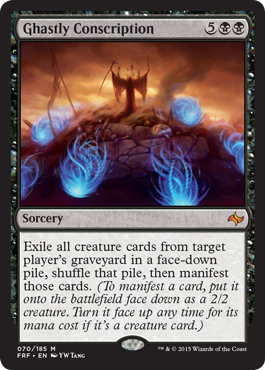
 

Ghastly Conscription
1 Month: Bulk
Dragons of Tarkir: Bulk

Unreliable in any constructed format, and not even great at what it does in EDH. Rise of the Dark Realms is just better.
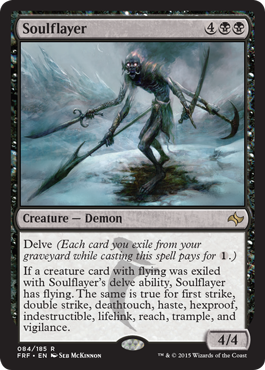
 

Soulflayer
1 Month: Bulk
Dragons of Tarkir: ???

$.10? $10? Nobody knows! Soulflayer is potentially one of the strongest cards in the set, but the setup necessary to get paid may not be worth it. There are some pretty powerful interactions in place in the format right now for him, that’s for sure. Pharika and Soulflayer may fast become friends, as Soulflayer eating Pharika gives you an indestructible 4/4, and Soulflayer provides double devotion for Pharika. If the pieces fall into place, “Soulflayer delving Chromanticore and Pharika” may be one of the most common and frustrating sentences spoken aloud at Standard events in the coming months. If it ends up being too difficult to reliably put together, it’s only a combo you’ll need to fear in the 1-2 bracket at FNM.

What I see as being the most important factor in Soulflayer’s success is how playable cards with those keywords will be independent of Soulflayer. Not having to jump through hoops to make him worth casting is the real trick. If there are keyworded cards that you’re happy to cast on their own, that makes Soulflayer a strong addition to a deck that’s already playable. If instead the format is all tokens, Siege Rhino, and Monastery Mentor, Soulflayer looks much worse. Either way, Soulflayer is not going to come out blazing.

Watch the Standard landscape to see what types of creatures are showing up. Do black decks have lots of keyworded threats? If so, then it may be time to move in on Soulflayer.
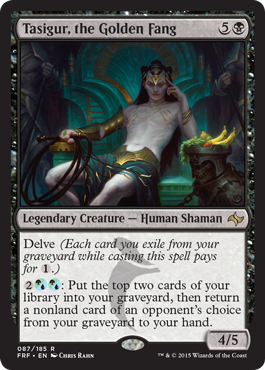
 

Tasigur, the Golden Fang
1 Month: $1-$3
Dragons of Tarkir: Bulk – $5+

Let’s start with this: Tasigur is possibly the best rare in the set. Three months with Treasure Cruise and DTT have made it crystal clear that delving three to seven cards can happen way sooner than you realize, even in Standard. With five in the graveyard Tasigur is a one-mana 4/5 that has “2CC: Draw a card” as an ability. To get a better picture of the strength of Tasigur, check out Sam’s article and Ari’s discussion of him as well.

What jumps out at me most while reading those descriptions of Tasigur is how many different types of decks can play him. He’ll be an almost automatic 2-of in Abzan decks out of the gate, which is a top-tier Standard deck and isn’t going anywhere. He also has a home in control shells as a stabilizer/finisher/card drawer. More aggressive decks looking to go under midrange can even find room for him as a way to play two spells early in the game and as a means to keep their hand full of pressure while trying to finish off an opponent.

When three distinct strategies all have an interest in a creature, that’s a big check mark in the plus column. Not only will he fit in multiple existing shells out of the gate, he’ll be a worthy candidate for nearly any deck that generates black mana in Standard in future. On that note, he’s only one color – another big check mark for price growth. One of the best ways for a card to dramatically increase its value potential is to be desirable in the eyes of multiple strategies and decks.

Beyond Standard, Tasigur looks even better. With Jeskai Ascendancy casting Cruise on turn two, we don’t have to wait long in eternal formats to resolve our first 4/5. Just crack a fetch and cast Thought Scour, and you can cast him on turn two. He’s a bit of a nonbo with Tarmogoyf, but that can be mitigated to an extent, and he’ll be able to fit in decks that may not be able to cast/support Tarmogoyf. Any black attrition shell should be interested in Tasigur as a way to earn extra value on all their spent discard/removal, and after delving away all the Thoughtseizes, Tasigur will keep recurring your removal.

I’m not blind to the similarity between Tasigur and Hooting Mandrills. Much is shared between the two cards. But just because they are similar, it does not mean they will see the same play, nor will they be the same price. While their colors are different, that’s mostly a wash. An extra point of toughness on Tasigur is a rather big deal – he survives Stoke the Flames and blocks Siege Rhino in Standard and 4/5 Goyfs in eternal formats. His activated ability is also quite relevant, as it basically says “draw a card.” That’s an awfully powerful ability, and if Hooting Mandrills had it, you better bet your butt that we’d be playing against Jungle Book.dec in Modern and Legacy.

Tasigur is legendary, which is a drawback, and he lacks trample as well. Both of those are fair concerns, but ultimately I don’t feel that they’re enough to offset what makes him better than Mandrills. The apes have been on the edge of playability since September, and my guess is that “draw a card” is enough to push them into multiple formats.

Where does this leave his price? If he was mythic, this would be a much easier guess. As a rare it’s more difficult to figure out. With so many mythics looking like they will have a real presence in Standard, this set could end up with a lot of pricey red rarity symbols. If we get a set where five or more mythics are Standard role-players, rare prices will be suppressed. If only one or two mythics end up breaking through, then Tasigur’s ceiling will be much higher. Keep in mind too that the fetchlands will be floating around in FRF packs, which doesn’t help, although I don’t believe the supply large enough to be particularly impactful.

It’s unlikely that Tasigur jumps from his preorder price out of the gate, although I don’t expect it to fall much/at all. Early success will push him up into the $3-$5 range, and if it’s consistent, that price will solidify/rise slightly. With Siege Rhino in the same $3-$5 range it’s tough to imagine Tasigur rising above that, but he could easily keep pace with Rhino. If he ends up being one of the best three cards of the set – which is entirely possible – he may reach double digits. Rhino probably already would have if not for the fetchlands.

Even if he doesn’t breakout immediately and sinks towards bulkish, he’ll be a great pickup over the summer. Until then, this is one of the few cards I picked up for myself at preorder prices.


Red

Bulk
Arcbond
Flamerush Rider
Outpost Siege
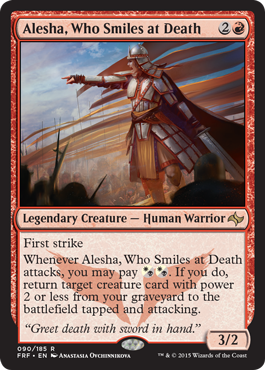


Alesha, Who Smiles at Death
1 Month: $1-$3
Dragons of Tarkir: $1 or $3-$5+


Daghatar the Adamant
Monastery Mentor
Battle Brawler

From Jund reanimator returning Hornet Queen to midrange returning Courser or Rabblemaster or Monastery Mentor to aggro returning Eidolon or Swiftspear or Battle Brawler, there are a variety of shells in a variety of colors that would be more than happy to pay Alesha’s trigger. Level zero is using it alongside Whip to get back Hornet Queens in a more aggressive reanimator deck, but there’s no shortage of options. I’m sure if I looked into Modern targets there’s some even more busted options. (Gigantomancer? Trostani’s Summoner? Sutured Ghoul?)

2R for a 3/2 first striker isn’t a bad rate, and the amount of hell she brings with her pushes her over the top. Attacking straight into Courser is a bit frustrating, but if you can set up triggers that either pump her past Courser or make dying to it irrelevant, you’ve more than gotten your money’s worth. If Tasigur is the best rare in the set, Alesha looks like she may be making a run for second or third. Then again, I’m a sucker for a good cheaty card.

Alesha is preordering for $3-$4, which means that the hype isn’t too big. It sounds like she’ll slip into Standard without a lot of fanfare, and without immediate results she’ll drop in price quickly. Within two or three weeks I wouldn’t be surprised to see her hanging around at about $1. Don’t think this means she missed the boat though – this is exactly the type of card that people forget about until it wins a GP and suddenly jumps in price.
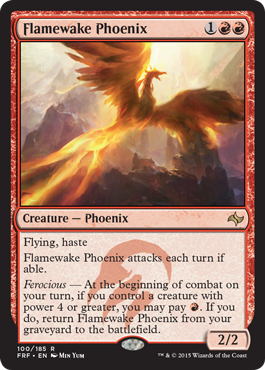
 

Flamewake Phoenix
1 Month: $2-$4
Dragons of Tarkir: $2-$4

Flamewake is legit. Three for a 2/2 flying haste is riiiight there, and with the number of great four power creatures in the format, he’s got no shortage of fuel. Without even leaving red there’s Shaman of the Great Hunt and Ashcloud Phoenix. If you’re willing to branch out there’s Butcher of the Horde, who will just keep eating the phoenix for repeatable vigilance and lifelink. I’m sure I won’t be the only one to be completely sick of this card within a few months.

Flamewake is already preordering for around $5, which isn’t far from the ceiling on a card like this. Even if it sees about as much play as it reasonably could I wouldn’t expect the price to be more than that. What we’re likely to see is the price float around in the few dollars region for quite some time, with only small variations within that window.
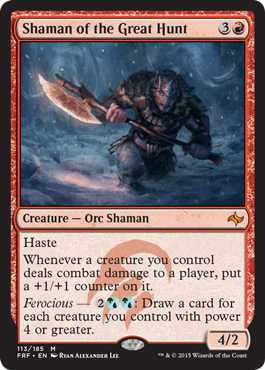
 

Shaman of the Great Hunt
1 Month: $3-$5
Dragons of Tarkir: $2-$7+

Most reception to Shaman is positive, and for good reason. Haste is easily one of the best keywords, and on a four-power attacker it’s extremely threatening. Many premier hasty finishers are often in that ballpark – think Stormbreath Dragon and Thundermaw Hellkite. His secondary ability means he grows out of control almost immediately if you let him connect just once, and even if he gets blocked the other guys you swing with will get to grow.

His ferocious trigger is great, especially when you consider how many four power options there are floating around. Savage Knuckleblade and Yasova both come down ahead of Shaman and give you additional ferocious power. Shaman having four himself also means that he enables Flamewake Phoenix, another strong hasty red card.

I’m sure you’ll be reading more about Shaman from strategy writers in the future, so I won’t dwell on his strength. He’s legit, which is what we’re concerned with. I don’t expect his price to dip much at all within the first few weeks after release. If nobody is able to find him a home he may slip below $3, but I think we’re more likely to see Kibler slinging a full set somewhere right along and that will prop him up at least around $5. A price tag of $5-$8 is reasonable, and above $8 is plausible, although that puts him as the second-strongest mythic or so in the set. Both $5 and $15 are potential price points for this guy, depending on how the format breaks.


Green

Bulk
Frontier Siege
Sandsteppe Mastodon
Shamanic Revelation
Temur War Shaman
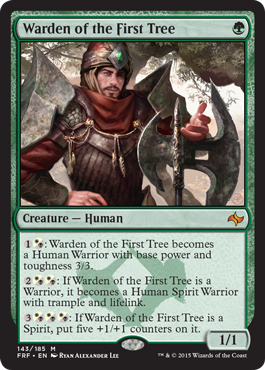
 

Warden of the First Tree
1 Month: $3-$6
Dragons of Tarkir: Bulk Mythic

Warden of the First Tree is my vote for the most overrated mythic in the set. When Figure of Destiny was first spoiled, people hadn’t figured it out yet. Turns out the card was amazing, and everyone remembers that. Now that Warden comes along, people want to make sure they “get” him before he breaks out.

Warden of the First Tree is not Figure of Destiny. I really like how Ari said it, so I’m going to quote him:

“Figure of Destiny was a 4/4 in a format of Agony Warp and Firespout.

Warden of the First Tree is a 3/3 in a format of Courser of Kruphix, Siege Rhino, and Lightning Strike.”

Figure let you swing for two on turn two while either playing something else that costs one or a tapped land. Warden requires two mana to hit his second level, which means that in order to activate him on curve you’re taking a lot of damage from lands and postponing dropping a tapped land until later turns.

Where the cards really diverge is on the second activation. Not only does Figure’s fire a turn earlier, he ends up as a 4/4, while Warden is a 3/3 with useful abilities. There are definitely formats where a 3/3 lifelink trample is better than a 4/4, but a format with Courser of Kruphix and Siege Rhino is not one of them. Let’s try comparing their total mana costs through the second activation. After five mana, Figure of Destiny is a 4/4. That’s a limited quality creature, for sure, but it’s not heinous. Warden is a seven mana 3/3 lifelink trample. That is a lot worse than a five mana 4/4.

Warden’s last ability pays you each time you activate it, where Figure’s will not. However, you can’t expect to activate the final level frequently. There’s some low percentage of games where you’ll be able to make him an 8/8 lifelink trample, but the number of games where you lose with an 8/8 lifelink trample but win with a 13/13 lifelink trample is absolutely tiny.

Perhaps the format eventually changes to make Warden useful. It’s possible. I think Courser has to rotate before we get to that point though, and even that may not do it when cards like Siege Rhino and Savage Knuckleblade are floating around.

Preorders are in the $10 range, and it’s not going to plummet immediately. A month from now he may still be $5, but I expect him to be near bulk mythic by the time Dragons of Tarkir releases.
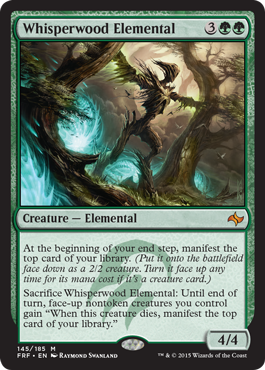
 

Whisperwood Elemental
1 Month: $3-$5
Dragons of Tarkir: $3 or $15

Whisperwood Elemental, and every card with the keyword manifest, is sort of an unknown right now. Technically, we know what manifest does. It flips a card face down onto the table as a 2/2, and you can unmorph it if it’s a creature. (Non-creature manifests can’t be unmorphed ever.) Like many mechanics before it, it’s going to take some table time to figure out just how useful the ability is. How often do we actually hit creatures? Do we care? How good is unmorphing stuff? Are any of the wombo combos with manifest, such as Hooded Hydra, good enough to matter? I have a sneaking suspicion that manifest is going to end up being strong when you aren’t overpaying for it.

Our first tool for understanding Whisperwood is Master of the Wild Hunt. Both are an X/X for X+1 that make a 2/2 each turn. Huntmaster comes down a turn earlier, but you actually end up with the token about the same time as you do with Whisperwood. If you cast Master of the Wild Hunt on turn four, you don’t get the token until the upkeep of your fifth turn. If you cast Whisperwood on turn five, you get the 2/2 at the end of your turn. Master gives you the token at the beginning of your fifth turn, and Whisperwood gives it to you at the end of your fifth turn. Since neither can attack that turn, they’re very nearly the same thing from a “vanilla 2/2” standpoint. In fact, your opponent has a longer window of time in which to answer the Master before he gives you a wolf token than they do to answer the Whisperwood.

Where Master was pseudo-removal, Whisperwood has Wrath protection. He essentially has “screw your sweeper” written on him. They sweep, you sac, and now you have several manifests in play when you untap. Sweeper protection on a strong green threat is greatly appreciated, since the type of deck to play Whisperwood is exactly the type of deck that can and will lose to a resolved Crux of Fate. Whisperwood allows you to overcommit to the board and begins generating value immediately. Not only does Whisperwood let you fearlessly play him into a board where you already control several creatures against a wrath deck, he also means that you don’t need to cast more threats after either. Just let him keep making his manifests, and unmorph those as you go. Your pressure continues to build without needing to put more cards into play.

Let’s talk about manifest for a minute. You see, manifest is sort of like drawing a card every turn. About one half to two-thirds of the time, the card you draw is a free 2/2, which isn’t bad. The rest of the time you draw a free morph. Whenever you manifest a real creature, you get to “cast” that creature for its unmorph cost. Manifesting Polukranos is just like drawing him, except until you cast him, he’s a 2/2 instead of a card in your hand. Drawing a free card every turn in a green deck is just going to be so strong against so many opponents. Against non-sweeper decks Whisperwood is pure gas. If he only made a 2/2 token every turn he’d be good enough, but making manifests is even better. The fact that he protects against blowouts at the same time is just gravy.

Whisperwood is preordering for about $5 right now, which is pretty close to bulk mythic as it is. If he saw absolutely zero play in Standard, he’d still be about $2-$3, right? He doesn’t have far to drop right now. Worst case scenario is that he loses $2 from where he is. What’s the best case scenario though? The best case is that he ends up being a major standard role-player, and any deck that makes green mana wants some number of copies. If that’s the case, he’s easily $5-$9, and possibly even double digits if he’s a real contender. Imagine he sees just as much play as Polukranos has. Polukranos has floated between $5 and $15 since release, and he’s both a fall set mythic AND is in a duel deck. That duel deck absolutely suppressed his price. Without that additional printing Polukranos easily would have been over $20 at one point.

At this point, Whisperwood has my vote for the most underrated mythic in the set. I’m not buying any copies today, but I’ll be picking up a set as soon as the preorder prices start coming down. I’m not guaranteeing you that Whisperwood is going to rise in price, but he’s very near his floor today, and the ceiling is over $20.
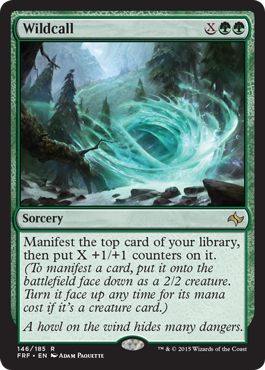
 

Wildcall
1 Month: Bulk – $2
Dragons of Tarkir – Bulk – $5

Wildcall is certainly a flexible card, which is always appreciated. Flexible cards are always in the running for being playable, even when you’re overpaying for any specific mode. Think of Wildcall as a modal spell, except it has an actual infinite number of modes. GG for a 2/2, or 1GG for a 3/3, or 2GG for a 4/4, and so on and so on. Is GG for a 2/2 exciting? No, of course not. Nor is 3GG for a 5/5. But having the option at any point in the game is certainly worth something. It can play the bottom of your curve if you draw a grip full of 3’s and 4’s, and it can play the top end if you draw a bunch of mana dorks.

If Wildcall just made a creature token, it may or may not be playable. We get more than just the token though, we get the face down card. A large portion of time it really will be a token – we’ll flip a land or a spell. When it’s a creature though, we really get paid. Not only do we get our X/X for X, at some point later we get to unmorph and have a real creature that now has a bunch of counters on it. The dream is unmorphing Hooded Hydra for GG, but even normal threats will be absolutely fine. Rattleclaw Mystics give you the option of a mana explosion, and creatures with trample or double strike could just kill the opponent out on the spot if they block wrong.

Wildcall will never be expensive, but it does have the chance to be a Standard role-player and earn itself a price tag of more than a dollar or two. If either Wildcall or Whisperwood starts showing up in lists, then the other is probably not far behind.
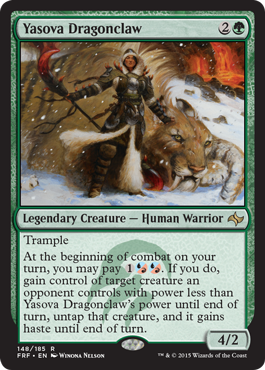
 

Yasova Dragonclaw
1 Month: Bulk – $2
Dragons of Tarkir: Bulk – $3

Yasova feels close to being there, but isn’t quite. Her stats match up poorly against Courser, which admittedly is true for Shaman as well, but he only has to sneak by once to start crashing through. Yasova is going to run into that problem repeatedly. She’s also brick walled by Siege Rhinos all day long.

Even though she’s only got two toughness, four power is a beating. And at three mana, she’s a potential turn two play off a Mystic. You also don’t need to attack with her to use her trigger, which means you can keep stealing and swinging with their threats without exposing her to danger.

The real trick will be finding a way to pump her power. Shaman is a start, and we should be on the lookout for other strong ways to do it. Xenagod is certainly an option, which not only opens up the door to stealing Rhinos, but just about anything in the format. Xenagod also happens to play beautifully with the new Gruul dragon, so maybe there resurgence of big Gruul beats is just around the corner.

I’m thinking she probably spends most of her time in the bulk to $1 range, but if enough power-pumping support ends up being playable, she could be a few bucks.


Multicolor/Colorless

Bulk
Crucible of the Spirit Dragon
Scroll of the Masters
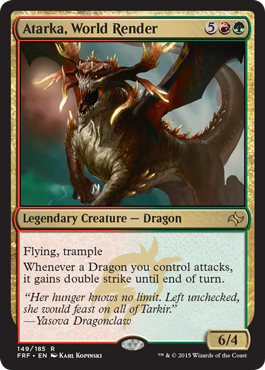


Dragon Cycle
1 Month: $1-$2
Dragons of Tarkir: Bulk – $2

The Gruul, Dimir, and Rakdos dragons should make occasional appearances in Standard over the next year or so. Xenagod combines with the Gruul dragon to kill in one hit, the Dimir dragon eats Elspeth alive and massacres the increasingly-powerful token theme, and the Rakdos dragon plays well with Frontier Siege and token strategies.

Even though three of the five have slots to fill in Standard, I don’t expect any of them to see enough play to warrant price tags above a dollar or two. They’re all curve-toppers and unlikely to be worth four slots even in their best decks. Casual demand will keep their value from bottoming out too low, but I don’t expect any of these to break $3 before Dragons of Tarkir. DOT will dictate whether these become more playable. I doubt we’re going to see two and three drop dragons, but if we do, then there’s the chance these guys become much better positioned. Those attack triggers get fearsome quickly when you can activate them more than once a turn.
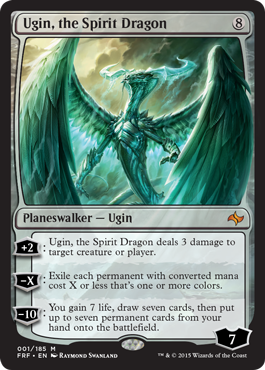
 

Ugin, the Spirit Dragon
1 Month: $25-$30
Dragons of Tarkir: $18-$25

Ugin is damn strong. Pat and Ari each wrote articles about him, as I’m sure many other strategy writers have and will. The long and short of it is that Ugin will show up lots of places.

In Standard, Ugin will be an important role-player. Even though he isn’t going to be a 4x in many decks, he’ll do a lot to make UB control more viable. UB hasn’t had a really solid finisher up until this point, and it’s had to rely on Perilous Vault to do it’s cleanup work. Ugin handling both of those roles is huge. That will in turn change the way the format plays out, so even operating as only a two-of in a single deck, he’ll manage to change the entire format. There’s a chance he could show up as a full set in green devotion or something, but I’m not counting on that.

Modern Tron will definitely be interested in a few copies. People are quick to compare him to Karn or Oblivion Stone. Yes, he comes down slower than Karn, and yes, he doesn’t do certain things that O-Stone does. What is being missed here is that while he’s not exactly Karn and he’s not exactly Stone, he does a damn good impression of them at the same time. Not only can he come down and clear the board like Stone will, he’ll also start zapping creatures/faces and moving towards a victory. Like a modal spell, while he may not do either half quite as efficiently as would be done on it’s own, the fact that he offers two halves in one card will be very important.

MUD decks in Legacy will surely be happy to have some number of Ugins, as not only will he wipe all sorts of problematic permanents (including TNN), he’ll leave your own artifacts alone. I’m not sure how many not-MUD decks will be interested in him, but I imagine at least one or two will be.

That he’s colorless means he’s an option for every single EDH deck, and given how amazing Pernicious Deed effects are in that format, I assume he’ll be adopted by many lists. We’ve never really had a Planeswalker with such universal EDH appeal so it will be interesting to see how much extra demand this generates. It will certainly drive the foils higher.

As if playability in Standard, Modern, Legacy, and EDH wasn’t enough, he’s also very cool. He checks a lot of boxes for casual players, even the dragon checkbox. (Sort of.) Planeswalkers have always been popular with the kitchen table crowd, and Ugin will be more so than most.

It seems the planets are aligning to make Ugin a valuable and sought-after Planeswalker. He’s fetching around $30 right now, and we won’t see that dip much within the first month. By the time Dragons comes out it will have dropped a bit, but I’m not even sure he’ll be under $20. I suppose eventually he will be under $20, but I’m not sure how long it will take, and without a reprint, it will be short lived. Once he bottoms out, perhaps next July, he’ll start rising and won’t stop until either $50 or a reprint.

Starcity released the foil at $80, and I don’t think that’s too far off the mark. Foil Planeswalkers are always expensive and EDH/eternal demand will help push that envelope even harder. It looks like foil Karn was at his lowest the fall after he released, so that may be the time to see how Ugin is trending. Other Planeswalkers have different foil trajectories, but many are tied closely to Standard success and reprints. Karn seems like the best approximation here.
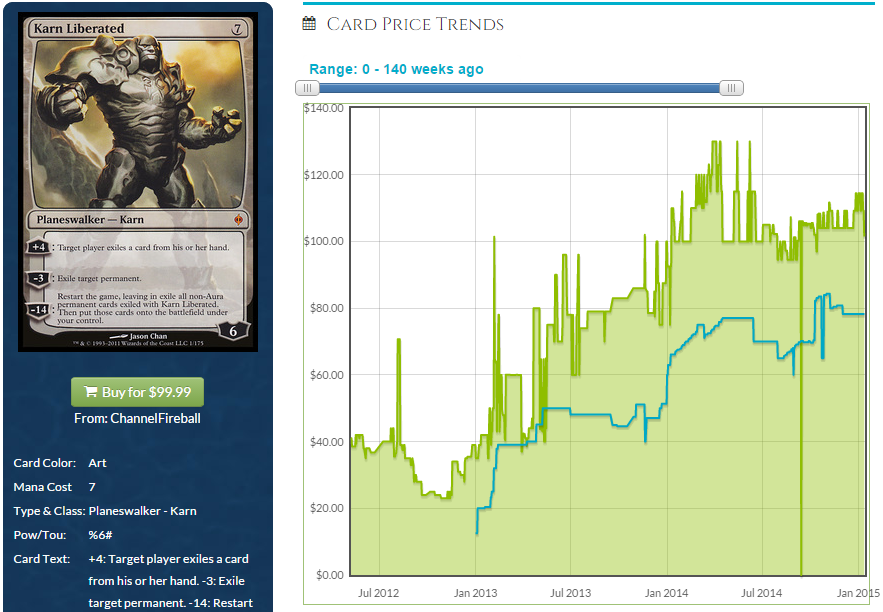
Capture

One last note on Ugin: apparently there’s an alternate art version that will show up occasionally in the prerelease packs. I’m not sure what the foil situation is. In any case, any alt-art foil Ugins will be worth more money than anyone wants to have to admit they spent on a Magic card, and they will probably never be cheaper than whatever their price will be a few days after the prerelease.

 

Imma Teach You How to Puca

By: Travis Allen

An (intentionally) untold number of hours of my life have been spent playing Diablo 2. A full fourteen years after it’s release the game remains a remarkable standard by which all action-RPGs (ARPG) are measured. Nearly every aspect of the game was honed and tweaked and polished to perfection by an incredibly talented Blizzard North. Environments were soaked with flavor, from the damp, muted, chilly English moors the game begins on, to claustrophobic, slimy, maggot-infested tunnels, to gothic fire-infused walkways spanning pits of lava in the depths of hell. Fans of the game are immediately transported back in time upon hearing just the first few chords of the Tristram theme music, which captured the travel-weary, besieged hero sentiment in such a way that a player immediately related to the beleaguered residents of the makeshift town.

Even today the game is arguably still the greatest ARPG ever released to the public. Combat was solid and satisfying, with even a level one character’s swing of the sword resulting in gratifying thwacks on Fallen hide. Spells from every character class were visually enthralling. Torrents of fire spewed from the ground engulfing zombie masses, and barbarians came crashing down amidst enemy hordes from thirty feet in the air, all of which evinced great effect. Each time you lobbed a spinning orb of ice or sent a spiralling spear of bone towards lumbering beasts or scurrying Fetishes, there was a visceral sense of action. Pacing between battles was quick enough that you never fell out of the rhythm, but not so high-strung at all times that you couldn’t appreciate truly large battles when the random monster layout ended up clumping half a map’s worth of foes in a single spot.

What captured the audience in a way nothing really had before, and was partly responsible for the historic success of World of Warcraft, was the game’s itemization and skill system. Item drops were paced in such a way that as a player worked their way through the various acts, upgrades to existing equipment occurred just frequently enough that you knew a new toy wouldn’t be far off, but not so frequent that you didn’t have time to appreciate cool gear before it was obsoleted. At the higher levels of character development items often ceased to be strict upgrades and instead became sidegrades, allowing for customization of play experiences.

While there was certainly a Grade A build for each class, an Abzan Midrange build that was well-known and versatile, the true beauty came from the vast set of options unlocked by the intersection of unique skills and functionally different gear. One of my personal favorites was the BearSorc, a hilarious frankenstein of a character build. By combining a certain set of items with no apparent synergy and dressing up a character that had no business using any of them, the emergent properties were such that you were now wildly powerful and completely unconventional. It was the equivalent of Tin Fins, a group of cards that seem discordant on paper, but is in fact unreasonably powerful in practice. If you’ve ever found yourself wanting a Magic: The Gathering action game, the best one that will probably ever be made already exists, and it’s been around for years.

Dream-Helm

One of the most interesting and engaging aspects of the game was one that grew up from the community entirely organically. A whole economy for powerful items matured as the game progressed, from early days of ubiquitous trading-window hacks to late-stage excessive duping and market crashes. Early on in the game’s lifespan one of the most valuable and universally desired items, the Stone of Jordan, was a key component of the Diablo 2 marketplace. Eventually market forces shifted and items were measured in value based on how many Stones of Jordan they were worth. A cool hat may have been worth one to two SoJs, a well-rolled Stormshield may have been ten or twenty, and a perfect Godfather or Windforce may have commanded a full forty Stones of Jordan.


That was where the market started to break down. When trading items between players, the absolute maximum number of items that could be traded away by one party was forty; the size of the player’s inventory. This became a hindrance as saturation and duping meant that items were worth more and more SoJs. Truly rare and high-end items were worth more than forty SoJs, but there was no safe or reliable way to perform a transaction that involved a greater number than that. One party would be able to completely hose the other, with absolutely zero in-game or customer service repercussions. This left players seeking solutions outside of the trade window.

stone_of_jordan

Aside from the hundreds of sites that sold Diablo 2 gear for cold hard cash, the one trading location that truly thrived was d2jsp. The website still exists for use in other games, although I’m sure the D2 portion is nearly defunct at this point. Like wavedashing in Super Smash Brothers Melee, if you don’t know the name d2jsp, you weren’t playing Diablo 2 at the highest level.

What set d2jsp apart from every other trading solution was that it introduced a flexible currency into the market between players. Normally trading high-end items between players was a nightmare. I may have a near-perfect Breath of the Ancients, but if I’m looking for an Ethereal 2os Crown of the Ages, it’s going to take forever to make that trade. Not only do I have to find someone with an exceedingly rare item, I have to hope they want my sweet sword. d2jsp fixed this by adding “forum gold.”

Forum gold was inherently valueless, with item prices set entirely by the community. It provided a tool for players to trade any item for any other item, simply by turning their half into forum gold, and then paying someone else for their item using forum gold. FG was, and still is, a currency. I would find someone with a huge pile of FG that wanted my sword. I’d give them my sword in the game, and they’d send me however much FG we had agreed it was worth. Then whenever someone was selling an item I wanted on the d2jsp forums, I would pay them the requisite FG and they’d give me the item in-game. It was a bit clunky, and required some level of trust in the people using the system that was violated with some frequency, but it provided a badly needed service to a community with item values that had massive spreads.

Forum gold changed the nature of the game for many, and made items that would otherwise have been completely inaccessible, obtainable. It was invaluable for the average or newer player that wanted to reach the upper stratospheres of items. Just playing through the game a player would occasionally find an item worth a few FG. They would gather up bunches of these items, sell them each for one or two FG, and then find themselves with enough to buy a higher-tier item. It was a reliable method a player could utilize to slowly increment the quality of the gear. No longer were the rarest and best items completely out of reach short of hacking local save files. There was a path, it was clear, and everyone could take it.

I loved d2jsp and forum gold. It was a rich vein for those that understood the system and how to use it. More than just buying things people were selling for too cheap and relisting it, it provided a tool to move unique and high-end gear that otherwise would rot away, while at the same time turning piddly low-level armor into genuinely useful pixels. With time I was able to amass quite a large pile of FG, along with several characters geared to the teeth with some of the best items money could buy. Of course I promptly blew it all on Diablo 3 when that came out some number of years later. In fact, Diablo 3 had an auction house that used real life money whose existence was almost entirely based on the success and necessity of d2jsp for the Diablo 2 community. (The auction house later imploded and was removed by Blizzard, but that’s a whole other topic.)

What does my waxing poetically about Diablo 2 have to do with Magic? There is in fact a great deal of similarity between the item market in D2 and trading MTG cards. Both systems use bartering rather than currency at the player-to-player level. Both require each party to want something from the other. Both result in headaches when one side of the deal is worth 10% more than the other and players are left trying to fill in missing value without using a granular currency like the USD. And like D2, a website has stepped up to fill in a gap between players.

Puca Trade (PT) is still just a Magic trading website, but it’s characteristically different than Deckbox and its ilk. Deckbox works by connecting players based on what cards they want. If we each have something the other wants, Deckbox makes it easy to connect with that individual and facilitate a trade. While it provides for a much deeper pool of players to trade with, it still suffers from the issue that each party needs to be getting something useful to them in order for a trade to be completed. Deckbox isn’t looking to solve this problem, it’s just looking to put so many players in the same pot that it doesn’t come up often.

Puca Trade functions more like d2jsp than Deckbox. I show up and see what cards people are looking for. I don’t attempt to broker a deal between us, though. I don’t browse their Haves list to see if we can make a trade work. Rather, if someone wants a card I have, I just ship it off to them. What I receive in return is not cards, but points. Points function as a currency. As I send real cards off to people, I get their points. Then when I decide I want a card, I use my points to ‘purchase’ that card. (Purchase isn’t exactly the right term, since I’m not going to the market, picking something, and handing the seller points. Rather, I hang a sign on front of my door – “I’d like one Snapcaster, please!” – and someone comes along, slides the Snap through my mail slot, takes the points out of a basket next to the door, and continues on their way.) What Puca Trade does is put a highly divisible middle-man into the trading process, making life easier for people on either side of a deal.

With a system of this nature comes many nuanced opportunities to maximize gains. There aren’t many ways to do something completely wrong, but there are strategies to take that will be sure to help you make the most of your Puca experience. This certainly won’t be an exhaustive list, but it should at least get you on the right path to getting the most bang for your buck, without actually involving any banging or bucks.

One particular aspect of Puca Trade makes it particularly unique, and will be the backdrop for most of our discussion. Card values are not fluid on PT; they are in fact the result of “complex algorithms.” During a real life trade, you and your partner are able to debate the value of cards. Maybe a Snapcaster is $30, maybe it’s $33. There’s a back and forth to decide on a value. On Puca Trade, it’s set in stone. As of writing this, Snapcaster is 3016 points. That value can and will change, but if you’re trading or picking up a Snapcaster today, it’s worth 3016 points. 99% of trades will take place with the pre-determined card values. (There are ways to circumvent this, and don’t worry – it’s not against the rules to do so.)

The fact that card values are set automatically is neither good nor bad, it just is. It’s important to be aware of this fact though, because it will dictate how we approach trading within the system. Values set through heuristics and algorithms will occasionally be “wrong,” in the way that any monetary value assigned to an item without intrinsic value can be wrong. Part of our strategy will be looking to capitalize on gaps such as this.

Know What You Want

The first thing you need to do when coming in is understand why you’re here. What are you looking to get out of the system?

The actual transfer of cardboard on PT is not particularly expedient. As a new user you’ll start with about five bucks worth of points. In order to get enough to pick up real cards, you’ll need to add your cards to the system, wait until you find someone who needs them, get them in the mail, and wait for them to receive them. From the day that you sign up to the first time your account is credited points from another user could easily be over a week. Then you’ve got to wait for someone who has cards you want to agree to ship them to you, then actually ship them, then get them in the mail…

It’s a slow process. Our takeaway then is that you shouldn’t be using PT to chase down Standard staples you need for FNM next week. PT is best when used for longer-term goals, such as finding the last few pieces you need for a Modern deck, slowly assembling a Legacy list, cards to fill in holes in your collection, and of course EDH components.

This isn’t to say you can’t use PT to acquire Standard cards. Just realize that it’s generally not going to happen quickly.

Know What You Have

While the actual transfer of cardboard can be a bit time consuming, the rate at which trades happen is blindingly fast. We’ll talk about this in a minute, but the lead-in is that you need to know exactly what product you’re working with. Go through your trade binder and identify the cards you’d like to trade. (Instead of blindly adding them to your collection, make sure you check what PT thinks their value is first. Most of the time PT is just fine and you should go ahead and add it. There are other times this isn’t the case, as we’ll see below.)

Only add cards to your Haves that you are 100% willing to trade at their given value. If there’s a card you’re not sure you want to get rid of, or if its PT value seems a little low, skip it for now. The reason for this is that you need to be able to pull the trigger to send a card within seconds of someone needing it. If you have to hesitate and question whether it’s a card you want to get rid of, you’ll miss the opportunity to send. When someone wants a card you have, you need to be lightning quick on the ‘Send Card’ button.

Part of maintaining this list will be removing cards from your Haves if you trade them off locally. If you’re only working with a handful of cards this isn’t hard to keep up with. If you find yourself with thirty or more cards on your PT list though, you may want to just pull them out of your binder and leave them at your desk so that you’re always 100% on knowing exactly what you have. You don’t want to see a Bloodghast pop up as a possible trade, and then wonder if you traded your last one at SCG last weekend and have to dig up your binder to check. By the time you have your answer, someone else will have already committed to send them the card and the opportunity is gone.

No Casuals

Knowing without hesitation what cards you have to trade away is key because of how quickly trading works. Anyone that wants a reasonably available, common-place card is going to have their order filled within seconds. The list of people that want Alpha Veteran Bodyguard will have names on it and is not going to change very often, but the list of people that want Mantis Rider is nearly always empty. Why is this? As soon as someone both A. wants Mantis Rider and B. has the points to cover it, someone agrees to send almost immediately. There are way more people looking to trade away Mantis Rider than there are people looking to pick it up, so trades happen lightning fast.

The flip side of this, and what strikes most new users, is that most of the time nobody wants your cards. Or more specifically, nobody fulfills the conditions of wanting your cards and also being able to afford them. Out of the 86,400 seconds in a day, there may be a grand total of twenty to sixty of them wherein you have the opportunity to send someone a card. You need to be paying attention when this happens, but how do you manage that?

I’ve been using Auto Refresh for Chrome, and I’m a big fan. It’s simple enough. Tell it how often to refresh the page, in this case the ‘Send Cards’ page, and then stick the window on another monitor where you can keep your eye on it. I usually do mine for about 20s or so. All day long it just sits over there, constantly refreshing, and as soon as a match comes up I’m mashing ‘Send Card.’ Like I said, prepare for long periods of downtime and then a sudden flurry of activity while you rush to send the card.

Other tools exist to help manage the tracking of trade opportunity changes. There are other apps that will monitor when the text on the page changes, which you can use to track the “Total: 0” text. I’m sure there are other tools as well. I haven’t dived too deep into this well myself, but there is certainly more out there to refine the process. These would be especially helpful if you don’t have the luxury of multiple monitors.

Use Auto-Matching. Also don’t.

When you’re looking at the page for sending cards, you’ll notice a toggle for auto-matching. When you turn this on, it will only show you cards people are looking for that are in your Haves. This page is what will nearly always be empty. When you’ve left the PT page to the side to refresh all day long while you’re working, you’ll want this to be on so that you only see valid trades.

We can definitely make use of the list when auto-matching is off as well though. I like to turn it off and then sort by points, highest to lowest. This will show you the most expensive cards people can currently afford in descending order. The first thing you’ll notice is just how many people want Alpha and Beta cards. Apparently a lot of people are trying to put together sets of those. (We’ll get to A/B cards later.)

What you’re viewing here is the list of cards people want, can afford, and haven’t been sent yet. This is interesting to us because we’re seeing the unserved market. Here are all the cards that are desired that aren’t being sent. Once you get past the slew of A/B and Legends stuff, you’ll see all sorts of odds and ends. It’s important to pay attention to this stuff – this tells you what to look out for when you’re trading at your LGS. There’s always a bunch of Snapcasters on the list. Shocklands are common. Modern foils like Spell Snare and Serum Visions show up. The new fetches, especially Flooded Strand, seem to be popular. Geist of Saint Traft has been underserved lately.

If you’ve been at the Magic grind for awhile like I have, you’ve probably got not only one trade binder, but a bunch, filled with all sorts of odds and ends across the spectrum. Browsing this list you may see cards that make you think “hmm, I think have one of those around.” You’ll dig around, find it, and agree to send it. When your collection gets big enough, it’s unlikely everything you’re willing to trade will make it onto your PT Haves list.

In addition to looking for possible trades, pay attention to not only what you’re seeing, but what you’re not seeing. Notice that there are nearly no Siege Rhinos. Checking the page for Rhino confirms that aside from two foil copies, nobody in the system is looking for and can afford that card right now. If you notice an absence of something, look up the card and you can see how many people in the system have it on their wants list, regardless of whether they can afford it.

Seeing what cards are heavily represented on that list, and therefore aren’t being sent out, may be of use to you in another way as well. If fifteen different people are looking for Snapcasters but they aren’t receiving them, perhaps there’s a reason why. When you see lots of copies of the same card not sent, that should be a flag that there may be a reason nobody is sending them.  If you aren’t sure why nobody will send the card out, it may be time to do some research.

Don’t Send Small Cards

The bare minimum in cost to send a card is the price of an envelope and stamp, which is probably in the neighborhood of $.50 to $.75. Keep this in mind when you’re deciding what to trade. I have a stack of Lotus Petals, but I’m not trading them on PT. At $3 each, the postage cost is about 18% of the value of what’s inside. That is way, way too high. If you can send them as a playset sure, it’s great. It’s not worth it one at a time though. Perhaps some of the guys that grind the heck out of PT can offer suggestions for how to profitably move smaller-value cards of this nature.

In general, I won’t send anything worth less than 500 points, or about $5. That keeps the value of the stamp relative to the card inside to under 10% or so. Even that’s not a ratio I’m happy with. I really shoot to move cards in the $10 to $20 range. Once a card is around $10 the cost of postage relative to the points you’re earning is much better, and under $20 means that you don’t need to worry about using additional security measures. Once a package is over $20, I’m putting it in a bubble mailer and using tracking through PayPal’s services, which puts me at about $2.50 in shipping with the cost of the mailer. Between $10 and $20 is the sweet spot then, as your postage:points ratio is optimum. (You get back into a good ratio once the package gets high enough in value, say about $70+. That will happen far less often than the $10-$20 trades though.)

Send Weird Cards

One of the biggest reasons to use PT is that you can get full value for cards that are otherwise very difficult to find buyers for. Foil Kaervek the Merciless is worth $8 or $9, but how often do you think people are going to want this type of card from you at your local store? That’s the type of card that has real value, and a real market, but there may not be a warm body within forty miles of you that actually wants the card. PT is an excellent place to out these types of cards, especially because many people are on PT with the intent of filling out EDH decks. The nature of PT means that EDH foils are a key pillar of the economy. All those cards in your binder that are worth more money than anyone ever expects but nobody ever wants to trade for? Those are perfect PT fodder.

Climb the Ladder

In general you want to be moving up the chain, turning lots of smaller and mid-level cards into bigger things. Think things like Vendilion Clique, Tarmogoyf, and big foils. In general more expensive cards are more expensive for a reason – they’re more useful. And more useful cards leave people’s personal binders less often. Relative to cheaper cards, they’re harder to find in trade binders and harder to justify buying with cash. Part of the beauty of PT is that it allows you to take this wide mess of lower-value cards and easily turn that into one or two solid pieces of cardboard that would otherwise be very challenging trade in real life. Consider two scenarios at a GP. You have a binder full of random $5-$20 cards and you want to trade for a Tarmogoyf, or you have a Tarmogoyf and you want to trade for a bunch of random $5-$20 cards. Your day is going to be a lot easier if you have the Tarmogoyf.

This isn’t to say you can’t pick up small stuff on PT. I traded for a slew of cards between $4-$10, and I traded away stuff as big as Mox Opals. The key is that those trades were for personal satisfaction; cards I really wanted for EDH. I framed it in my head as such: in real life, would I be happy trading card X for all these foils? Frequently the answer was yes. I had a spare Crucible of Worlds, so I shipped it on PT, and the points probably got me three or four cards at least. I decided I would make that same trade in real life, so I was ok turning the Crucible into points. If you’re looking at a card in your binder, and looking at the cards on your Want list, and thinking that you wouldn’t trade the card in your hand for the cards on the screen, just don’t send it. There’s strategy in trading up the chain, but it’s ultimately a personal decision.

Manage Your Team

Don’t just shove every card you’re eventually hoping to trade for onto your Wants list or you may find yourself never coming close to picking up the bigger cards you want. As you rack up points, cards that you can currently afford will show up as potential trades in the system. If you have twenty cards under 1,000 points on your Want list, you’re going to end up getting all twenty of them before you get a single 3,000 point card. Because you only receive points when the individual on the other end confirms he got your cards, your points will roll in sporadically. You’ll keep breaking the 1,000 point threshold, someone will send you one of those twenty cards, and you’ll be right back down to thirty-five points, no closer to that 3,000 point card.

If there’s fifty cards you’re hoping to pick up through PT, have an idea of priority. If there’s one or two you really need before all the others, put only those on your list. Once you have enough points for those two and you receive them, you can start adding the other, less important things to your Wants. Keep in mind too that expensive cards often take longer to find matches for. When I started I put around thirty or forty cards on my Wants list. While there were cards on my list under $20 I couldn’t keep more than 1,000 points in my account. Now that I mostly only need $40+ cards, they’ve been sitting there for a week, and who knows how long it will take. A foil Stoneforge Mystic may be your highest priority want, but keep in mind that you could possibly pick up every other card on your list before you ever would have gotten someone to send you the SFM.

The silver level membership is useful for this, as it adds a Watch list. This particular feature is handy, although certainly replaceable outside of the system. Silver also adds the ability to send points, which we’ll talk about later.

Death to the Hoard

Always have a plan for your points. Avoid having a stockpile of points with nothing you plan on spending them on. A situation where you have thousands or even tens of thousands of points and no cards on your Want list is exactly the situation you want to avoid.

Our reason for avoiding this is inflation. Every time a new account is created, there’s 500 free points to be had just by doing things like filling out your profile. Adding 500 points per person isn’t bad, but it isn’t the whole story. Puca Trade also sells points for cash, which has the potential to add huge sums of points over the long run. I honestly have no idea how often people buy points directly from PT, but if my Twitter feed is indication, I’d bet at least 3-5% of users, with possibly up to 10-15%, have and/or will continue to buy points from the site. 

Introduction of these points to the system still isn’t the biggest issue. Inflation in a system such as this stems from the fact that there’s no outlet. Once points are in the system, that’s it. They’re there. Points added to the system never leave the system. If every month PT is adding thousands of points to the market, but they’re never leaving, the average value of a point is decreasing over time. Theoretically, if this trajectory were to continue unaltered, five years from now points would be worth considerably less than they are today. Therefore, it’s unwise to keep part of your collection’s value tied up in a currency that currently is facing the possibility of inflation.

There are three caveats to this warning. The first is that you shouldn’t worry about this in the short to mid term. Looking to save your way up to a dual land or a Workshop? Go for it. There’s nothing wrong with saving up for a big card. Inflation doesn’t happen overnight, and it happens gradually. You aren’t going to lose money spending a few months building up a bank account of 30,000 points.

The second is that this is a risk/reward caution. Remember, we’re all striving to be Bayesians. It’s entirely possible that for some reason Puca points rise in value. If that were to happen, you’d obviously want to have as many points as you could. However, it’s far more likely that they lose value. Think of it this way: if you cash your excess points out into shocklands, it’s a very safe investment. You don’t need to worry about those devaluing anytime soon. If you instead hold the Puca points, there’s a small chance the points could gain value, but a much larger chance that the points lose value. So why increase your risk exposure by having a volatile asset with low reward when you could just put your collection value into something much more sturdy?

Third, I’m sure the guys over at PT are aware of this facet of their model. After asking them about it they tell me that currently there still aren’t enough points in the system based on whatever mathemagic they use, so they’re allowing more to enter. If it reaches a point where inflation starts to creep up, they may introduce point sinks to help pull excess out of the system. A bit of guidance from an economist may be all it takes to safeguard Puca Trade against concerns of this type. Even still, I point you back to the second paragraph – why take a risk that you don’t need to?

Don’t Bother With Short-Term Specs

Do you know how many people wanted Chalice of the Void while it was still 500-600 points on PT but spiking to over $10 on TCG? A lot more than were shipping it. Picking up spec targets is fine, but they need to be long burns. Nothing that you expect to spike in under two months.

Work the Margins

Before adding a card to your PT Haves, make sure you check out it’s market value here on MTGPrice. The cards with wide spreads between retail sales and Puca points are what you want to be sending away, while the cards with real tight margins are what you want to be receiving. Let’s see an example.

ROE Emrakul, the Aeons Torn
TCG Copies: $35-40
Puca Points: 4,806

RAV Foil Doubling Season
TCG Copies: $35-$40
Puca Points: 3,376

If you have the Emrakul, you can trade him away on PT for 4,806 points. You can then use 3,376 of those points to pick up a Doubling season, earning you a cool 1,430 points in the process. Meanwhile, you can head to TCGP and pay the same price for both copies of the cards. Theoretically if you were going to buy a Doubling Season from TCG, you’d be better off buying an Emrakul instead, trading it away on PT, then using those points to pick up a Season.

This isn’t a perfect example. Emrakul shows up as $54 on MTGPrice, while that foil Doubling Season is only $40, so there’s your 1,400 point gap. For the guy with cold hard cash though, they’re the same price. (This is a good example of how fluid and unreliable our concept of worth is.)

This does illustrate an important concept though: be aware of the spreads between the rest of the market and PT. Your goal is to put yourself on the ride side of every transaction. It won’t always happen, but it will help inform you what is worth listing on PT and what isn’t. There’s a reason there are never less than a few playsets of Snapcaster Mage in demand. The PT value is so close to the cash value that for many people it’s not worth sending the card out. Why take 3,000 points when you could have $27?

Seller Beware

Currently, foil Slobad, Goblin Tinkerer is 339 points. Meanwhile there’s a single NM copy on TCGP and it’s $17. Slobad spiked after Daretti emerged as the most popular Commander 2014 deck, but Puca’s algorithms haven’t caught up yet. For awhile foil 7th City of Brass was around 400 points, which is $4, while copies are actually worth about $100. When you’re plugging cards into your Haves, especially foils, do yourself a favor and be sure that PT is up-to-date on prices. You don’t want to actually send a $75 card for seven bucks worth of points.

Alpha Mail

When browsing the list of all possible trades, it’s readily apparent that Alpha and Beta cards are heavily represented. People all over the system are trying to put together sets (good luck) and are using PT to make it happen.

Alpha and Beta cards exist solely as collector’s items, which makes their pricing more complicated and nuanced than everyday Standard staples. There’s an entire article in discussing how the pricing model for collector’s items behaves differently than competitive staples, but the long and short of it is that A/B cards have a much wider spread between a site that uses retail prices like PT and a consumer-to-consumer site like eBay. Snapcaster Mage may run you $30 on any given MTG retail website like CFB or SCG, and in a player-to-player sale the price will likely be at least $25. On the flip side of that, while you may pay $125 retail for a Veteran Bodyguard, on a site like eBay you’ll pay less than $100.

With such disparate pricing across different markets, A/B cards are great for adding a big volume of points to your account quickly. Picking them up for secondary market prices and then shipping them on PT for retail-equivalent points is a great profit.

But wait, we can do even better. Imagine the guy with an Alpha Veteran Bodyguard in his trade binder. How long do you think that’s been sitting there? Given how long I’ve had my two Beta Dark Rituals front and center, probably a long while. There’s a definite market for these types of cards, but the buyers are spread out and not necessarily the type of person to swap binders at FNM. Even if someone does happen to seem interested, the retail price tag my scare them off. That’s where we come in.

Chances are the guy with the Bodyguard would like to move the card. By making aggressive trade offers, you may be able to pick it up for a lot less than the sticker price. Make offers with Standard staples that you know are popular. You may be surprised what deals people are willing to make on product like this. Try starting with three Flooded Strands, for instance. That’s $60 in grade-A Standard stock that’s not going to be hard to move. It’s solid, reliable, popular, useful cardboard. This is going to be appealing to someone that’s watched that Bodyguard develop wrinkles it’s been in his binder so long. It may require some haggling, and not everyone will go for it, but you may be surprised how willing people are to trade expensive, collector’s-only cards for less value in useful Standard cards.

A playset of Strands is 7,460 points as of 12/21/14. If you trade the set of Strands for the Bodyguard, you can then ship the Bodyguard for 11,249 points, earning you 3,789 more points – nearly $40! Living the dream on A/B cards will be cutting a profit at both ends. Pick them up in trade for below average rates by offering quality Standard cards, and then ship them for maximum retail value in the Puca system. It’s unlikely these opportunities will come up often, as NM Alpha and Beta doesn’t show up in binders every day, but keep it in mind as you browse, and remember that prices are much more flexible when bartering for collector’s material.

A Silver Level You Can Buy

Multiple account levels exist within PT, with the differences listed here. There’s a big jump from common to uncommon (silver), and a much smaller jump from silver to gold. Upgrading from silver to gold doesn’t give you much in the way of lasting benefits, especially when you consider that card price history and trends are readily available right here at MTGPrice for free. That leaves sending cards as gifts (pfft), higher priority visibility, and increased referral bonuses. Unless you’re working the referral bonus game, that basically leaves the higher priority visibility, which I’m pretty sure isn’t worth an extra $5 a month.

Jumping from a free account to silver is definitely worth considering though. There are a lot of added features that can matter, such as the Watch list, receiving foils, and list exporting. While these are useful, what we’re most interested in at this level is the sending of points. Being able to transfer points between users opens up a lot of options in wheeling and dealing that wouldn’t exist otherwise.

Perhaps the most common use of this feature is the sending of non-NM cards. Let’s say I’m browsing the list of cards people are looking for and I see someone needs a Reset. I have one, but it’s a bit edgeworn. I can’t send it as NM, but I’d still like to ship it for points. I can message the guy who needs the card and ask him if he’d like an SP copy. If the NM copy is 1799 points, perhaps we negotiate to a price of 1600 points. I click the “send card” button and ship him an SP Reset. Once he receives the card he completes the trade, and I get 1799 points. I then use my ‘Send Points’ functionality to send him the difference of 199 points. Without the ability to send points like this, I would never be able to ship SP cards without using external reimbursement, like PayPal or shipping him additional cards with the Reset, which are both messy options.

Sending points also opens up the door to cutting deals. If User A is twenty or thirty points short of affording a 2,000 point card, User B can just send him the card and User A can transfer his 1,980 points to User B. This allows for transactions to occur that otherwise wouldn’t have happened, because User A’s desire for the card never would have shown up on the ‘Send Cards’ screen.

On that note, don’t be afraid to negotiate. I’ve already worked out a few deals where I agreed to pay less points than PT assigned a card. I felt PT was asking too much for something, I told my trade partner what I thought was a reasonable number, and he agreed. Everyone’s happy. Negotiating on cards comes up most often on foreign language product.

Game On

I upgraded my account to silver simply because I wanted to trade for foils, and I don’t mind paying the yearly fee, but there’s a way to game this if you so desire. You need silver to trade for foils, but you can trade them away without it. A free account has full functionality when it comes to shipping cards. If you know there are several foil cards you need, make a note of their total value. While your account is free, keep sending cards and increasing your bankroll. Once you’ve got enough points to cover all the foils you need, buy a single month of silver. Ideally, you’ll pick all of them up within that single month. Now instead of having silver for two or three months and not taking full advantage of it, because you have to spend weeks shipping cards and earning points, you only need to pay for it for a month. If you’re only looking for a specific handful of cards and not continued usage of the service, it’s a good way to save yourself a few months of subscription fees.

Timing is Everything

Cards will pop up on your send page when people have enough points to cover it. People earn those points when someone they send a card to confirms that they received the card. People tend to check their mail when they get home from work – between 5pm and 9pm. This means that the most lucrative times to watch PT are the evening hours. If you’re looking to send as many cards as possible, the times when people are getting home from work and opening their mail are exactly when you want to be watching like a hawk. A lot more people are opening their mail and sitting down to the computer at 7pm than they are at 3am or Sunday at noon.

Whew! That was a lot of strategy. I hope you find some of it useful. Good luck trading!