The Spread on Fate Reforged

By: Jared Yost

Based on the work I’ve done previously for Khans of Tarkir (which you’ll want to read if you have no idea what I’m talking about when I mention spread), let’s take a look at the spread on Fate Reforged singles to see if we can tell where prices are going in the future.

Comparing Retail to Buylist

Let’s take a look at the Top 25 cards by retail price from Fate Reforged.

CARD NAME FAIR TRADE PRICE BEST BUYLIST PRICE SPREAD
Ugin, the Spirit Dragon $32.22 $23.50 27.06%
Monastery Mentor $19.80 $11.01 44.39%
Soulfire Grand Master $14.46 $9.70 32.92%
Whisperwood Elemental $13.40 $8.00 40.30%
Shaman of the Great Hunt $7.23 $4.00 44.67%
Tasigur, the Golden Fang $6.99 $4.01 42.63%
Brutal Hordechief $5.92 $3.01 49.16%
Warden of the First Tree $5.14 $2.51 51.17%
Crux of Fate $3.42 $2.15 37.13%
Outpost Siege $2.86 $1.55 45.80%
Torrent Elemental $2.78 $1.01 63.67%
Mastery of the Unseen $2.55 $0.75 70.59%
Valorous Stance $2.01 $1.25 37.81%
Temporal Trespass $1.96 $0.95 51.53%
Flamewake Phoenix $1.92 $0.60 68.75%
Citadel Siege $1.31 $0.48 63.36%
Frontier Siege $1.31 $0.31 76.34%
Mardu Strike Leader $1.31 $0.55 58.02%
Alesha, Who Smiles at Death $1.03 $0.14 86.41%
Soulflayer $0.99 $0.13 86.87%
Silumgar, the Drifting Death $0.96 $0.28 70.83%
Ghastly Conscription $0.95 $0.21 77.89%
Wild Slash $0.84 $0.23 72.62%
Monastery Siege $0.78 $0.10 87.18%
Kolaghan, the Storm’s Fury $0.77 $0.21 72.73%

One trend that should always be noted is that low spreads do not necessarily correlate with the higher priced fair trade cards. For example, even though Monastery Mentor has the number two retail price in the set at the moment, there are six other cards with lower spreads than the Mentor.

Warden of the First Tree has the highest spread amongst the cards in the top ten retail prices. The reason the spread is higher on Warden is because it only fits into one current archetype, Abzan Aggro, which needs to compete for demand in a field of other Standard deck possibilities. The best out for your extra Wardens is to trade them, since you’re hardly going to get half its retail value if you decide to buylist.

Now that we’ve gotten idea of what the desirable cards from the set are, let’s take a look at the list sorted by lowest to highest spread. This will better tell us which cards should be watched closely for price increases.

CARD NAME FAIR TRADE PRICE BEST BUYLIST PRICE SPREAD
Ugin, the Spirit Dragon $32.22 $23.50 27.06%
Soulfire Grand Master $14.46 $9.70 32.92%
Crux of Fate $3.42 $2.15 37.13%
Valorous Stance $2.01 $1.25 37.81%
Whisperwood Elemental $13.40 $8.00 40.30%
Tasigur, the Golden Fang $6.99 $4.01 42.63%
Monastery Mentor $19.80 $11.01 44.39%
Shaman of the Great Hunt $7.23 $4.00 44.67%
Outpost Siege $2.86 $1.55 45.80%
Brutal Hordechief $5.92 $3.01 49.16%
Warden of the First Tree $5.14 $2.51 51.17%
Temporal Trespass $1.96 $0.95 51.53%
Mardu Strike Leader $1.31 $0.55 58.02%
Citadel Siege $1.31 $0.48 63.36%
Torrent Elemental $2.78 $1.01 63.67%
Flamewake Phoenix $1.92 $0.60 68.75%
Mastery of the Unseen $2.55 $0.75 70.59%
Silumgar, the Drifting Death $0.96 $0.28 70.83%
Wild Slash $0.84 $0.23 72.62%
Kolaghan, the Storm’s Fury $0.77 $0.21 72.73%
Frontier Siege $1.31 $0.31 76.34%
Ghastly Conscription $0.95 $0.21 77.89%
Alesha, Who Smiles at Death $1.03 $0.14 86.41%
Soulflayer $0.99 $0.13 86.87%
Monastery Siege $0.78 $0.10 87.18%

Ugin’s Spread

The greatest point of discussion that we can draw from this is that Ugin, the Spirit Dragon has the highest retail price, highest buylist price, and lowest spread of any card from Fate Reforged. This highest spot in all three categories tells us some important information about the card. 

First, since he is played in Standard yet only played as one or two copies in any given deck, it means that there is gigantic casual demand for the colorless spirit dragon. No wonder! Being colorless means that he can literally just be jammed into any Commander or casual deck. Got a five color slivers deck? Throw Ugin in. B/R Goblins? Ugin’s good here. Is your Roon deck lacking burn? Ugin’s your man. So even though everybody only needs one or two copies, pretty much every single Magic player out there is picking them up as opposed to cards like Whisperwood Elemental which only a subset of players would need for a deck. 

Second, any card that is below a 30% spread is usually a good indication that it will further increase in price. Am I saying that the most expensive card in Fate Reforged could possibly get more expensive? Yes. There is a very real possibility that Ugin hits $40 or more during his Standard lifetime, just due to the fact that he is a popular casual planeswalker in addition to a huge Standard bomb. 

Last, the foil price is also an interesting area of discussion. Foil Ugins are currently almost $100, with just the amount of play that he is seeing now. That is almost unheard of for a Standard legal card. I’m not sure if foil Ugin will ever come down from the $90 highs, but my gut feeling tells me that there is more room for the foil to grow over time, especially if Ugin finds a home in a Standard deck that plays more than just one or two copies. That might seem farfetched now, however good mana ramp is always right around the corner and even though Nykthos is rotating doesn’t mean that we won’t have a suitable mana ramp replacement in the fall set. 

OK, so all in all what am I saying about Ugin? Essentially, given the demand for Ugin from the casual crowd in addition to his power in Standard, I’m saying that Ugin could be slightly undervalued based on the low spread that I’m seeing from the Fate Reforged top spreads data. Don’t be surprised if you see Ugins going to $40 and beyond next year. If you want an Ugin to play with, now might be the time to pick it up. 

Rest of the Top Ten Spreads 

Soulfire Grand Master is next on the list of lowest spreads, and this is a card that I’ve been highlighting since Fate Reforged has been available. It’s been showing up in Standard pretty consistently even if it might be fairly weak in the early stages of the game. The late game is where this card shines, and if you can stick a Master and cast even one or two spells with it you’re going to come out pretty far ahead. At this point, I’m hard pressed to see Master dropping below $10 retail since the buylist is so high. Similar to Ugin, I think the price here might also be driven by casual demand – after all, lifelink and lifelink spells scream casual to me and fulfill the demand of every casual player that has a lifegain deck. 

Crux of Fate is the best black sweeper in the format for now, however even with low spread I’m not entirely convinced. Its hard to see this card going above $5 since fewer and fewer control decks are seen in Standard these days compared to aggro or midrange. Still, if you need the card for Standard it certainly won’t be going down over the next year based on the data. 

Valorous Stance, an uncommon, has the fourth lowest spread in the set. This is big news for speculators looking to pick up a cheap target. I don’t think you can go wrong with Stance – it is a very playable card in Standard in Modern, it dodged a reprint in the latest event deck, is easily splashable at only one white mana in the cost, and is just an all-around flexible spell. Will this be the next $4-$5 Stoke the Flames? Unlikely, yet I do think there is some room for growth since it is an uncommon from a small set. 

Looking for other speculation targets based on price and low spread, we have Tasigur, the Golden Fang at $7, Shaman of the Great Hunt at $7.20, and Outpost Siege at $2.90.  Of these, Tasigur is the best speculation target for both foils and nonfoils. The best time to pickup your Tasigurs will be during the summer, since Magic Origins and Modern Masters 2015 will drive the spotlight away from him and potentially lower his price a bit more. He is a Standard and Modern powerhouse, and foils will be especially good targets for future gains. 

Trade Bait 

Cards that should be traded rather than buylisted if you’re looking to get rid of extras include Warden of the First Tree, Torrent Elemental, Flamewake Phoenix, and Mastery of the Unseen. These cards are pretty good in the right deck, however have narrow use in Standard which is why their spread is much higher than other cards on the high priced retail list. 

The only card I’m on the fence about (and I guess vendors are on the fence too since the spread is almost 50%) is Brutal Hordechief. Better to play it safe than sorry, so I would recommend holding onto your copies until we know if he will be played in any future Standard decks. Remember, Hellrider was insane in the right Standard environment, and Hordechief could easily follow in his Hellrider’s path if the opportunity presents itself. Not having haste is a huge downside but at least he still creates a trigger for every creature that attacks. Definitely a card to keep a close watch on even though the spread indicates that it might be worse than it actually appears. 

Final Thoughts 

Spread can definitely be one of the more powerful tools for picking undervalued cards because vendors aren’t playing around when it comes to buylist – they’ve also done their homework to set prices where they want them, and if a buylist spread is getting smaller and smaller it usually is only a matter of time before that card’s retail price rises as well. 

This time around, I’m more inclined to think that spreads could more easily shift since this is a smaller set where prices on mythics especially tend to get a little crazy if the card is super hot and in demand from several types of players. What do you guys think? Do the spreads add up or are vendors / players missing something about the higher priced Fate Reforged Cards? Do you see spreads changing pretty drastically depending on the results coming in over the next few months?
 

PT Finance 101 and Deal or No Deal

Good morning, and happy Pro Tour Friday! These weekends are some of my favorite all year. Even though we live in a time of plenty in terms of streaming Magic, there is just nothing like watching a Pro Tour. We’ll get to a couple of smaller topics as well, but I want to discuss what I am going to be doing this weekend, and what you should be doing also. We are also going to talk about my new favorite game in the whole wide world.

Pro Tour Finance 101

Before we begin, there are a couple things to know about Pro Tours to understand why they are unique. First of all, they have the highest stakes of any Magic tournament (outside of the new Worlds format, which is a closed event and only hosts 24 players), and they have very low attendance compared to most Grands Prix. Pro Tours are also in a weird space where they are open to the public, but are largely not considered public events. If you live near a city hosting a Pro Tour, it is cool to go check out, but there are largely not going to be the kinds of things catering to you that a GP might feature (don’t expect that $5 Commander pod to fire, for example). This used to not be the case, and for a while Wizards tried to offer other events to draw in people who weren’t local, but it largely didn’t work. Pro Tours were also briefly closed to the public, although that only lasted for maybe a year.

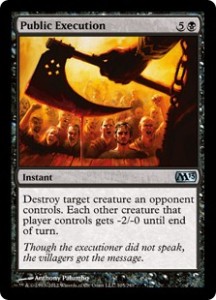
publicexecution

The reason why I stress the attendance aspect is because it directly impacts the amount of vendors interested in coming to the events. While big events like GP New Jersey or GP Las Vegas are great opportunities to buy and sell, Pro Tours are largely the opposite. According to the Wizards website, there were at most two vendors at Pro Tour Fate Reforged. There were three vendors at Pro Tour Khans of Tarkir, but none of the big names you would have expected to see made the trip to Hawaii. The last Pro Tour I personally attended was PT San Juan1 (what we would today call “Pro Tour Rise of the Eldrazi”), and there were actually a few big vendors there, but there was also the WPN Championship and a few other unique events happening there that same weekend.

A lack of on-site vendors means that players will often need to bring entire sets of Standard (or more!) to be personally prepared, or expect to pay a hefty premium to get the cards they want at the event. Add to this the fact that Pro Tours are occasionally held in somewhat exotic locales, and the scarcity becomes even more of a factor. Now, crazy “on the floor” prices for events are not anything new—but what they highlight is demand.

Widespread demand for a card means that several different testing groups have all “discovered” it, and that it factors prominently into the environment that is expected for the weekend. While the floor price most likely won’t stick in the outside world, the old one is sure to go up.

Something that is important to understand about Pro Tours is the impact that a restricted playerbase can have on a tournament. Since many of the elite players travel and prepare for the tournament far in advance, they are more likely to properly assess the hierarchy of threats in the format and develop a control strategy that is able to foil those threats. When given the opportunity, many of the world’s best players will opt to play a control strategy, as it typically is able to reward skill more than an aggressive approach. Perhaps to put it more accurately, better players will play decks that allow them to leverage their skill to an advantage. The upside here for us is that typically the cards that reward that style of play are more difficult to assess during spoiler season, and may currently be underrated.

Here are a few cards I am watching this particular weekend and why:

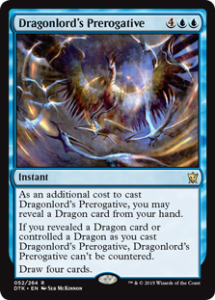
dragonlordsprerogative

Dragonlord’s Prerogative: I’ve been talking this up for a while, but the truth is that it needs to show up this weekend if it is ever going to. The “if dragon” clause doesn’t actually hurt you if you can’t meet it, and in some matchups it is going to be largely irrelevant. It’s good on rate, and buying in at the floor feels like a good opportunity (waka waka!).

Ojutai Exemplars: This card could very well be one of the best threats in Standard, or it could be a total bust. While the price has stayed pretty close to $7, the buylist price has actually risen since release. This could be indicating that demand for the card is strong and dealers don’t want to get caught with it out of stock.

The downside here is that if you go too deep on them, you’re going to be stuck with a bunch of copies of a white mythic four-drop that cost you $7 each. I’d snatch up a couple in trade as a hedge, or take a flier on a couple off of PucaTrade, but I’m not comfortable enough dropping about $30 on a set.

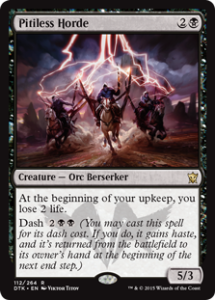
pitilesshorde

Pitiless Horde: Just like Prerogative, this card is so cheap that it won’t really destroy you if you don’t hit the mark on it. It’s a flexible threat that can be cast on curve in an aggressive deck, or very quickly close out the game in a control list. Black also has a lot of really sweet cards right now, so even a light splash for Thoughtseize is enough to cast this card reliably. Also, it matches up well against Ashiok, which seems like more than mere coincidence.

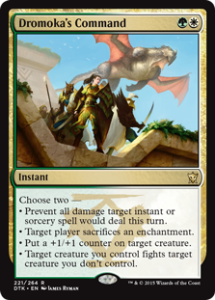
dromokascommand

Dromoka’s Command: In case you haven’t heard, I really like this card. I’m not sure about the financial upside here, since I’m not sure how much higher the price can go right now, but I wanted to be on the record that this card is bananas.

Dragonlord Atarka: This has sneakily gone up a couple bucks in the last few days. This is the kind of card that seems like an ideal target to try and cheat into play—and seems absolutely busted with multiple copies of Rescue From the Underworld. Of course, that is most likely not what is happening here, since a RG Dragons deck won the Standard Open last weekend (with two of these maindeck).

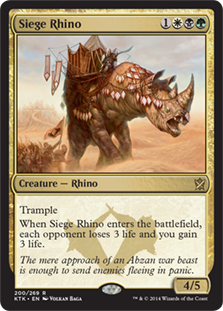
siegerhino

Siege Rhino: Haters are gonna hate, hate, hate, but he’s just gonna siege, siege, siege.

Deathmist Raptor: The card started presales around $5, and is now three times as much. If there is going to be a deck that takes full advantage of this card, it is at least being tested in preparation for this weekend. If it doesn’t appear, or the deck puts up an overall poor finish, these may begin to slip.

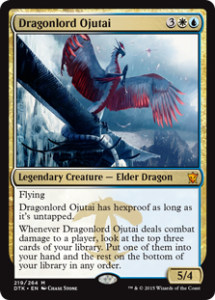
dragonlordojutai

Dragonlord Ojutai: This card has gotten expensive quickly. It definitely seems like a potential new UW Control finisher, but those typically only have one or two in the deck, not four. I actually expect this to start to go down, but if it does hit this weekend, I expect the deck to have four Dragonlord’s Prerogative in it.

Descent of the Dragons: Somebody is going to have an early feature match playing the deck that runs this and Battlefield Thaumaturge, and the hype train is going to briefly go crazy. The second you see this in round five or whatever, be ready to sell your Thaumaturges (if you have them). Neither card is something I like long-term, and the deck is, in all likelihood, not very good.

If you have any cards that you are watching, or want to talk about one I picked, let me know in the comments!

Deal or No Deal”

Pack Wars is a game-play variant that has a lot of different rules depending on who you ask. My favorite version, however, actually comes from the sports cards community: any number of players open a pack, and the player that opens the most valuable card wins all the packs opened that round. This is a great way to familiarize yourself with prices and bust extra packs. It’s very quick, though, and the suspense doesn’t build much (you pretty much know if you’ve won or not when you see your rare). Last week, my long-time friend (and local game store owner) Eric and I came up with an elegant solution that we call “Deal or No Deal.”

There are two ways to play—head-to-head or multiplayer. I think the first option is the most intellectually enticing to me, but the second one is what we have played the most. Either way, I’m getting ahead of myself, so here are the rules.

Head-to-Head Rules: Two players split the cost of a single booster pack (packs are $3 at Eric’s, so each player would pay $1.50). Open the booster without looking at the contents, remove the token2, and shuffle the pack. You may have a neutral third party randomize the pack if you so choose. Then, place the contents face down and spread out. Roll a dice to determine who goes first (or something more creative if you so choose). The first player will pick one card and reveal it and move it to the side. Now the second player makes their selection, reveals it, and moves it to their side. This repeats until all of the cards have been selected. The cards you picked, you own. Hopefully you got the better picks! The idea here is that if you play twice (or an even number of times), you have the potential to “break even” by getting a rare half of the time, but you could also win twice in a row!

Multiplayer Rules: Same basic thing, but each player contributes a pack. This way, there are multiple rares in the “pool,” a higher percentage chance for a foil, and more tension. It is also possible to get multiple rares for your $3 (or whatever your particular cost of entry is), so there is the sneaky potential for value. This mode is a lot of fun, because you can track how many rares have been revealed, and it seems there’s always one that doesn’t get turned over until the very end.

This game solves some of the inherent problems with other Pack War games. In the “best card wins” arrangement, the winner is simply whoever opens the best pack—you know right away that your Harbinger of the Hunt isn’t going to take down their Dromoka’s Command, and typically the only “excitement” is seeing which bulk rare has the highest TCGplayer median price. This also doesn’t have the value negative center that “Flip It or Rip It” has—it merely redistributes the pot, not destroys it. Next time I play, I’m going to record a round and post it.

Well, that’s all for this week. Good luck this weekend, and come on, Dragonlord’s Prerogative!

Best,

Ross

P.S. I’m interested in doing a mailbag article soon because they are less work because they are fun and people love them. Got a question? Submit it in the comments.

1 I went as a railbird, not a participant.

2 Obviously this is difficult to do if you are using Innistrad and Dark Ascension packs, since the check cards have Magic backs. If you are doing that, I say leave it in. Suspense!

We All Lose at Pack Wars

By: Cliff Daigle

We are about two months away from what is likely to be the biggest Grand Prix ever. Three sites worldwide, a format of Modern Masters 2015 sealed, and a cap of 10,000 players, of which 4,000 have already preregistered.

Las Vegas is a town that can handle such a crowd. That’s not the issue at all. It wasn’t an issue in 2013 when the Electric Daisy Carnival was in town the same weekend. There is no worry about finding a hotel, even with a holiday weekend involved.

My concern is that what you’re going to be spending to play in side events is not going to be a good return on your money.

Specifically, I’m talking about the lottery ticket that is opening booster packs.

There are instances where packs are worth it, but mostly, you’re gambling and losing…a philosophy that leads to casinos making billions off of the hopeful.

For me, and for you, opening packs is almost always a money loser.

I want to take five examples from Magic’s history and examine the value involved before making my case about Modern Masters 2015.

Case #1: Dragons of Tarkir

This is the new set, containing the new toys and the hot tech. Let’s say we can get a box for $100 even, including shipping and tax, a number that works out to roughly $2.75 per pack.

As of this writing, there are 26 rares and mythics that beat that price, and the set is only a few weeks into being sold.

Here’s the issue, though: there are 68 rares and mythics in the set, giving you a 38% chance of getting your money back per pack.

Let me put this a different way for you: You could buy a playset of Thunderbreak Regent, a playset of Dragonlord Atarka, and have enough for a set of Surrak, the Hunt-Caller…or you could buy a box that potentially has none of those.

Yes, you’ll get some foils, but the variance is not in your favor there either.

Case #2: Khans of Tarkir

How about Khans? There’s fetches, and Siege Rhinos, and lots more!

Well…no. Not really. As an in-print set, let’s say we get our box price down to $90. That’s $2.50 per pack, but as the set page shows, only 16 cards beat that price! At $2.62, one of them is the uncommon Monastery Swiftspear, so it doesn’t count. So 15 out of 68 means we have a 22% chance of making our money back with the rare.

Case #3: Modern Masters 2011

This set had the second-highest MSRP of any booster (remember, the Alara block all-foil packs were sold for $15!) at $7, and had a guaranteed foil in each pack. Currently, a box of 24 packs can be had for about $375, a price per pack of $15.60.

Of the 68 rares and mythics, a mere 13 beat that price. Elspeth, Knight-Errant is not pricey enough to earn your money back! Your success rate for nonfoils is 19%.

Case #4: Rise of the Eldrazi

Widely regarded as a blast to draft, this also has a host of expensive cards. The boxes go for about $600 plus shipping, giving us a pack price of roughly $17.

Only seven of the rares and mythics in the set beat that price, giving you a success rate of ten percent.

Case #5: Revised/3rd edition

Revised boosters for $50! As someone who bought lots of these for three bucks, half a Benjamin for one is stealing. It does not matter if you buy at the single rate, or the box rate of about $1800. Even if you got lucky on eBay and got a box for $1500, you’re still scratching a lottery ticket. There are exactly 10 cards worth more than $25 in the set, and no surprise, they are the duals.

Compounding the problem is that this edition has nearly twice as many rares as modern sets do: 121 of them, giving you a success rate of twelve percent.

One other note: don’t you dare buy loose packs, especially online. Box mapping is totally a thing and you will never ever snag one of those pricey mythics, and the foils will be looted out as well with use of a highly accurate scale.

For Revised and older, the packs don’t need to be mapped. The plastic of the booster is just translucent enough to allow someone a peek at the card located at the top of the stack if it has been slid up a little.

So what can we take away from all of this? Well, it’s clear that the best success rate is right now, with the newest set. Best, though, is still no guarantee, since it’s still 60/40 that you will lose money buying a booster pack and opening it.

This is going to be my philosophy with Modern Masters 2015, especially as the packs are $10 each. It’s possible that at first, there’s lots of $10 rares, and maybe by the time of GP Vegas, that will still be the case.

However, the more packs that get opened, the more the values will decrease as the supply goes up. This is a four-day event, and it seems reasonable to expect that vendors will be lowering their buy prices accordingly at the event as time goes on. So even if they are worth it at first, they won’t be for long.

I’m not saying you should never open packs, as you’re often paying for an experience. Some stores or events have $10 drafts, or Half Price Sealed type of things. Going to GP Vegas is going to be quite a time, and likely there will be some incredible stories. I encourage you to go and have that experience, but when it comes to calculating the value of the events (especially $75 side event sealed!) keep in mind that value is not always equal.


The Myth of Making Money

A few weeks ago, I was lucky enough to have a weekend away from work, and I decided to spend it at SCG Dallas with a few friends. We headed down on Saturday afternoon, and while we had vague plans of playing in the Modern 5k on Sunday, we all knew the trip was mostly just to hang out and have a good time.

And good times were had, no doubt. But that’s not the point of this story. While we did spend some time on the floor, it was mostly to trade. Specifically, I was on a mission: to find the last two foils I needed for my Modern Merfolk deck: a foil Oboro, Palace in the Clouds and a foil Mikokoro, Center of the Sea. They may not look like much, but they’re lands that make blue mana that don’t die to Choke… At least that’s what I thought. As you may have noticed, Mikokoro doesn’t actually make blue mana, and it turns out the card I needed all along was Minamo, School at Water’s Edge. Somehow I got confused and mixed myself up and missed out on a chance to trade for one.

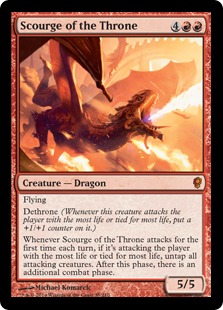
Anyway, I did manage to find an Oboro, and trading was had, with the usual rifling through each other’s binders and making small talk while we did so. My trade partner made a stop on a particular page of my binder, the one filled with a dozen or so Scourge of the Throne.

scourgeofthethrone

“That must be nice to have those, huh?” he prodded, referring of course to the small spike that Scourges went through a month or so ago.

“I guess so,” I replied.

And on paper, it is nice. I bought mine at $7 or so to fill a few orders at the LGS where I sell cards, and I grabbed a handful of extras in anticipation of Dragons of Tarkir. And it worked out great! After all, the card moved from $7 to $14 after I bought them. Must be nice, huh?

Today, those Scourges buylist for around $8. If I were to sell them, I would make about 75 cents a copy after shipping charges.

Not exactly paying the rent with that.

The Conversation That Started It All

“Marianne: So how did it go?

Me: It was okay. I went 3-1 playing, but I made like $30 trading!

Marianne: Great, so are you taking me out to dinner tomorrow night? Or are you going to buy me shiny things?

Me: Well, it’s more like “theoretical money.”

Marianne: So macaroni and cereal again?

Me: (sigh) Yeah, but I really like those!”

That’s what I wrote on December 22, 2010, when I was a dirt-poor sophomore in college just trying to put together some cards to play FNM (writing this makes me feel old). I’ve contributed a few things to the realm of “MTG finance” writing, but I consider the articulation of this concept the most important thing I’ve ever done in the field. Remember that in those halcyon days of 2010, smartphones weren’t a thing, trading was a great way to make value, Marianne and I weren’t yet married, and I loved eating macaroni and cereal (one of those four things still hasn’t changed, and I can report that we’re approaching our third wedding anniversary).

Another thing hasn’t changed. Then, like now, everyone wants to brag about their successful spec. “I just knew this card was going up!” people constantly shouted. Then when you see their binders full of the newly-expensive card (probably some garbage like Consuming Vapors, which was all the rage back then) and showing it off in the store. They would be so proud of themselves for getting in on the hot spec beforehand, and they would revel in all the money they made.

Twelve months later, I’d see that exact same binder when they came to sell to me, their Consuming Vapors now bulk again.

Tell me, did they really make any money?

The Myth of Making Money

Nothing, I repeat, nothing matters until you out a card. Whether that’s to a buylist or eBay for cash, or to another player in a trade, there is a hell of a lot more to making money on Magic cards than simply the price you acquire it for (your “in” price).

Your “out” price (the number you ultimately move it for) is even more vital. The difference between those two numbers (after shipping/fees of course) is the money you made on those cards. That’s it. It doesn’t matter how high or low the price went in the interim. If you didn’t move it when the price was higher, your $8 Consuming Vapors may as well have been $100 for all the good it did you.

It’s a lesson I learned the hard way in 2011, when I decided to speculate on Primeval Titan after the banning of Jace and Stoneforge Mystic in Standard. With the Caw-Blade menace leaving the format, things seemed wide open for the decks abusing Valakut, the Molten Pinnacle to return with force to the forefront. And I was quick to the party, getting my copies before the price predictably rose.

The only problem? I was racing the clock. A known reprint was coming in Magic 2012, and I was late in getting my copies listed and shipped. In the end I lost about $20 despite being “ahead” of the curve when the price spiked.

The Myth of Making Money™ strikes again.

It’s a lesson that people new to the finance scene seem to have to learn the hard way. Travis Allen went through the same experience last year (and made out better than I did), and wrote a great article about the experience.

The Myth of Making Money™. It strikes us all.

But it only has to strike once. Or, for those of you reading this today, hopefully not at all.

Avoiding the Trap

There are definitely a few ways to mitigate the risks that cost Travis and I so much.

Temper Your Expectations

First, have realistic expectations. If you see an $8 card and believe it can push $11 or $12, think twice before you buy into it. Using Scourge of the Throne as an example, it took the card nearly doubling up for me to break even on a buylist. And the truth is, if you’re speculating on a card to resell, buylists are likely going to be your best option if you bought more than a playset or two. Know that whatever you buy, you need to reasonably expect a double-up before you can expect to get your money back after shipping.

Trading

Trading for cards is a good way to eliminate some of the upfront costs, given that the “true value” of your $8 retail card is closer to $4 or $5 in cash. If you can use that card to pick up the $8 card you want to spec on, you’re getting yourself a much better deal than buying in it for actual dollars.

Go Deep

If you feel strongly enough about a card to move in on it, do it for enough copies to make it worth it. Having a playset of a card you knew was going to strike it big is great, and you’ll have those to play with, but if you do feel strongly, don’t be afraid to go deep. You have to risk it to get the biscuit, after all.

Account for All Costs

When I mention the costs here, I’m sure the first thing that came to your mind was postage. And it’s true, that is a major cost. But it’s far from the only one and, I would argue, not even the most important.

Your time is a cost, and your time is worth money. Spending time researching and buying a spec, or trading into it, is time you aren’t spending playing Magic or hanging out with your girlfriend or delivering pizzas for some extra cash. If you’re going to look toward this as a way to make a little money, you must absolutely account for the cost of your time.

Do It for the Story

I have one other piece of advice when it comes to speculating.

I’ve explained the Myth of Making Money™ today, and I hope it helps you understand that making money on “MTG finance” is not anywhere near as easy as some people paint it. It’s work, and it can be hard work with little reward. In almost all cases, your time is better spent delivering pizzas if you’re looking for some extra money.

But Magic can give you something that Pizza Hut can’t.

The memories.

Nobody is retiring off of money they made flipping some Magic cards over the weekend. But you may be able to foil out pieces of your Commander deck by doing so. And when someone comments on your cool signed foil Fifth Dawn Eternal Witness, what’s a better story: that you made enough money to get them from your out-of-right-field spec on Death’s Shadows, or that you delivered some pepperonis to buy it?

One of my favorite pieces to ever write was the story of how I sold my fetch lands that I had spent years acquiring through trade. In the end, I sold them for about $25 apiece, far from the heights they would later reach. But I don’t regret the decision. It was the completion of a story a long time in the making, and it’s one I remember vividly today. Hell, even stories where things go wrong (like my 94 Splinterfrights) are worth it for the story later. I keep that pile on my desk as a reminder that we can all screw up, no matter how long we’ve been doing this. Sure, I lost some money on that spec, but it’s a fun story anyway.

The Myth of Making Money™ is a vital concept for anyone getting into Magic finance to understand, and you won’t ever truly succeed in this field until you do. If you believe in a card and want to try your hand at speculating, don’t be afraid to do it. But make sure you give yourself a chance to succeed. And, for your own sake, enjoy it.

You may make some cash, or you may not make any money at all. Just make sure you make some memories along the way.

Thanks for reading,

Corbin Hosler

@Chosler88 on Twitter

MAGIC: THE GATHERING FINANCE ARTICLES AND COMMUNITY