UNLOCKED PROTRADER: Gods and Generals, Part 3

We’re at the end, readers. You made it through the first two parts, and I think some of you are pretty excited for part three. I can’t pretend I’m not excited myself—I called Purphoros as my pick of the week in the latest episode of Brainstorm Brewery, a podcast I hope you’re all listening to. You get it a day before the rest of the plebians by virtue of being a ProTrader, so that’s pretty cool. If you think my opinion is worth reading, why not give the podcast a listen?

Is that a bad endorsement? “Listen to the podcast where I mention Purphoros a week after I wrote about him!” Look, I don’t have to justify myself to you nerds. I just felt I’d be remiss if I didn’t plug the podcast where you get to hear three other finance experts agree or disagree with my called shots. I don’t imagine this is a super tough sell to a bunch of finance article readers, but what do I know? Besides what I think about the last five Theros block gods, that is.

We saved the best for last, I think, and my favorite god of the 15 is going to get a really in-depth look. I’m excited to write up this last batch, so forgive me my digressions. I’m sufficiently pumped now. Let’s do dis.


Athreos, God of Passage

Untitled

$10?!

3tm4cj

Athreos certainly got a ton of buzz from its release, and why not? The card looked and smelled an awful lot like some other cards that existed in a similar vein, only it seemed better.

Untitled

Though it failed to do much financially, Immortal Servitude was the basis for a (tier, like, 10) deck that was fun to play and that’s about it. But what if your Immortal Servitude effect were on a permanent and getting enough dudes into play let that permanent attack? People had enough experience playing the gods to know that if Thassa could get there, Athreos could certainly do so too, given its low mana cost and inherent unfairness. What would we do with this? Run wraths to take us to value town? Loop Elvish Visionary for value? Whatever it was people thought they were going to do, they mostly haven’t. Athreos hasn’t made much of an impact if any on Standard, and its price has stayed within a couple bucks of $10 basically as long as it’s been a card.

Could EDH be a reason for this? Certainly it could. I think Athreos is absolutely the top choice of general for a deck with lots of Shadowborn Apostles in it. Does that make it a $10 card on its own? No. Athreos is a fine commander in other builds as well, but I think third-set stickiness is propping the price up to an extent. Can we rule that out if we see the other generals coming in cheap? We’ll cross that bridge when we get to it. If EDH is really the culprit here, will we expect to see that reflected in the foil price? Yes. Yes, we will.

Untitled

You’ve got to be getting pretty good at analyzing these graphs by now. What do we think? A multiplier of three on a card that already seems pretty overpriced? Is Standard doing that? Or is EDH?

Personally, I think we can see EDH’s influence here pretty significantly. The price looks so flat compared to the non-foil, which means copies aren’t moving very quickly, but quickly enough for the dealers not to change their buy prices. Honestly, $30 may be just about perfect, which for our purposes, is actually a bad thing.

We want our gods to be the wrong price or to look like they’re going to be the right price soon. Athreos seems neither. With EDH propping the price up as well as third-set scarcity, I don’t expect the foil or non-foil to drop a ton at rotation. Certainly the non-foil has room to fall, but the foil likely isn’t going anywhere, either up or down, in the near future. I am a 2/5 on this card both in foil and non-foil.

The non-foil does have some chance of getting more reasonable at rotation, but dealers are actually cutting their buy prices rather than raising them. Could that be in anticipation of the price coming way down soon or is it in anticipation of people wanting to ship a ton of these while the buy price is $5 and the dealers would end up stuck with cards they paid $5 for and can’t sell for $4? I think it could be a bit of both. What I see is low demand and a high price for this card and both those factors kind of suck.

Is Athreos good in EDH? Sure, but all 15 cards sort of are, and I’m not bullish on the ones where I don’t see room to make a profit. I could be persuaded to go in one these at like $4, which seems unlikely but not impossible. I’m certainly keeping an eye out.

Iroas, God of Victory

Untitled

Remember what I said about third-set stickiness? Well, here’s a great baseline. Worth half as much as Athreos but well below half as playable, Iroas never made an impact in Standard. This card is $5 for the same reason Godsend is $5: it has a non-zero amount of casual appeal, it’s in a durdly third set with not a lot to be excited about, and it is technically not unplayable in EDH. I could see Iroas getting there as a utility-enchantment-cum-beater in a deck with a different commander, like Jor Kadeen, but I’m not jazzed about him otherwise. Neither are dealers, who are cutting buy prices significantly, probably in anticipation of rotation. While the price is relatively flat, dealers have tried to pay as little as $2 for this card. I’ve seen people no-sir offers of $4 on Godsend before so nothing surprises me a ton, but I don’t see demand for this. Heliod at $0.75 tells me gods have a long way to fall, some farther than others. I’m a 1/5 at $5 and a 4/5 at $0.75. I imagine you will be able to get them for somewhere in the middle, but unless it’s closer to $1, I don’t know that you want to.

Untitled

A multiplier of three, as well. That’s very interesting. It kind of puts the multiplier on Athreos into perspective, doesn’t it? When I said, “This price is likely due to EDH,” above, I think what I meant was, “This price isn’t not EDH,” but judging by Iroas, a mostly-ignored card, the multiplier appears to be some sort of weird standard.


Quck aside: Isn’t it fascinating that the gods seem to get their cues vis-a-vis their prices from their expansion set rather than their playability? It’s a good thing I grouped these by set or I may never have noticed these trends. I literally almost did all 15 gods alphabetically the first week. It’s a good thing I write too much or this could have been a mess and we would have learned way less. Should we predict the same multiplier for Kruphix or Keranos? Absolutely not, but nothing would surprise me. However, if we do see that for Pharika, I think we can pretty safely conclude the multiplier is a supply issue. I’m interested to see what we come up with when we get there.


As for Iroas, I feel the same as the dealers who have been slashing their buy prices. I’m like a 1/5 at its current foil price. You’d have to make these pretty cheap to make me get into the 3/5 or 4/5 range. Like, if current buy price became the new retail price, I’m probably a 3/5 at the price dealers are paying then. Maybe even not that. Iroas seems like this set’s Heliod or Ephara.

Keranos, God of Storms

Untitled

I have been quoted numerous times saying, “If it weren’t for EDH, only about 100 Magic cards would be worth more than $1.” While I think that’s true and smile whenever I hear someone repeat it, we can acknowledge that Modern has been a real bro and made some cardboard worth some moolah. Thanks, Modern!

Keranos was touted as a Modern option, and while that hype appears to have trailed off, dumping Keranos nearly back where it was before all the hype, I expect its EDH playability to have a real effect on the foil. I understand why Keranos was $20 for a while—what I can’t figure out is why it’s the same as Athreos.

EDH clearly can’t pull the non-foils above $10 unless the card is played a ton (like I imagine we’ll see for Kruphix) and the dive back to $10 seems to indicate that Modern demand has all but evaporated. Keranos was never more than a one- or two-of in Modern anyhow, and that can mimic EDH demand in some ways. I expect expensive foils if only because we won’t see the race to the bottom the way we did with the non-foils.

Keranos may not be played in Modern as much anymore, but the fact that it’s an option can work both for and against us. Price memory is going to make the price stickier come rotation, which makes me pretty bearish on the card unless it comes down more than it probably will.

While the buy price for most of the rest of the gods is tailing off, Keranos is actually increasing. Dealers are going to buy super aggressively if the spread is low at rotation, making it harder to get your hands on Keranos and limiting the chance the price falls below where the buy price is now. Do I like these at $6? Not a ton, no. They’ve demonstrated an ability to be $20, but you’d have to think that will happen again to pay $6. Should these miraculously fall to $3 or $4, I’ll change my attitude significantly, but this still won’t make it past a 3/5 in my excitement. My money is better-invested elsewhere, in my opinion.

Untitled

Yuck. You see the price spike as a result of Modern, but the price has not come down the way the non-foil has. I don’t think EDH is the culprit for the price staying up as much as scarcity is. See those “mini” fluctuations? Those point to a very, very low supply. If one or two purchases can upset the price balance, you’ll see little jumps like that when the stock is completely bought out by virtue of buying a small number of copies.

So the demand is non-zero, but if buying a few copies can make the price “twitch” like that, steady demand would completely wreck the price and we haven’t seen that. I’m not super bullish on the foils here, honestly. EDH demand isn’t going to put much upward pressure on the price and buy prices aren’t really moving despite the retail price coming down a smidge. This graph is ugly, folks. I’m like a 1/5 for foils and I don’t get to a 2/5 until the price gets somewhere the price won’t get.

I have a good feeling about this next one, though.

Kruphix, God of Horizons

Untitled

Get. Hype.

This is what opportunity looks like. Cheaper than Iroas, steadier than Keranos, more playable in EDH than Athreos—this card has it all. The spread is currently pretty wide, so even dealers aren’t really on this guy. However, Kruphix is the most EDH-playable out of the crop it’s in and its price is not reflecting that fact.

I’m a 3/5 on this card at its current price, and if it gets really cheap, I’m even deeper. This is never going to get the boost Keranos gets from Modern, Athreos gets from casual, or Iroas gets from the people who have made Godsend $5, but it does get help from being very good.

Don’t let the low price fool you, as it’s a good thing. This card is unplayable in Standard and that has made its price plummet, but it has a ton of upside and I’m deep on these if I can pay what dealers are paying now. I want a big old pile of these. This is Purphoros-tier as far as I am concerned: useful in decks but best as a commander. Let’s see if the foil agrees with us.

Untitled

Here’s a nice gut-check. The prices are very low for the foil and the non-foil. Did we misevaluate something? Is Iroas more playable than we think? Is Kruphix worse than we think? Did I overreact to the cheap price because I don’t understand that it’s cheap for a good reason?

Let’s check our multiplier, shall we? What’s that? It’s five? Not only that, it’s been five forever? I think that tells us that we’re onto something. Not only that, it tells us we have real upside on the foils. If the non-foil is $4, then that multiplier gives us $20 foils. If the non-foil hits $10, we’re looking at $50 foils, provided the multiplier holds.

And why shouldn’t it? This is a real EDH card. If I can pay what dealers are paying now for foils, I’m a 5/5. I don’t expect that to happen and I am still a 2/5 at its current price. If it doesn’t fall at all, I may buy a bit down the road if I start to see any upward movement at all.  Kruphix is money, and I am glad there is actual opportunity here.

Pharika, God of Affliction

Untitled

This was pretty heavily touted early by the likes of Conley Woods, but it never made the impact on Standard anticipated. EDH isn’t propping this up more than it’s propping up Kruphix and the few times it’s flirted with $6 are confusing and an insult to the god of horizons, frankly.

We can really see the relative difference in distributions between sets here: both the distribution of the cost of a redemption set over the total cards in Journey into Nyx and the distribution of Theros relative to Journey. We have $1 Heliod and that’s a damn sight more playable than Pharika, even though Pharika is a general people are going to try and try to build around.

I’m losing steam, folks. I saved a card I don’t care about for last.

Dealers are not thrilled about this card, so why should I be? At the $1.50 dealers are paying, I think this is okay, since in a few years, even bad gods strike me as $5ish cards (I’m basing this off of what we saw with planeswalkers when there were relatively few of them), but I’m not going to throw cash at Pharika at basically any price. This is played a bit in EDH and that could indicate upside if we’re buying very cheap. The foil can tell us how much EDH play there is.

Care to try and guess the multiplier for the foil?

Untitled

Did you guess a multiplier of six? I will admit I did not. Not only is it six, it has been for a while and dealers don’t appear to disagree! That’s wacky.

Is EDH propping this up? It must be that, which makes the non-foils a bit more attractive but leaves a lot of questions unanswered. The plateau indicates there isn’t a ton of sales-action happening, but a race to the bottom would throw the price into at least a bit of disarray. This is honestly just mostly puzzling. Still, if the price is this flat and irrespective of Standard play, there is little potential movement in the price at rotation. I’m not bullish on these at the current price. If I could buy at buylist, sure, fine, but I don’t see this being as good a pickup as Kruphix, although that could be pure bias.

Objectively, this card looks strong, but subjectively, I’m not jazzed. With Kruphix seeming like a better pickup, why would I hedge my bets anyhow? Still, if you clicked the link and looked at how many Pharika decks there are (gorgon tribal could be a thing, I imagine, but Damia or Sidisi seem better for that), you might feel differently than I do. I’m leaving these alone, so more for you, I guess.

Something Something Omega

That concludes my series on gods. I’m a little saddened by this realization, because I enjoyed writing this series and how much good feedback I got from all of you about it.

I’ll be back next week with something different, so stay tuned for that. You won’t want to miss the next series I potentially start because I can’t keep it under 10,000 words. Leave your questions and comments in the section below and let’s make some money.

Going Mad – It’s Time to Start Thinking About Rotation

By: Derek Madlem

“It’s probably a little late for that one Derek”
-some guy that hasn’t read this article yet.

Late? Or early? No, I think I’m proceeding right on track here. We’ve grown accustomed to the 24 month life cycle of Standard. When Theros hit store shelves, we knew that we could settle in for the long haul because this was going to be a part of Standard for TWO FULL YEARS. We also knew that one year into that two year term that Theros cards would likely hit their all-time high price as Return to Ravnica block rotated out and Khans of Tarkir rotated in.

Timing this price point was a time-honored secret for success for a long long time. We used to watch Block Constructed results from Magic Online and at the Pro Tour to help us determine which cards were going to be exceptionally powerful going forward. While these results helped us hone in on format superstars like the “Mythic” deck during the tail end of Shards of Alara Standard, most of these picks were painfully obvious like Stormbreath Dragon or Elspeth, Sun’s Champion.

We knew to pick up Elspeth’s when they bottomed out at $20 because we could easily unload them at a higher price once Khans of Tarkir was released (ended up being at $30). We also knew that the back side of that last year was a slow slide from the price peak to basically nothing.

It’s Different Now

Your Theros cards are worthless. Yes, basically all of them. Arguments can be made for cards like Sylvan Caryatid and Courser of Kruphix in Modern, but let’s not get too carried away because these cards certainly don’t see anything resembling “regular” play in Modern and there’s a metric ****ton of them in the wild right now.

But Theros is not what I’m talking about. I’m talking about Khans of Tarkir and Fate Reforged. Something that nobody’s really mentioned yet is the new economics of rotation. As Theros and Magic 2015 rotate in September at the release of Battle for Zendikar, Khans is already going to be rotting in your binders. Why’s that?

Six months to live. Yeah, that’s a thing. You might not realize this, but Khans of Tarkir was born with a birth defect common to all sets going forward: a shortened life span. While many of it’s ancestors lived to the ripe old age of 24 months, Khans is only going to see 18 and Fate Reforged is going to fare even worse: 15 months.

So that means we need to rethink cycles and card prices and we also need to acknowledge that in relation to when Khans is rotating, we’re already past the traditional “peak” of one year before rotation.

Seasons Still Matter…

… but not as much as they used to. Some of you may not remember this, but PTQ season formats had a real impact on card prices. Back when Extended was a thing for three months a year, there was a massive sell-off at the end of every season because these cards were simply useless for 95% of the population for nearly an entire year… could be longer because we didn’t know when a format would come back around.

Right now we’re in the middle of a PPTQ season that’s featuring Modern. This means that outside of Grand Prix’s and the SCG Open Series that there is little reason to keep an arsenal of competitive Standard cards, and many of the prices already reflect that sentiment. Take a look at one-time all star Whisperwood Elemental, this card has nearly halfed in value since it’s peak in March ($15-$8).

Modern Masters Effect

I would be doing a disservice if I didn’t point out the obvious: there’s only so much money available in the Magic economy at any given time and Modern Masters 2015 is drawing a lot of that water right now, both directly and indirectly. There were a lot of pent up desire for Modern cards. Many players were waiting for this set to “make their move” into Modern and they’re coming on board in large numbers, which is one of the primary reasons so many card prices are going ape right now (pro tip: it’s not speculators).

With MM2015 on the horizon, many of Modern’s card prices “locked in” because of the uncertainty of what was going to be reprinted. Nobody wanted to go out and drop $200 on a Tarmogoyf if it was going to get reprinted in a couple months. If Tarmogoyf was confirmed early to not be in MM2015, we’d probably be looking at $250+ Gofys right now, but that impending reprint kept that price in limbo. You can repeat this example with just about any card that’s gone up in the last month. Pro tip: it wasn’t a spike, it was a correction.

The Point

Ahh, finally we get to the reason for all these words: some of your Khans block cards are already dead and should be abandoned ASAP. Like what?

Dig Through Time

Like Dig Through Time for example. This card is the unbending backbone of blue decks in Standard. Dig is amazingly powerful, which is why we’ve seen it banned in Modern and watched as it makes a really strong case for being banned in Legacy as well. What’s that mean for those Digs you’re sitting on?

BULK BOX

Dig Through Time is going to be a bulk rare in the very near future. There are roughly a billion-kajillion of these in existence and anyone that needs them for Legacy already has them. Sure there might be some casual demand for this card in Commander, but it’s power is diminished substantially in 100-card singleton formats.

Whisperwood Elemental

Whisperwood, as mentioned above, has fallen from grace. This card is clearly awesome, but it just exists in the wrong space and time. There is virtually zero chance this card sees Modern play after rotation as it’s simply outclassed by cards like Thragtusk. Legacy? Not a snowball’s chance. There’s also just too short a window for this card to curve out. While there’s sure to be casual appeal for this card for years to come, it’s not going to be enough to sustain a price above $3-4… if that.

Sarkhan the Dragonspeaker

Dragons are sweet.
Planeswalkers are sweet.

So this should be worth a million dollars right? That’s what we thought when he first showed up. We quickly figured out that he’s not really good in Standard and his price reflects it. Sarkhan, the Dragonspeaker is hovering around $5 solely because his card says “Planeswalker” on it. This is not going to show up in competitive decks past Standard so that demand is going to be tied to casual demand only. The good news is that he’s unlikely to go much lower without a Duel Deck appearance, but he’s almost certainly not going to go rise this fall.

Sorin, Solemn Visitor

Sorin, Solemn Visitor has a much better chance of mounting a slow and stable recovery as he’s replaced his previous self in all those B/W token decks in Modern. He’s still at a great risk of a Duel Deck reprint thanks to being a vampire and that whole tick craze still sputtering along. But how has Sorin fared in Standard lately? Yeah, exactly. Not exactly inspiration for a big investment. This is another card that’s not going to tank outside of a Duel Deck reprint, but it’s going to be a slow climb moving forward.

Anafenza

Anafenza, the Foremost is still a card that I feel suffers from “too much textbox syndrome”. People just forget that whole secondary clause about exiling creatures instead of allowing them to hit your opponent’s graveyard. I was very bullish on Anafenza as a Modern contender because she did a great job of hosing many of Birthing Pod’s shenanigans while still being a fairly insane addition to basically any Abzan deck that attacks with creatures. But as Fleecemane Lion leaves Standard in search of a new mane wig, Anafenza is going to be left behind with a short window and few allies to help her prove worthy of a higher price. Anafenza’s likely going to pull an impression of Thalia, Guardian of Thraben in Modern and possibly Legacy, only showing up in niche scenarios as an oversized hatebear. I’m not going to be surprised to see these as low as $2 by / after rotation.

Brutal HordechiefIn case you haven’t figured it out yet, Brutal Hordechief isn’t Hellrider. You can spend the rest of your life looking at the text box trying to figure out how this card never became a thing, but my bet’s on the fact that it’s a Hill Giant and nobody likes a 3/3 for four mana. You can lump Shaman of the Great Hunt in with Hordechief as a promising young athlete that failed to make it big in the NFL because they got drafted to the Lions or the Raiders. The lack of compelling teammates doomed both of these cards to mediocrity and there’s no chance for recovery. These are already on the cusp of bulk Mythic and I expect to them to retire as such, maybe they can open a car dealership or something.

Crux of Fate

Do you know what a $1 board wipe looks like? It looks just like a $6 board wipe except it’s rotated. There is not much hope for Crux of Fate after rotation because in a vacuum it’s pretty crappy compared to cards like Supreme Verdict or Damnation. These are already slipping as people figure out that playing mirror matches in the draw bracket all day is the very definition of Standard Hell, but you can still get out at $3 if you want to save a little of that value.

Everything Else

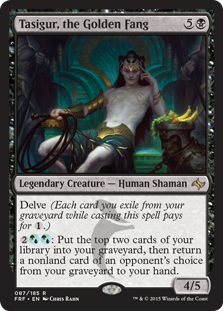
Obviously the fetchlands are pure gold. they’re going to retain the bulk of their value and continue to grow incrementally going forward. Tasigur, the Golden Fang, Monastery Mentor, Soulfire Grand Master, and Ugin, the Spirit Dragon are basically the only rares outside of the fetchlands that I don’t see cratering as they leave Standard. Even Siege Rhino is struggling to hold onto that $5 price tag and he was an absolute BOSS. If you have Standard cards that are worth more than $1 that you are not going to need in the next nine months, it’s time to ship them. There’s a very short window for recovery and most of these cards are unlikely to be lifted by it.

Except for maybe See the UnwrittenELDRAZI!!!!

edit: I think people were missing the point of the article by a fair margin. I’m not saying that all of these cards are worthless now, I’m trying to point out that we have a new rotation starting with this set so we’re likely to see things behave differently this time around and you will not have as much time to divest from Khans block as you have had in the past. Couple that with the reality that most of this block has no life past Standard, you’re in for some Temple of Epiphany sized losses if you don’t plan ahead.

Announcing Unlocked ProTrader Articles

Hello everyone, Corbin here!

You may be used to seeing my name when my column comes out on Thursdays, but I also handle of lot of editorial duties around here, and today that means I’m lucky enough to make an exciting announcement: the first batch of ProTrader-only content is now free for everyone to read!

Dig Through Time

We run both free and ProTrader-exclusive content here, and while I believe all of our content is of the highest quality, the writers on the ProTrader side tend to focus on more immediate calls for those looking to stay as far ahead of the market as possible.

But we don’t want to hide our content away behind a paywall forever, so all articles here will unlock after 45 days. WIth the launch of ProTrader-exclusive content last month, that means I have some great pieces to share with you today, many of which are still extremely relevant today.

Remember, if you like what you see here, I hope you’ll consider signing up for a ProTrader membership, which in addition to exclusive article content gives you access to lively forums, advanced statistical tools and more.

Enough preamble, onto the content!

Sigmund Ausfresser – Advanced economics of MTG finance, Part 1

Part 2

In a must-read two-part series, Sigmund Ausfresser details some of the advanced underlying economic conditions that make Magic’s secondary market just so vibrant.

Danny Brown – Planeswalker Finance

Planeswalkers are the face of Magic, and there are plenty of them in the game. Danny Brown breaks down exactly how they line up financially.

Travis Allen – Safety Deposit Boxes – Khans of Tarkir

A huge part of Magic finance is always looking ahead, and in this article Travis Allen identifies which desirable Khans of Tarkir cards have bottomed out.

Corbin Hosler – Why I Love Casual Magic, and Why You Should Too

Corbin Hosler – Casual Hits of 2015

Anyone who’s followed my own content knows I love investing in long-term casual cards, and I explained exactly why in this piece, with a follow-up piece chock-full of great casual speculation targets.

Guo Heng Chin – Spikecatcher 

Guo knows how difficult it is to stay ahead of the market, and in this article he gives a few tips to make it easier on yourself.

Ross Lennon – The Coming Storm

At this point Modern Masters 2015 was just beginning to see spoilers, but Ross Lennon was already ahead of the game, prepping readers for the impact it would have.

Remember what I said about timely calls? This was published on May 1, and Ross included this tip:

At some point you have to expect Magus of the Moon to start climbing. That card was in one set, and that set wasFuture Sight, so it almost doesn’t even count. Plus, do you remember the 8-Moon decks? I sure do, they were sweet. I’m tempted to just buy a ton of magi right now for retail. 

On May 1, Magus of the Moon was $9. Today, it’s $19.

Guo Heng Chin – The Meta Report 

Part of an ongoing series, Guo looeds over the most recent results in the Standard metagame to keep readers updated and find the latest targets.

Danny Brown – Assessing the Risks of Speculating

It’s sometimes a dangerous game we play, and Danny does a great job in this piece detailing what those risks are and how to manage them.

Travis Allen – A first look at Modern Masters 2015

With the Modern Masters 2015 spoilers coming in quickly, Travis wrote a solid piece analyzing what the early movements looked like.

Ross Lennon – Silver and Cold

Part of an ongoing series, Ross Lennon looked back at Coldsnap to evaluate the set for any financial opportunity hidden in the Dark Depths of the set.


There you have it! A great set of articles, and just a small sampling of what you’ll have access to with a ProTrader membership. Thanks for taking the time to stick with us, and I hope you’ve enjoyed the unlocked content today!


– Corbin Hosler

UNLOCKED PROTRADER: Taking a Closer Look at Demand Sources

Imagine if Wizards of the Coast told us exactly how many packs of Dragons of Tarkir had been sold so far. We know how the cards are distributed, so with an accurate pack count, we could determine precisely how many Dragonlord Atarkas there are in the wild and compare that with the numbers for Fate Reforged and the amount of Monastery Mentors in existence. Armed with that info, it would be really easy to pinpoint where cards were in short supply and buy accordingly.

Unfortunately, Wizards does not publicize that information, or at least not very often. We get hints about proportions (“X is the best-selling set of all time!”) every so often, but ultimately, we’re left to determine supply based on anecdotal data and broad assumptions.


Sure, it’s pretty easy to say there’s a lot more Innistrad out in the wild than Lorwyn, but by how much? We don’t really know, and can’t with the amount of information we have at our disposal. And things get murkier when we start comparing recent sets. How does Dragons of Tarkir compare with Journey into Nyx? Or Dragon’s Maze? We can broadly assume that Dragon’s Maze was unpopular so there’s probably far fewer Voice of Resurgences out there than there are Dragonlord Ojutais, but it’s all guesstimating—we are just not in a position to know what the actual card counts are on these cards, or any cards for that matter.

So while the pattern over the last decade or so has been one of extreme growth (and thus ever-increasing amounts of supply), we know the proportions between set printings in only the broadest terms. Again using Dragon’s Maze as an example: we know it was an unpopular set, but we don’t have the numbers as to just how badly it actually performed. If we did, we might find that Voice of Resurgence is greatly over- or underpriced when we consider the actual number of copies out there.

Way back in 2013, Anthony Capece, a former writer for BrainstormBrewery.com, did some very important work for the community in shining a light on some of these supply issues. Those articles, “Rare is the New Uncommon” and “Size Matters,” should be required reading for every single MTG financier, so if you haven’t read them before (or even if it’s just been a while), click those links. They’ll open in a new tab and everything, so you don’t even have to stop reading here.

Anthony did some great investigative work to come to rough estimates on supply of new sets compared to old ones, but we still don’t have the exact numbers. However, just like Magic is a game of imperfect information, so is MTG finance, and our job is to take action based on the information that we do have available.

Courser of Kruphix versus Gilded Lotus

Let’s compare two very different but similarly priced (at time of writing) cards: Courser of Kruphix and Gilded Lotus.

courserofkruphix

Courser derives most of its value from Standard play, though that value is tapering off fast from a high of over $20 to the current price of $6. The card has seen a little bit of Modern action, as well, but doesn’t make the MTG Goldfish list of the top 50 creatures in the format. To top it off, Courser isn’t exactly undesirable in the most popular casual formats, Commander and Cube. 

Despite being good outside of Standard, most of Courser’s historic price comes from Standard demand, where it has been a complete staple and almost always a four-of. The price loss over the last several months is almost certainly attributable to the upcoming rotation, and we may still lose some more off the price by the time we lose Theros block from Standard.

gildedlotus


Alternatively, we have Gilded Lotus, which saw no Standard play after it was last reprinted in M13. The card derives all of its sharply increasing value from casual play, as there’s a copy in most cubes and in most Commander decks, but nary a single competitive deck wants something like this (cue someone linking to a Vintage deck that just needs to Tinker out Gilded Lotus for some reason).

Delving Into Hypotheticals

I love data, but unfortunately, we just don’t have enough of it to determine exactly why these cards are virtually the same price despite such different demand profiles.

Hypothetically, let’s say the demand comes from the following:

Courser of Kruphix

  • 35% of Standard players need four copies of this card for a Standard deck (reasoning: MTG Goldfish cites Courser of Kruphix as being a 3.8-of in 35.94 percent of Standard decks).
  • 20% of Commander players need one copy for their decks (reasoning: this is good in any green deck, and theoretically, one-fifth of decks in Magic are of a particular color).
  • 90% of cubes need one copy (reasoning: some cubes have special restrictions, but this is good enough to warrant an include in most lists).
  • 5% of Modern players need or want to have available four copies for a Modern deck (reasoning: it’s hardly a staple in five-percent of decks, but some players need to have everything).
  • The Invisibles playing wild card.

Gilded Lotus

  • 90% of Commander players need one copy for their decks (reasoning: some aggressive decks might not want this, but it’s a colorless fixer that ramps to giant fatties and can go in literally any deck).
  • 90% of cubes need one copy (reasoning: some cubes have special restrictions, but this is good enough to warrant an include in most lists).
  • The Invisibles playing wild card.

Again, these are just numbers I pulled out of thin air—they’re here only for illustration’s sake.

If these numbers were accurate, do you think we could use them to determine the total number of active players in each format? I hope you’re saying no, because these numbers are not accounting for the mystery I discussed during the first part of this article: how many copies of each card is actually in existence.

We just can’t fill in enough of the variables to fully solve the equation. This is why no speculation target is ever 100-percent safe: we (the MTG community) do not have enough information to know for sure that there is or is not enough of one particular card to satisfy the demand from all players who might want one or more copies for whatever reason.

Using the Tools We Do Have

Still, I think the exercise of going through where a card’s demand is coming from can really help to streamline one’s thought process regarding a card one is considering buying. Several MTGPrice writers have (rightly) been harping on three major targets from Khans of Tarkir block, so let’s consider where the demand might come from for each of these moving forward.

Siege Rhino

I have not bought in to Siege Rhino, but the card is an extremely interesting case. Normally, a three-color card has very limited upside, as only a select few decks can play it, but we’ve seen Standard and Modern decks designed essentially because this card is powerful enough to warrant it.

Still, there’s pretty much a maximum of one deck in Standard and one deck in Modern that wants this card, and even if those comprise a huge part of each metagame, there’s not any cross-deck applicability to really keep Rhino’s price up.

Further adding to my concerns is that this isn’t going to be in hardly any Commander decks or cubes, given its limited upside in the 100-card battlecruiser format and the limited space for three-color cards in most custom drafting environments.

Just piling on to my concerns, it’s a rare from a large fall set, and if you read Anthony’s articles that I linked above, you’ll know why that’s bad.

In summary, when I started writing this section, I thought that Siege Rhino was a fine pickup (if not as good as others), but now that I’m finished, I don’t want to be buying into this at $4. Yes, it’s good enough to warrant decks designed around it, but the assumed supply is as high as cards get and its applicability is highly specific, despite its power level.

Tasigur, the Golden Fang

Tasigur, on the other hand, is awesome. Delve cards aren’t automatic four-ofs, but even if Tasigur only sees play as a three-of, he’s wanted in Legacy, Modern, Standard, Commander, and Cube, and has plenty of applicability in all kinds of decks from aggro to control.

Again, he suffers from being rare and not mythic, but in this case, we’re looking at a small set that didn’t sell for nearly as long as Siege Rhino’s Khans of Tarkir.

It’s easy to envision much more demand for Tasigur than for Siege Rhino, and it’s also fair to assume the supply is lower. Considering it’s already begun its ascent, the MTG finance community seems to agree.

See the Unwritten

See the Unwrittenon the other hand, has gone down since its initial surge in popularity in response to the announcement of Battle for Zendikar. It’s now just above $3, and it has a much different demand profile than Siege Rhino or Tasigur.

With See the Unwritten, we’re speculating not on current playability in Standard or eternal formats, but on future playability with the assumed Eldrazi coming in BFZ. Initially, this seems riskier than something like Siege Rhino, and maybe it is.

But I have bought in to See the Unwritten, unlike Siege Rhino. The reasons are three-fold:

  1. I strongly believe there will be Eldrazi in BFZ.
  2. The Standard Eldrazi deck might be good, but even if it’s not, this is a mythic and people will want to try out the deck.
  3. The card has enough applicability in Commander that I expect it to grow slowly over time regardless, so in the worst case, it becomes a long-term spec instead of a short-term one.

If See the Unwritten was a rare, I wouldn’t give it a second glance at this price, but mythics can do crazy things, as there’s far fewer of them compared to their rare counterparts. When observing exactly who might be demanding See the Unwritten, it has the smallest group of any of the cards I’ve discussed in this article, but the lower supply due to its mythic-ness makes me much more willing to take a risk on it. Remember, a strategy doesn’t have to be good for a spec to pay out.

In a Perfect World

In a perfect world, we would know the exact number of Siege Rhinos, Tasigurs, and See the Unwrittens in existence, and we would also know exactly how many active players each format has.

Of course, if we lived in that world, then presumably the market would adjust itself so that every card was perfectly priced and there were no speculation opportunities for anybody. Come to think about it, maybe that’s not such a perfect world after all…

MAGIC: THE GATHERING FINANCE ARTICLES AND COMMUNITY