UNLOCKED PROTRADER: Dregs of Tarkir

By: Danny Brown

Most players with a modicum of interest in MTG finance know the “obvious” calls leading up to the rotation of Theros this fall: getting rid of Theros block stuff that isn’t bottomed out already or applicable to eternal formats should be first on your list (three months ago, that is). Not far behind should be the acquisition of Khans of Tarkir block cards that have dipped a bit too far in the face of all the supply that has been put out on the market in the last nine months, or that might be very powerful with the types of cards we expect to see in Battle of Zendikar.


But I’m not going to talk to you about the Tasigurs and Siege Rhinos of Tarkir today. Rather, I’m going to discuss the dregs of Khans of Tarkir—the cards you probably don’t even remember existing unless you’re still actively drafting the set.

On Tasigur

Before we get into that, let me immediately do what I just said I wasn’t going to do and discuss Tasigur. But I’m doing for contrasting purposes, so it’s totally cool.

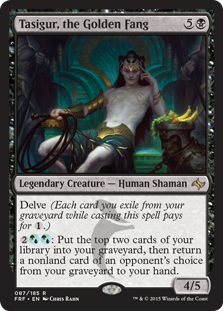
Say you’re picking up Tasigur at around $6 right now. That’s almost certainly a good call (I’ve been trading for them at that price myself), but what’s the ceiling on that type of spec? Tasigur is from a small set (good), but is only a rare (bad). He’s powerful in eternal formats (good), but the small set he’s in got drafted twice as much as a New Phyrexia or a Dragon’s Maze (bad).
tasigurthegoldenfang

Let’s assume Tasigur triples up to $18. Vendors feel confident in being able to sell copies at that price, so the spread is at a quite-reasonable-for-an-eternal-staple 33 percent.  That means that buylists will be at about $12, and assuming that’s your out, this is a double-up, which is a success by any metric. Sell all those $6 Tasigurs for $12 and glory in your wisdom and foresight.

That’s probably a reasonable expectation of what will happen in the fall, but what about your wildest dreams? What if Tasigur emerged as the de facto beater in Standard, Modern, and Legacy and jumped to an absurdly large ceiling?

How absurd is too absurd for wildest-dream-level absurd, though? Do you really believe a rare in a Standard-legal set could reach (and maintain) $50?  I do not. The absolute best-case scenario that still strikes me as within the realm of possibility is probably $40 with a 25-percent spread. This is by no means a prediction of what’s going to happen (I don’t actually believe it will get that high, at least within the near to mid future), but in my estimation of the card and circumstances around it, that’s the ceiling of what I believe is possible: a quintuple up.

Of course, the (just as unlikely) downside is that Tasigur gets reprinted/banned/outclassed/hosed or any number of other things to make him more or less useless. With his eternal pedigree, Tasigur dipping down to bulk-rare status is about as unlikely as him exceeding $50 retail, but crazier things have happened. In that (again, very unlikely) case, you bought in at $6 and have a card worth as low as 10 or 15 cents per copy.

These two extremes are very unlikely, but despite the low chances, they could happen. I fully expect the more realistic scenario I began with ($18 retail/$12 buylist) to be closest to the truth, and that’s why I think Tasigur is a good buy, but the range of possibilities goes from a rather large loss per card (proportionally) to around five times the buy-in price. That’s a pretty large range that has as much downside as upside, disregarding the likelihood of these extremes.

Speculating on Dregs

On the other hand, picking up cards that are at or just barely above bulk right now mixes up the range significantly. If you buy a rare for 15 cents each, you’re not risking much if anything—you can always get 10 cents per rare when selling in bulk, and some dealers will happily pay 12 or even 15 cents each. Even buying cards at 20 or 25 cents isn’t all that risky.

The upside on this type of card, though, is substantially more than the ceiling quintuple up that we presumed with Tasigur.
nightveilspecter

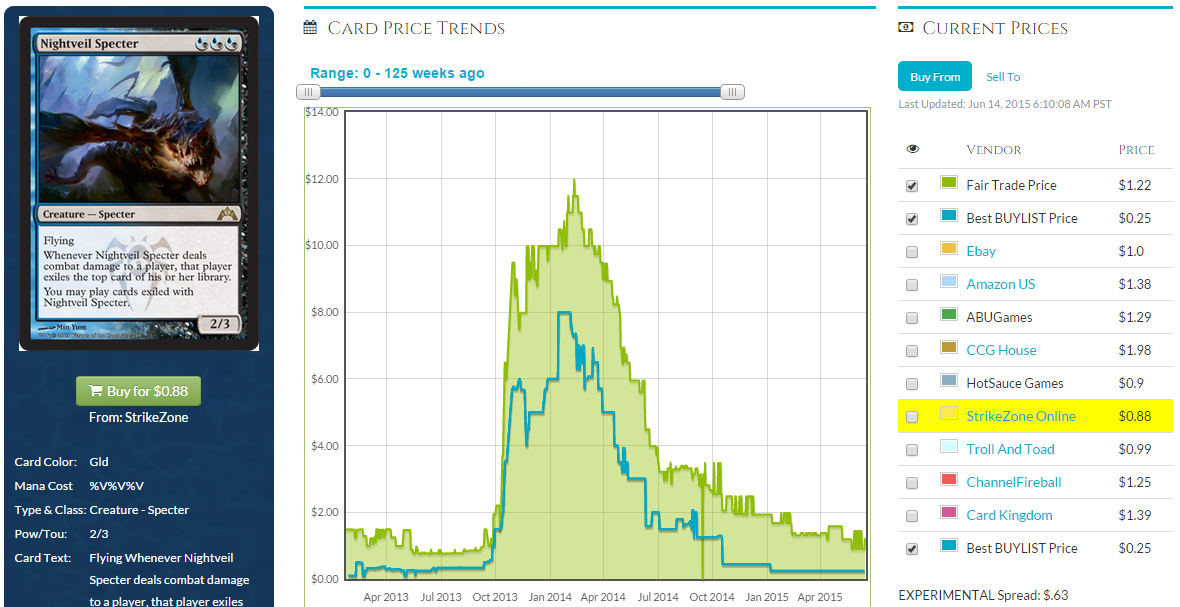
Nightveil Specter is this type of card. Though the floor wasn’t quite as low as the 25 cents referenced so far, it did get as low as 75 cents TCGplayer mid, and the most successful speculators on this card managed to snag copies under 50 cents. When the card became a staple in Mono-Black Devotion, it catapulted to $12 with an $8 buylist, meaning some financiers got around sixteen times their initial investments back.
severthebloodline

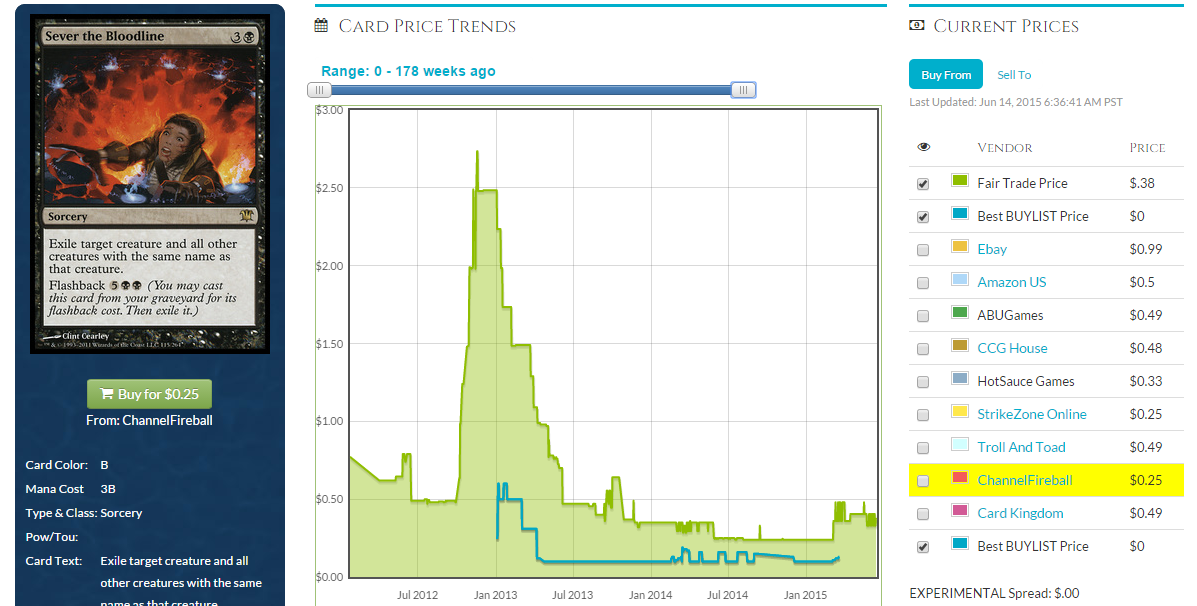
Sever the Bloodlinean Innistrad rare, bottomed out in Standard at 48 cents TCGplayer mid, and I personally bought copies as low as 15 cents from the site. When the card reached $2.50 retail, the buylist price didn’t follow, but that’s where trading comes in—I traded out all of my copies for at $2.50, in turn picking up cards that I hoped would increase even more.
whipoferebos

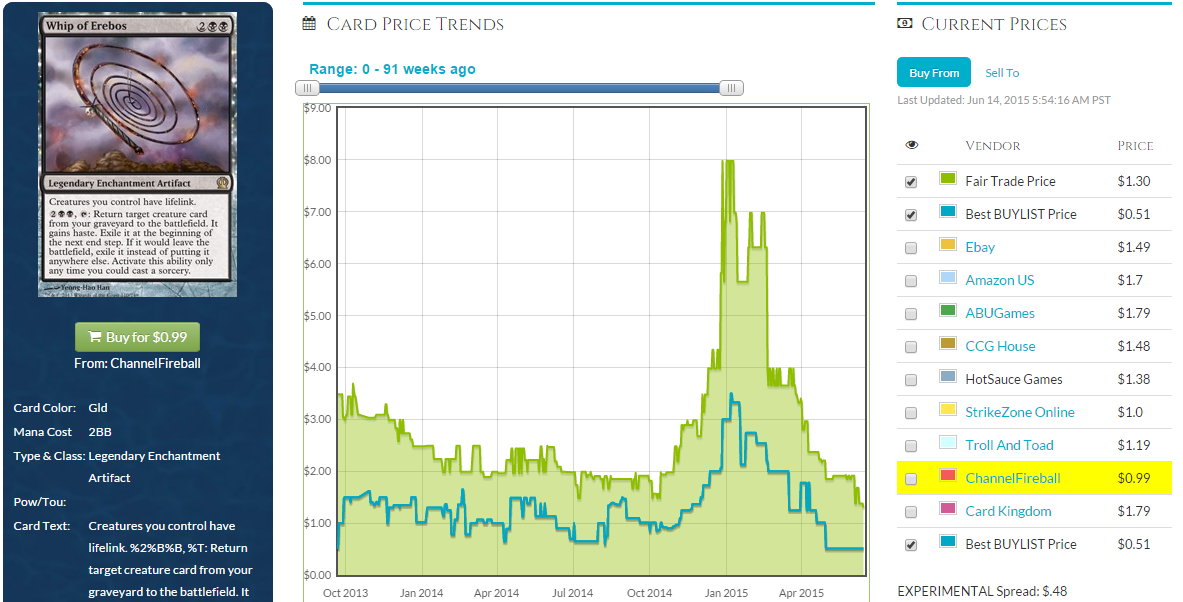
Whip of Erebos bottomed out a little below $2 TCGplayer mid, but copies were around for $1 and would have gotten you $8 in trade or $3 on buylists, a nice little increase if you bought in at the floor.

To varying degrees, almost every set has a low-cost and forgotten rare that becomes relevant in the following year’s new Standard format, even if only briefly. These cards often spike hard, and as you can see in the three examples above, often fall off in a big way as the format evolves and these cards get closer to rotating themselves.

So the pros of speculating on this type of low-cost but high-reward rare are that the buy-in is low, the risk of loss is minimized (due to the floor of bulk rares), and the potential multiplier on one’s investment is much higher if the card hits. The cons are that the ceiling price doesn’t often last long, and the buylist price doesn’t always follow, meaning you have to trade in order to get value from your specs. You also need to buy a lot more copies to make the same amount of total profit.

I’m on record as not wanting MTG finance to consume too much time and not liking to feel rushed to get rid of specs, but even I must admit that the pros outweigh the cons here, so every year around this time—early summer—I like to take a close look at the types of rares that are at the bottom of the list of a price-sorted set.

Durdles and Draft Bombs

As you might expect, among the cards in Khans of Tarkir that are less than 30 cents TCGplayer mid, we have a whole lot of cards that only the most casual of casual players could love. Cards like Thousand Winds, Ivorytusk Fortress, Kheru Lich Lordand Rakshasa Vizier are not at all exciting for more “hardcore” casual formats like Commander and Cube, and even were only mildly exciting in Draft.

There’s a whole lot of junk in this category, but one creature stands out from the rest of the field: Necropolis FiendJust from virtue of being included in an Intro Pack, the card has limited upside. But let’s not forget that it saw some early Standard play after Khans of Tarkir was released. Yes, Tasigur, is much more efficient, but Fiend acts as removal and can fly over ground troops, giving it utility that Tasigur just can’t provide. Just glancing at TCGplayer, there are lots of copies available in the 10 to 20 cent range. I don’t look at this card and strongly believe that it’s going to spike in the fall, but given its past play and a financial risk of virtually zero, the question is whether you’re willing to spend the time it would take to purchase, store, and out this card on the small chance that it does something.

Besides the durdly creatures, the dregs of Khans rares offer up plenty of spells that were bombs in Draft but not really exciting outside of it (for example, Flying Crane Technique and Icy Blast). There’s also cards that just aren’t exciting even in Draft, like Howl of the Horde or Trap EssenceThere’s just not a lot here that seems to have breakout potential in a new Standard format.

Looking a little higher than the below-30-cent rares, a few more things do stick out. Ghostfire Blade is at a TCGplayer mid of 35 cents, and while it’s no Cranial Platingit has shown up in the occasional Affinity list to further bolster the deck’s tiny robotic troops. Duneblast (30 cents TCGplayer mid) was considered one of the most powerful cards in Khans of Tarkir Draft, and though a seven-mana wrath has as much chance as being a staple in Standard as Brainstorm being in Battle for Zendikar, the power level of this card could make it appealing to Abzan Commander players. Again, there are copies on TCGplayer for under 15 cents right now. If this breaks a dollar, sweet, but if not, the only thing lost is the time it takes to bulk these out eventually.

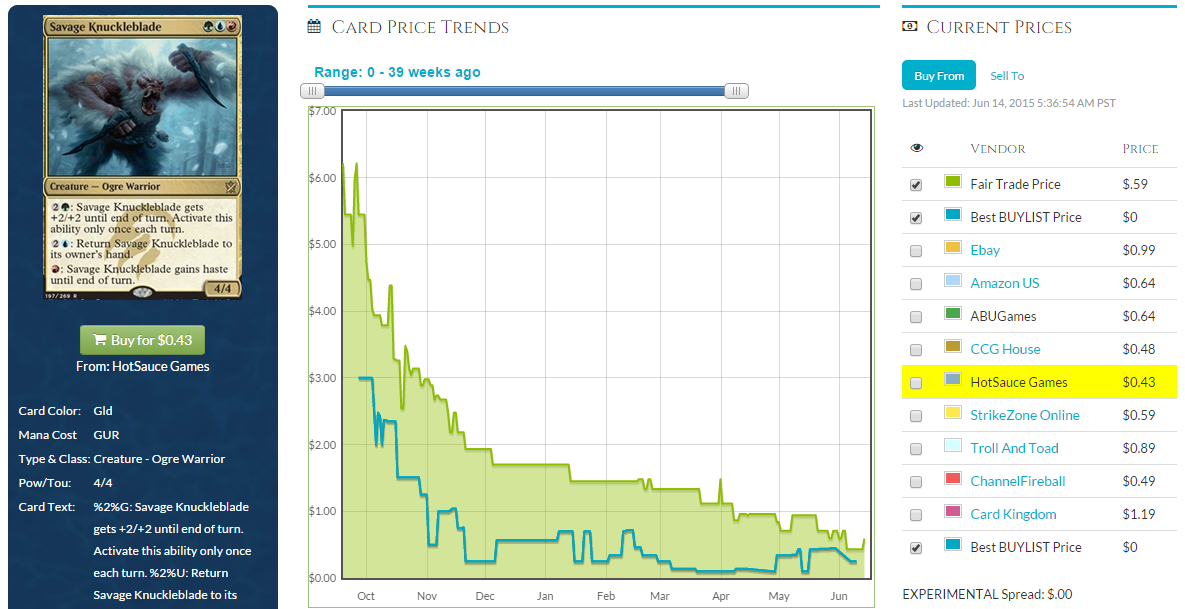
Finally, let’s talk about Savage Knuckleblade, which has dipped all the way down to 58 cents at TCGplayer mid. Brian Kibler had some success with a Temur Aggro archetype shortly after Khans was released, but Big Knucks hasn’t done anything since that time and has plummeted in value.
savageknuckleblade

The card is clearly powerful, but it just hasn’t quite fit in to this Standard format. My inclination is to stay away from this at 40 cents (where many copies are available), as Zendikar seems unlikely to offer support for three-color decks. That won’t keep me from grabbing copies as throw-ins when possible, though, because this really is a powerful card and could easily hit $5 if people are playing it.

Uncommon Love
flinthoofboar


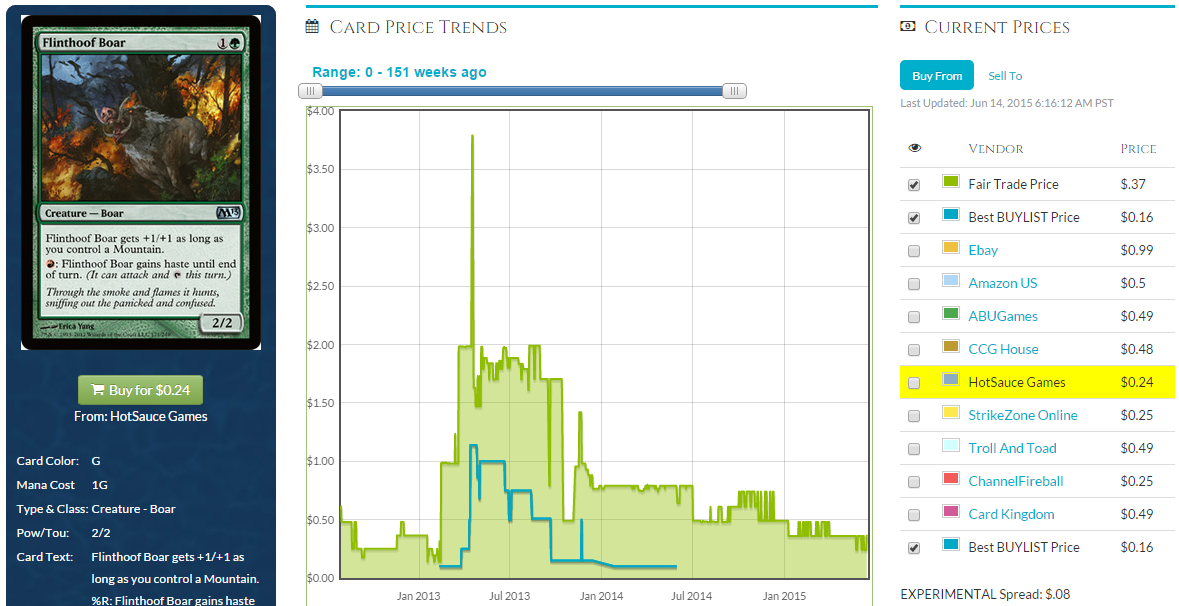
My first real success with speculating on an uncommon came with Flinthoof Boar, which I picked up a bunch of at 18 cents each and eBayed out for just under $2. Ever since that time, I’ve been keeping an eye on potential breakout uncommons that are being left on draft tables across the world.

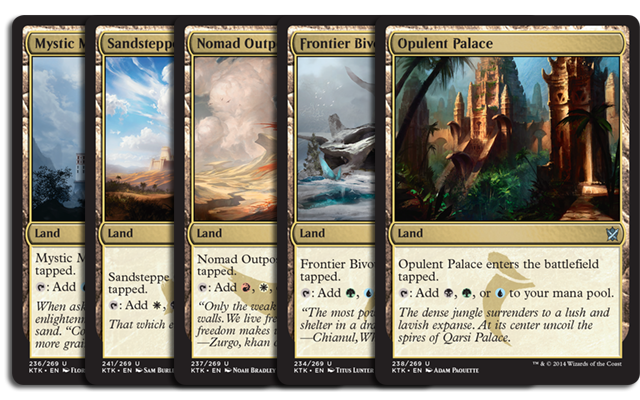
When I look at the uncommons of Khans, there are five specific ones that stick out to me most:
tri-lands

Copies of the trilands abound on TCGplayer for around 20 cents each. Pretending that there’s not tons more copies of Khans of Tarkir trilands than Shards of Alara ones would be wrong, but it is worth pointing out that the Shards trilands buylist for over a dollar and retail for nearly two—and they have all had reprints since Shards, so there’s not that many more copies of the Khans ones.

Although the long-term prospects on Khans trilands look good, if they see a lot of Standard play this fall, the short-term prospects will be even better for those who have copies at their disposal.

Assuming the Battle for Zendikar lands are the enemy fetches (a fair assumption, I think), that means we’ll have ten fetches, five trilands, ten gainlands, and…whatever is in Magic Origins. How deep I go on the trilands will be highly predicated on what fixing is available in this set: if it looks like three-color decks will be supported, I’m much more willing to pick up trilands en masse. If not, they’ll be slow gainers that aren’t worth acquiring with as much haste.

Small Buys, Big Gains

Keeping an eye on Magic Origins spoilers is very important at this point, because they can hint to us what might be good in the next Standard format, which will in turn lead us to buying the correct cards from Khans block.

It’s always worth going through the bottom cards of a set to see if anything is blatantly underpriced. There’s nothing that screams BUY ME NOW in Khans of Tarkir, but there is potential in some of the cards I called out above. Magic Origins spoilers will help dictate how to handle these penny-stock-style picks, so keep a close eye.

I’m 500 words over my limit and I didn’t even touch on Fate Reforged and Dragons of Tarkir, but there’s a lot of opportunity in these sets as well. Do you see anything that sticks out? You know what to do.

UNLOCKED PROTRADER: The Chicken Little of MTG Finance

“The sky is falling! The sky is falling!” – Chicken Little

The folk tale of Chicken Little dates back over 25 centuries. References to the little critter are used frequently in our society. Most often the metaphor is used to describe one who is overly cautious or prone to catastrophizing. In the world of MTG Finance, people may refer to me as Chicken Little.

tweet1

On Wall Street, analysts who frequently predict a doom-ridden future are known as “permabears.” Marc Faber, publisher of the Gloom Boom & Doom Report, is probably one of the more vocal “Chicken Littles” of Wall Street. CNBC showcases an article with his opinion on a weekly basis.

What value could permabears have for the MTG economy? Can everything truly be so dire? Why am I always so risk-averse?

Hopefully I can shed some light into my motivations in this article, along with why it’s not a bad idea to listen to Chicken Little…once in a while.

Motivations

I’ve mentioned my primary motivation for MTG Finance numerous times already. My son is three years old – in 15 years I hope he decides to pursue a college degree. To help pay for said degree I’m attempting to generate as much cash as possible from this hobby. Once I earn a certain amount of profits, I move funds out of Magic and into a Fidelity account. This Fidelity account houses a well-balanced portfolio of stocks and funds which will hopefully grow and compound profitably over the next 15 years.

That’s my approach. Losing money hinders my objective. The goal is to make money in Magic. Simple enough, right?

What accompanies this objective is a corollary I’ve come to accept: playing the game can be bad for business.

This isn’t always true. I’m oversimplifying here. For one, there’s always the risk/reward balance to keep in mind. Maintaining a Tier 1 Standard deck can be costly when new sets are constantly shaking up the metagame. If you’re a skillful player, that may not matter. You could win enough events to more than cover your expense for maintaining or switching decks in Standard. Guess what: I don’t play frequently enough to be a skillful player.

That means Standard is out. I honestly haven’t been excited about Standard in quite some time anyway.

I used to view Modern as the ultimate compromise. I could build a deck I liked and confidently play it for years to come, maintaining minimally while not having to sink a thousand bucks into a mana base and some Force of Wills. Then this happened:

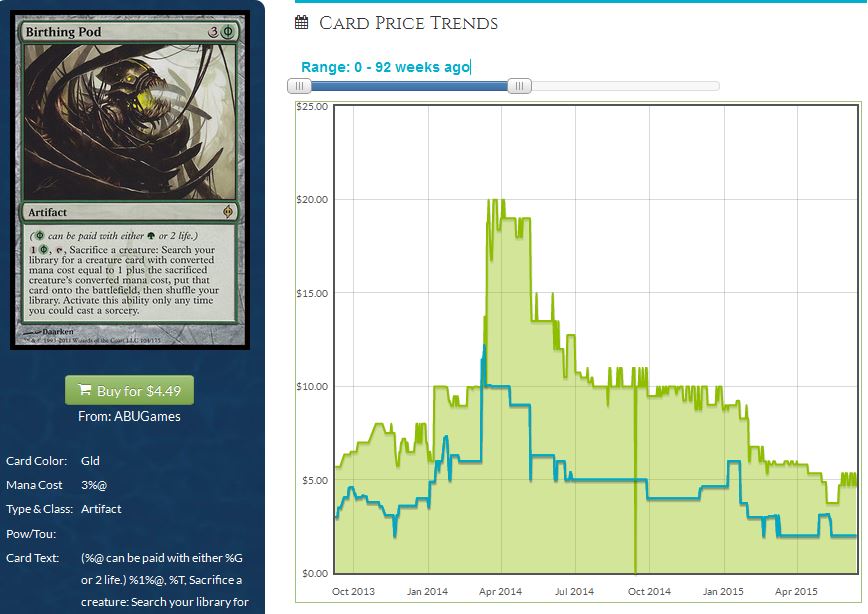
Pod

My Modern deck was blown out of contention by the banning of Birthing Pod. Not only was I left with an unplayable deck, but I was also left with measurable financial loss. Was the loss completely unbearable? No. But remember, I hate losing money.

What is Enjoyment Worth?

I didn’t want to abandon Modern altogether so I built the deck that looked most attractive to me after Melira Pod. That happened to be Amulet Bloom. I bought into the deck, and have since netted a small amount of profit thanks to its rapid rise in popularity. The deck rose to Tier 1 status, and I was beginning to feel energized by the format again.

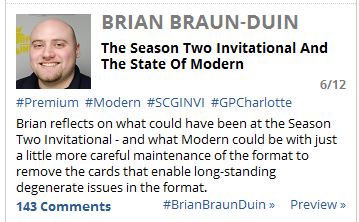
Then Brian Braun-Duin wrote an article.

BBD

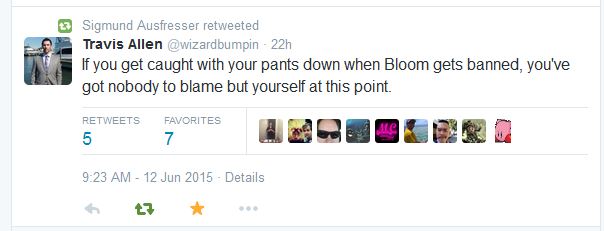
When professional players write about and clamor for a Modern banning, I listen. And when it’s my deck in particular they are stating is overpowered, I act. Can you blame me? I was fooled once by holding my Pod deck for too long, shame on WOTC. Do you honestly think I can hold the newly hated Amulet Bloom deck? If I did, I would be the only one to blame. In fact MTGPrice writer Travis Allen put it best recently on Twitter when he exclaimed:

tweet

Let me be first to admit this is a bit of a Chicken Little statement in and of itself. There are no guarantees something in the Bloom Titan deck gets banned. Additionally, a potential ban could take months or even a year while Wizards closely examines metagame evolution. Still, you can see why Travis’ tweet struck close to home.

With all this swirl in the rearview mirror, I decided to sell my Amulet Bloom deck. Perhaps my action was a bit rash, but I believe my gut instinct is correct in this case. It all ties back to my motivations. In reality I was playing Modern on a very infrequent basis – other formats are simply more attractive to me. So my net enjoyment of the Amulet Bloom deck was low. Weigh that against the risk of financial downside, and you can quickly see how the logic added up in my mind.

Is there really significant downside in holding an Amulet Bloom deck? I would challenge you to define significant, because that word could mean different things to different people. For some, the blow of even $50 in value could be a major hit worth avoiding. Meanwhile others may laugh at a $50 loss and chalk it up to “the cost of playing the game.” For me personally, it’s less about the absolute number and more about the implication. I will have lost more money from my son’s college fund. And to what end? A few casual games of Modern with no rewards or ramifications to the outcome of those games? I don’t play in competitive Modern events nearly enough to justify this.

Thus, I decided to sell the deck and move on.

Big Picture

In hindsight, perhaps Modern isn’t the right format for me. I’m constantly weathering reprint threats, bannings, and metagame shifts when attempting to maximize value of the collection. And while I DO have a soft spot for the game in my heart, I need to focus on my overarching objective when making financial decisions. This conclusion is what motivated me to write my recent article on why trading Modern is a boon but investing in Modern is a fool’s errand.

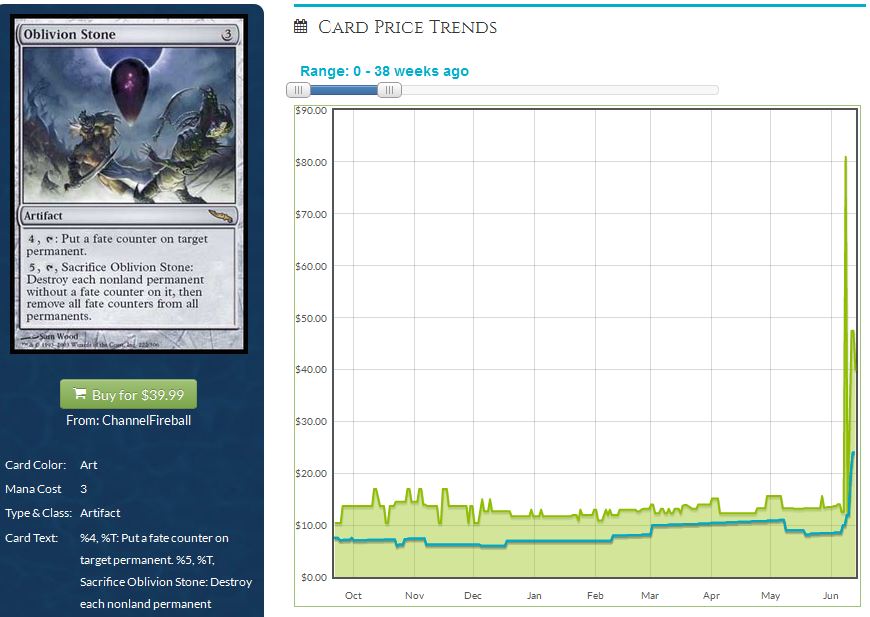
We should be buying and selling Modern cards in order to catch jumps in stuff like Raging Ravine and Oblivion Stone.

O stone

At the same time, we should also recognize that these price jumps come and go on a daily basis. To avoid losses, it’s imperative that we sell cards on these jumps. For the risk averse (or risk intolerant) like myself, there’s no other way to interact in this format.

This is exactly why I’ve adopted a “permabear” type attitude in Modern; a Chicken Little mindset, for those who want to add humor at my expense. In the five years I’ve been actively involved in MTG Finance, I’ve learned a great deal about my motivations. Acting according to the final objective of funding a beloved child’s college education is only logical. My holding of high risk cards that I use once every two months at a kitchen table simply cannot be justified.

“It’s a Game, Sig”

Magic: the Gathering is a game. We’re supposed to have fun playing and not worry about financial implications.

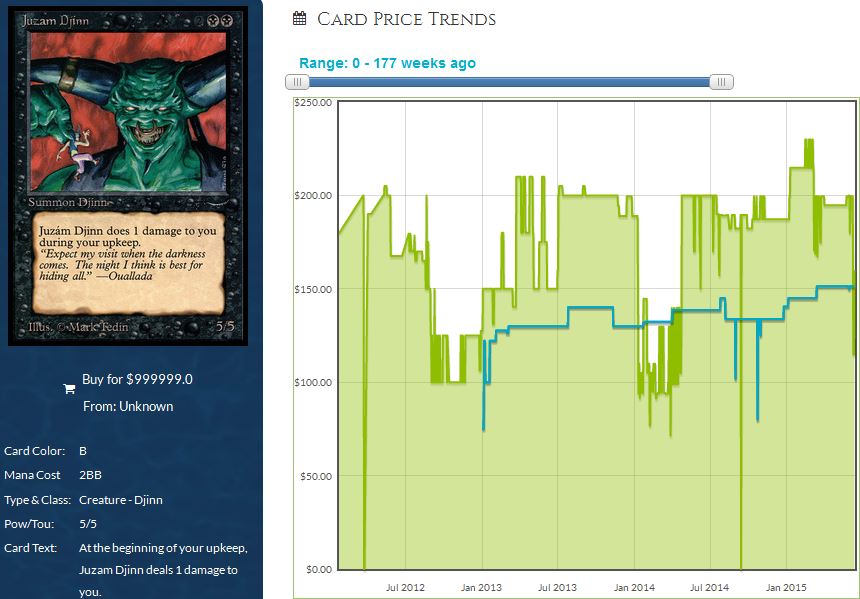
I could not agree more. That’s why I’m shifting focus to the formats I really enjoy most: Legacy, 93/94, and Commander. These formats allow me to play with cards I love while also enabling me to maintain or increase value of my collection over time. Sitting on a 93/94 deck is like making a long-term investment that you also can enjoy on occasion. I don’t have to worry about my Beta Hypnotic Specters or Juzam Djinns getting banned or reprinted.

Juzam

Even if I only enjoy playing a 93/94 match once every two months, there’s virtually no threat of sudden price depreciation. As I’ve stated before, it’s the perfect format for the Chicken Littles of MTG Finance.  Or for those who have other responsibilities that inhibit them from playing in frequent competitive events.

That includes me.

Wrapping It Up

I do want to mention one other variable my critics fail to give me credit for. By constantly flipping Modern cards for modest profit I’m maintaining high liquidity. Being vested in Modern or Standard decks can soak up a sizable chunk of one’s bankroll. By remaining less engaged in these formats (or alternatively, playing budget decks) I can free up cash for other investments.

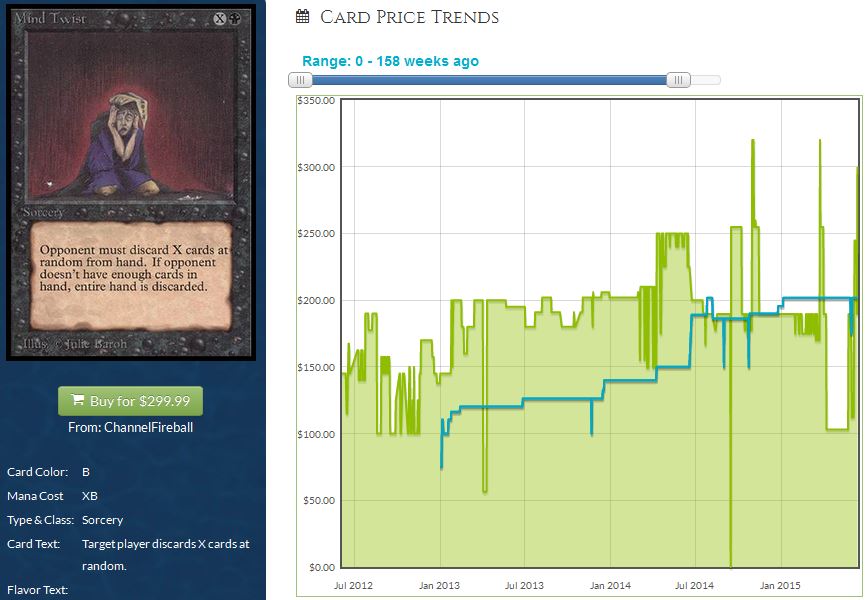
So when I sell my Primeval Titans, Summer Blooms, and Amulet of Vigors it’s not like I’m sitting on dead money. The cash is put to work. Having liquidity in and of itself is extremely important. Just recently an MTG friend on Facebook alerted me to an attractive eBay listing: a SP Beta Mind Twist for $120. That’s a steal of a price, and my friend encouraged me to pick it up if I was in the market for the card.

Mind Twist

Why didn’t my friend purchase the card himself? He stated he was lacking the funds after purchasing numerous other Old School MTG cards. For those of us who aren’t working with dealer-sized bankrolls, this problem is easy to relate to.

So what’s more likely to appreciate in price in the next 365 days, an Amulet Bloom deck or a Beta Mind Twist? My money is quite literally on the latter. Which is going to be more enjoyable to me during my kitchen table battles? Still the latter, as the Mind Twist fits perfectly in my 93/94 deck.

“The sky is falling! The sky is falling!”

The story of Chicken Little is very well known. It’s obvious Modern is a healthy format with a bright future. Card prices will rise and fall for years to come. My advice to you is to consider your own motivations for MTG Finance. If you’re getting tremendous enjoyment out of your Modern and Standard cards by playing in frequent tournaments, it’s absolutely the right decision to stay the course. You can filter my panic and let my worries go in one ear and out the other.

Permabears aren’t correct a lot of the time. No one should blindly follow them. But what permabears and Chicken Littles do well is they frequently challenge your investment decisions. We are forced to at least consider what they’re saying, which keeps us in check. Hopefully they can help us avoid any unsustainable price bubbles. It’s when the permabears become bullish that we truly must panic, for when the last bear remains bullish we have truly hit a peak. Obviously we’re not there yet.

Chicken Littles can also help us reexamine our motivations, so that we keep our eyes on the prize. For me, I will remain content flipping Modern cards over a short term period to grind profits from the format. This is a very exciting time for Modern prices where spikes happen on a daily basis. There is SO much money to be made here.

My long-term MTG positions however, will remain in safer cards. This helps me sleep better at night, and it also keeps me on track for achieving the end goal of funding my son’s college education. For if that sky ever does fall (no matter how unlikely), I don’t want to be devastated by the ensuing blood bath. Chicken Little will always be one step ahead in this regard.

Sig’s Quick Hits

I continue to check mtgstocks.com on a daily basis, and lately I’ve noticed a trend. There are two categories of cards with significant representation on the recent price movers: Modern and older reserved list cards. Everyone knows about the Modern ones, but did you know…

Tawnos’s Coffin, a rare from Antiquities, has been sold out at SCG for weeks now. Don’t be mislead by the $24.99 price tag – this card has exploded in recent weeks. Finding nice copies of this card for under $50 will be very difficult moving forward.

Guardian Beast has also been on the rise recently. Star City Games has just 1 MP copy in stock with a $39.99 price tag. Seeing as the top NM buy price according to mtgprice.com is $50, you can be sure SCG’s pricing will be on the rise some point in the near future.

– Don’t ask me why, but Shahrazad – my all time favorite Magic: the Gathering card – has shown up on the MTG Stocks Interests page a couple of times now. The card is deemed by most as completely unfun, although I personally love the flavor. In any event, SCG has just 1 copy in stock with a $79.99 price tag. Don’t expect this to double any time soon, but if you’re looking for a copy for nostalgia’s sake, you may not want to procrastinate forever since this won’t be getting any cheaper.

UNLOCKED PROTRADER: Two More Modern Cards

By Guo Heng

Now that Modern season is in full swing, we are starting to see Modern cards spiking all over. Some like Olivia Voldaren was probably due for a spike due to their set’s age. Some, like Huntmaster of the Fells started becoming popular in the Jund builds that emerged after the banning of Treasure Cruise and Birthing Pod in February, but as there were not a single major Modern event until last weekend’s StarCityGames Invitational, his price stayed low for months and only spiked this week when the wolf is out of the bag.

There are two cards that I have been watching and holding for a while. Those two cards surprised me when they both dodged the reprint bullet in Modern Masters 2015. Those were two cards I’ve discussed in an article a while back as well.

And I think those two cards are positioned to spike again soon.

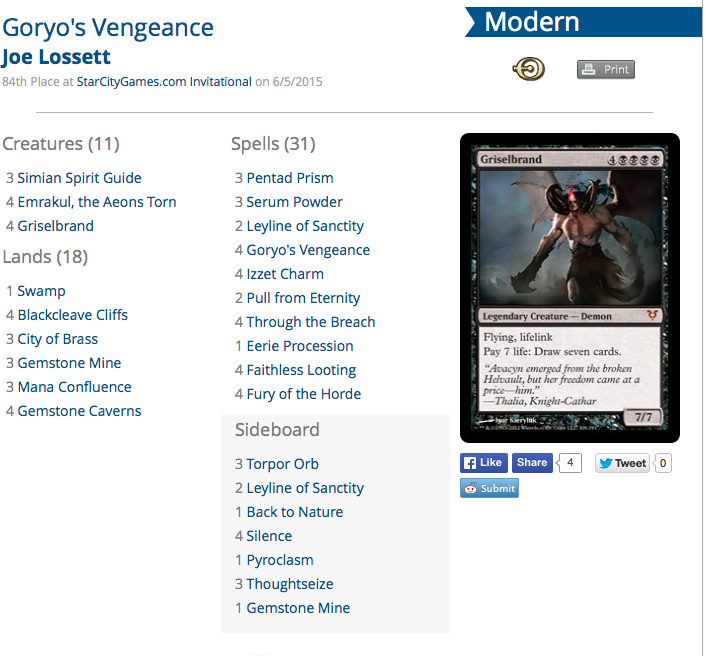
Those two cards fell under the radar and resurfaced when I saw Joe Lossett playing in feature match during the Invitationals with this deck:

Goryo's Vengeance by Joe Lossett

By now you would probably have guessed the two cards I am referring to. Before I explain why I think those two cards are undervalued right now, let’s have a quick look at the deck and the reasons why I think the deck has a future in Modern.

Back with a Vengeance

Goryo’s Reanimator is an all-in combo deck that aims to cheat into play an Emrakul, the Aeons Torn or a Griselbrand as early as turn two (turn one for some builds, but lets not get there) using its namesake card, Goryo’s Vengeance. For those unfamiliar with the deck’s interactions, Goryo’s Vengeance instant card type allows you to reanimate Emrakul from your graveyard while Emrakul’s shuffle trigger is on the stack, giving you a hasty 15/15 flying attacker with annihilate 6. You could also reanimate a hasty Griselbrand and use his Necropotence activation to chain multiple Fury of the Horde and attack phases to win that very turn.

Through the Breach provides you with an alternative way to cheat your win conditions into play that works around graveyard hate, imbuing the deck with another angle of attack and added resilience.

While Goryo’s Reanimator is a glass cannon combo deck, it has a few characteristics that make it more reliable than your typical Belcher-style decks:

  • Multiple angles of attack means the deck is less likely to fold to hate cards.
  • Multiple builds are possible. A year ago, streamer Jan van der Vegt tore through day one of Grand Prix Prague with a Goryo’s build running primarily Fist of Suns instead of Through the Breach. While he went unscathed on day one, he ultimately fell short of top 8 on day two, ending up at 44th place.

Financially, cheaper Griselbrand and Emrakul made the deck more accessible. After nearly a year of being handed out as Grand Prix promo, Griselbrand’s price is half where he was a year ago. Emrakul’s reprint in Modern Masters 2015 made $30ish Emrakuls available in the market.

While I do not think that Goryo Reanimator’s time to shine is right now, it is worth talking a look at the key cards that make the deck work.

Goryo’s Vengeance

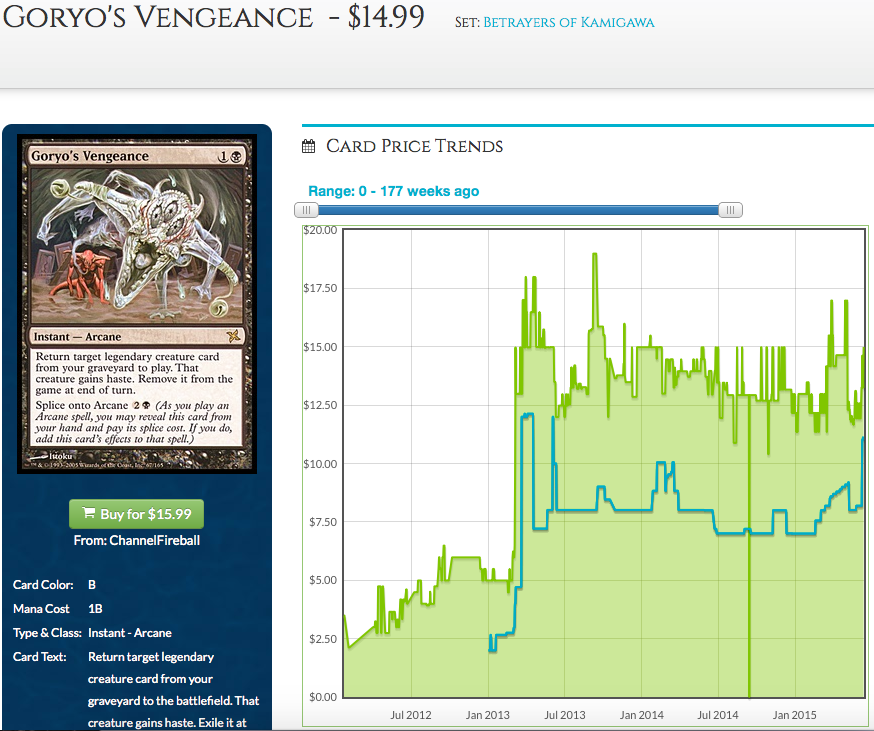
Goryo's Vengeance Price

Goryo’s Vengeance spiked above $10 when the Goryo’s Reanimator archetype came out in mid-2013. It has been hovering between $12 to $15 since.

Now why am I talking about a $15 card? Surely Goryo’s ship has long sailed?

I think that Goryo’s current price is still quite far off its ceiling. First off, An entire Modern archetype was made possible by Goryo’s Vengeance, a rare from Betrayers of Kamigawa, a small set that was released ten years ago and has not seen a single instance of reprint. I was fairly surprised that Goryo’s Vengeance was skipped over for reprint in Modern Masters 2015, as big reanimation targets and the arcane subtype were in the set.

Take a look at another card, Oblivion Stone, that is played in exactly one archetype in Modern. The Stone recently shot up to $40 on the back of Red-Green Tron’s stellar performance last weekend, after hovering at $13 for ages. Granted, Tron is now a tier one archetype while Goryo’s Reanimator is tier two. On the other hand, Oblivion Stone is from a large set, and has two printings. I don’t think Goryo’s Vengeance would shoot up to $40 if the archetype becomes popular, but it is not a far shot to imagine it hitting $30. After all, being an arcane card with a plane-specific name, the odds of Goryo’s Vengeance seeing a reprint is much lower than that of Oblivion Stone.

The buylist price for Goryo’s Vengeance spiked after the Invitationals weekend and Goryo’s Vengeance now has a spread of just 26%. It does not take much for an old card in low supply to move.

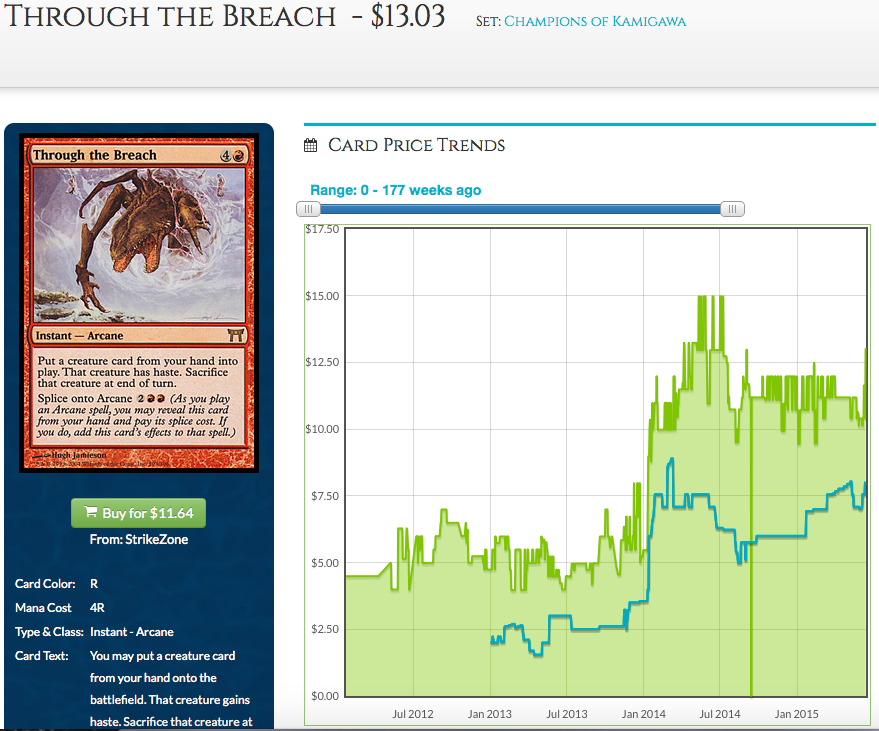
Through the Breach

Through the Breach Price

Like Goryo’s Vengeance, Through the Breach broke the $10 ceiling ages ago. I was even more surprised that Through the Breach was skimped over for reprint in Modern Masters 2015 than I was with Goryo’s Vengeance. Goryo’s Vengeance requires a discard outlet to work with the Eldrazi, but Through the Breach is a two-card combo with any of the Eldrazi.

Through the Breach’s only printing is from Champions of Kamigawa, which is eleven years old as of writing, though Champions is a large set. Though the Breach has two upsides over Goryo’s Vengeance. First off, it sees play in the sideboard of Legacy Omnitell decks, albeit as a one-of. More importantly Through the Breach is not restricted to just one archetype.

At Grand Prix Madrid last November, Through the Breach was featured as a four-of in a Through the Breach – Summoning Trap hybrid ramp deck designed and piloted by Ricardo van den Bogaard which plowed through day one with a perfect record and made top 8 of the Grand Prix (sadly losing in the semis to variance).

And that deck was no fluke. While the archetype did not take off in popularity, the deck took down a PPTQ in Switzerland and was runner-up in a 214-player Modern tournament in Tokyo.

Through the Breach’s spread of 39% is not as low as that of Goryo’s Vengeance, probably due to its larger supply, but as with Goryo’s Vengeance, I am confident that Through the Breach is undervalued right now, more so for the fact that Through the Breach is ran in other archetypes beyond Goryo Reanimator.

With only a single printing from eleven years back, Through the Breach really shouldn’t be as low as $13, seeing that decks that runs Through the Breach wants three to four copies of the card.

Closing Thoughts

Both Goryo’s Vengeance and Through the Breach are already relatively expensive to buy-in at $15 and $13 respectively. Buying in at such prices entails higher risk than buying in $6 Disrupting Shoals or $6 Huntmaster of the Fells. I featured those two cards today as I am confident that they are undervalued at their current price, and I suspect they are only so because the archetype(s) that run them has yet to take off in popularity.

All it takes is a Grand Prix top 8 with either of those cards during Modern season. Ricardo’s top 8 unfortunately occurred outside Modern season, which could be a reason why Through the Breach did not spiked hard in response to his top 8. Do share your thoughts in the comments below or catch me on Twitter at @thguoheng.

PS: A wild speculation. What could Red-Green Tron do to survive all the expected hate cards directed at it in the upcoming metagame? Chuck in a few mainboard Through the Breach to next level that smug opponent who mainboards Blood Moon


Wait, What?

By: Cliff Daigle

I like unusual things in Magic. I will sign up for most any tournament with an uncut foil sheet or an oversized card, or some other kooky thing.

I admit, I’m a collector. I like having unusual and/or rare cards. Today I want to go over a few of the cards that have a lot more value than you might expect, for no other reason aside from people who want them.

Let’s start with a big category.

Foreign Languages With Humorous English Meanings

This is more than some random person who has a playset of German Lightning Bolt and likes to scream out, “Blitzschlag!” every time he casts one. It’s funny the first time, but not the twentieth. This is not a comprehensive list of all the cards that have amusing translations, but these are some of the more widely known. Taste varies widely on these, and prices can too.

There are specific cards that when translated into other languages make Magic players giggle. As you can imagine, foil versions of these can command quite a premium.

Sarkhan el loco

The normal English version is $9, but unusually for Spanish, this one is more just because he’s fun to say, probably with an offensive and overstated accent.

He’s also a great fit in any Dragon deck, as he can come down and just nuke a player.

$_57

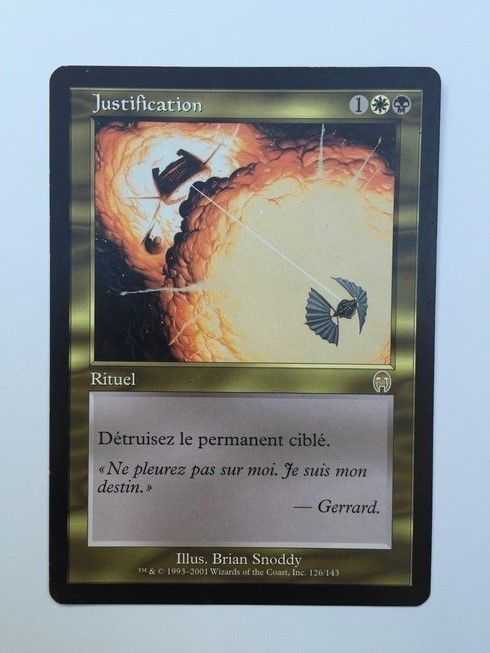
Justification

Vindicate is a card with an excellent history. It solves a very wide variety of problems, and for only three mana. This French version allows you to be more righteous at your table. Like Sarkhan, this is only a couple of bucks more.

$_57 (1)

Retard

The French version of Delay, this is something to truly test the maturity level of the player who takes a look at the card and starts short laughing. Some people think that this is too offensive to be allowed around, but there are lots of others who think this is just fine and dandy.

Crimps

This refers to cards that have been caught in the process of sealing a booster pack, process, on the top or the bottom edge. This is sort of rare, and it’s very unusual to find more than the black border that has been crimped.

Some people love these cards, others think they are insane. Totally up to the tastes of the buyer. Most stores regard these as damaged and worth less, but there are some folks who live for these mistakes. Also, keep in mind that some people are crimping their own cards in an attempt to add value. Everyone has something they like more.

CGimXRAUcAAaW-x

Miscuts

Again, this is a huge category and what people want can vary widely. There’s a whole spectrum on these, from slightly off-center cards to some that show parts of four different cards.

A word of warning: There’s a surprising number of people who are willing to take an uncut sheet to a print shop and have the cards deliberately miscut. This leads to newer miscuts being a lot more prevalent than older ones. I don’t agree with this policy at all, as I’d rather have the sheet of cards from any set, but I’ll respect anyone willing to try and extract what value they can.

Foil Gift of Orzhova

Why am I mentioning a card worth a quarter? Because the foil version is about $6. Johannes Voss does some gorgeous work on such a tiny space, especially the original Restoration Angel, and this stained-glass masterpiece looks exquisite in the shiny form. It’s not powerful, it’s not rare, it’s just wonderful to behold.

Foil Little Girl

You may not know this, but the list of foil Unhinged cards has some jaw-dropping prices. I bet you thought the lands were the top five, but the frame-defying cards of Richard Garfield, Ph.D. and Who/What/Where/When/Why make the top three. I admit, I thought Super Secret Tech would be much more expensive, and I certainly wasn’t expecting Blast from the Past to be $32 in foil.

Little Girl, though…a foil common whose flavor text references incontinence, has climbed to $37. I admit it, I traded for one of these two years ago for about $25 in value, when my first daughter was born.

That is the reason for this relatively kooky price. It’s literally a hundred times more expensive in foil than in nonfoil, because parents are suckers in all sorts of ways.


MAGIC: THE GATHERING FINANCE ARTICLES AND COMMUNITY