The Tool We Need and Probably Deserve Too

By: Travis Allen

In the field of MTG finance (a name I find myself disliking more with each passing day) we focus on finding the cards before they get big. Scour MTGO dailies for growing trends, identify EDH cards before they blow up, pinpoint combo pieces that will get broken, recognize when a card is at the bottom of a valley. All of these, done well, will put you in a position to be profitable. Cards will be obtained for some number of dollars, and a few weeks or months later, they’ll be worth double, triple, or even ten times what you originally paid. Pop the champagne. 

We as a community tend to focus very hard on this part of the process – figuring out what cards are going to rise in value, so that we may obtain them before they do. Understandably so, of course. It’s the most difficult part of the entire profit cycle, which means it deserves attention, and it’s also the sexiest.

The latter half of the process is getting rid of cards after they’ve risen in value. I discussed this topic to some extent awhile ago when I had jumped in on Ghaves a week before he quadrupled in value. In short, it’s a lot tougher for this to be profitable than it may seem at first blush.

It is with this postulate that I today encourage anyone that is reasonably involved with buying and selling cards to consider a TCGPlayer seller account. Creating an account is simple, using the website isn’t too painful, effort required of you is no more than PucaTrade or Deckbox, and most of all, it provides a convenient avenue for outing your specs.

I’ll tell you right off the bat: there are better solutions out there. Members of the community that have made a full-time job of trafficking in Magic have no hesitation speaking ill of TCG from a seller’s perspective. I will not discount these concerns. Like eBay, TCG bends over backwards to protect the buyer. It is far easier to find people willing to use your system to make money rather than spend it, so their incentive is to keep the buyers happy, not the sellers. It’s not that they don’t care about vendors, but we are undeniably second to the people actually spending money. This leads to buyers usually receiving the benefit of the doubt in nearly all situations. There’s a ten day wait on receiving funds as well. If you’ve got a bankroll this isn’t much of an issue, but not everyone has that luxury. The UI is a bit clunky, with it taking far more clicks than it seems should be necessary to view and close orders, an issue compounded by the fact that their servers seem to take at least five seconds to respond to any request, made even more dumbfounding by the fact that I live within two hours of their offices. They take north of 11% of each sale you make, depending on how much the sale is for. (My own history shows an order total of $5.98 paying a 19% fee, and a $294 order paying an 11% fee.) This isn’t a totally unreasonable amount, as you’ll pay 10% at eBay plus PayPal fees, but it’s hardly any better.

So why, if there are so many complaints regarding TCG, do I recommend anyone that buys more than one or two cards each month with the intent of flipping them open a seller’s account? The easiest answer is that you get to sell for TCG prices.

When I discussed flipping Ghave, one of the limiting factors was the buylist values. $5 was the highest offering, which barely covered my investment. Meanwhile, over on TCG he was in the $10 range. At the time that wasn’t an option to me so I was stuck facing buylists, eBay, or finding private sales. With a TCG account, I’d get to tap into that $10 retail price tag. Suddenly my spec would have been far more profitable. Even if I wasn’t greedy and listed at $8 or $9 instead of the $10 to $11 others had him at, the margin would have been large enough for a healthy profit.

It’s frequently discussed in regards to specs that you never get to sell them for retail. You buy in at retail, and then after the card spikes, you have to sell at buylist or below retail. But with a TCG account, this is no longer the case. You buy in at TCG low, and when you decide it’s time to move your cards, you get to sell at TCG low. Selling via TCG doesn’t get rid of all the fees or inconveniences of other methods, but rather, it raises the price you get to sell your product for. This is why, for the average person looking to move a few playsets of Ghostway, it’s a preferable venue.

The volume of cards I’ve sold after adopting the use of TCG have increased dramatically. eBay is really your only other open market option, and the demand of shipping every single card with tracking information drastically cuts into your profit margins. Selling expensive cards on eBay is mostly fine, but Ghaves or Skullbriars or Past in Flames sucks out loud. Moving my operation to TCG I’m now able to list cards under $10, something I wasn’t comfortable doing with eBay. People are much less scammy on TCG, meaning you get to use plain white envelopes for smaller sales. This opened the door to putting far more cards from my binder up for sale. That Rafiq or promo Honor of the Pure been gathering dust in your binder, and you want the space? Pick up a Soulfire Grand Master last night and you want to ship it before it falls further? Onto TCG it goes.

What really drove me to discuss this today was a feature recently added. Foreign cards can now be listed, a major boon to both customers and vendors. When I returned from Japan I brought back thirty-eight Japanese Black Markets. Up until now I’ve had no reasonable way to sell them. With foreign support having been added, I can now list my Black Markets, and all the other Japanese product I brought back. It’s great for people that end up with foreign product in their possession, and it’s great for people that wanted foreign product in their possession, a challenging goal if SCG didn’t have what you were looking for.

It’s important for people buying and selling to know what’s available to them on both sides of the process. Knowing how to move your cards is just as valuable, or perhaps more, than knowing which ones to pick up. I’m not shilling for TCG, I didn’t get paid by them, and I have no vested interest in their company. They provide a service that is quite valuable to people that do this type of thing frequently, and it’s helpful to be aware of it as an option. It isn’t flawless, and there are options with better returns, but those options usually involve running a store, or at least a case in a brick and mortar, which aren’t reasonable for people that don’t want this to be a full-time job. If you’re a mid-level actor in this market, TCG provides you an acceptable venue to sell at retail or near-retail prices.
 

Results from Japan

By: Jared Yost

I was browsing MTGTop8 results and noticed that there were three major events that took place in Japan over the recent weeks – there were two Standard PTQ’s along with a large Legacy event that had almost 300 players. Let’s see what types of results have come from these events since they could be adopted by other regions for metagames. 

Standard – PTQ Takadanobaba

Decklists

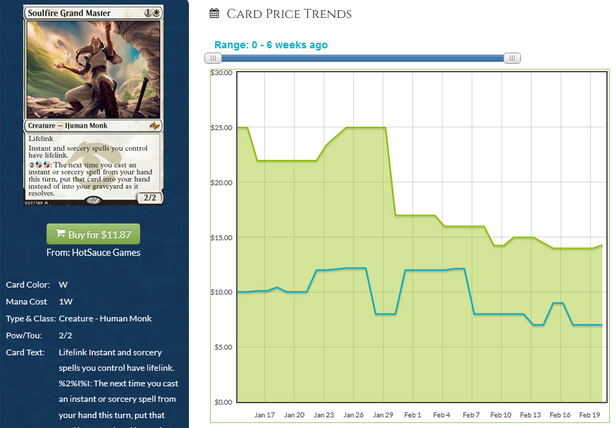
Soulfire Grand Master – This card showed up as a playset in the second place deck. This makes me wonder if this was a metagame call or if the Grand Master has the potential of being a main staple of Jeskai decks in the new Fate Reforged Standard. The current price trajectory of Soulfire Grand Master over the last month:

soulfire grand master price history

The cheapest current price is $12, a lofty fall from its preorder price of $25 and higher. Many have thought that the Grand Master was nothing more than a cute, gain-more card that was destined to fall pretty hard. While this is true, it has also proven that it can be a powerful card in Standard. Its inclusion in the second place deck along with another appearance in the Boros Aggro deck that made the Top 8 (with two copies appearing the deck) is making me seriously consider this card’s playability in future Standard events.

Cheap casting cost mythic rares can be hit or miss. However, I really think this card has struck a chord with spikes and has incredible casual appeal. Remember that time in your Magic playing career that you loved gaining life? This card takes that desire to a completely different galaxy of possibilities for the casual players among us.

While I believe that the Grand Master has some room to drop as Fate Reforged continues to be opened, if it starts going into the single digit ranges I’m going to be watching it very closely as a potential pickup. It has current and future Standard value as well as casual appeal. To me, these are all signs of an undervaluation if the Grand Master continues its price descent.

Soldier of the Pantheon – This card also made an appearance, in both Jeskai Midrange and one of the Abzan Midrange decks. Soldier currently sits at around $0.83 retail, with many copies listed at $0.75 or less. There could be potential for a spike in the short run if Soldier turns out to be good in the new metagame, and if that happens it will be the time to get rid of any copies of Soldier that you have. I don’t expect it to become a Modern or eternal mainstay so the last chance to get value out of Soldier will be in the coming months.

Wedge Tap Lands – Wedge tap lands are seeing play in nearly every deck due to the three color nature of the format. The time to get in on wedge tap lands en mass is coming soon. Even Sandsteppe Citadel, arguably the most widely played wedge land, is only around $0.50 retail. If you can pick up these lands for $0.40 or less it will be a great addition to a long term spec box.

Rakshasha Deathdealer – Another card that appeared in several decks, the power of Deathdealer in the new format cannot be underestimated. It is one of the best shades that Wizards has printed and it could really shine in Standard at some point. At $1 it seems like a very good pickup for future gains. 

Standard – Tarukiru Dragon Kiden (Japan)

Decklists

Archfiend of Depravity – Three copies of this card showed up in an Abzan Midrange list, which is surprising since I didn’t figure that that this card had constructed potential. Due to the inclusion it makes me want to watch the card closely over the next few months in case it pops up anywhere else.

Kolaghan, the Storm’s Fury – The dragon appeared in the sideboard of the Mardu Control list. In addition to constructed playability, Kolaghan will also be popular with the casual crowd. This will enable it to retain a fairly decent price even if it doesn’t see much Standard play. I like foils here if you can get them on the cheap.

Citadel and Outpost Siege – Many players are hyping the red siege (Outpost) since it brings Chandra, Pyromaster’s best ability out as an enchantment, which is generally harder to remove. However, Citadel Siege should not be overlooked. In aggro decks this card really shines as both modes can be useful to you throughout the game. I’ll be keeping a close eye on Citadel Siege as Fate Reforged results continue to roll in.

Soulfire Grand Master was seen at the top tables at this tournament too, being featured in Boros Aggro as a playset. This furthers the idea that it could have Standard possibilities.

Monastery Mentor only showed up in Jeskai Tokens, which means that he is not quite as popular as Goblin Rabblemaster in the current Standard. This leads me to believe that his price will come down a bit more over the coming months. I would watch out for any good deals through the summer because even though Mentor isn’t a powerhouse in Standard now we all know that he will be quite good in the future once Rabblemaster rotates.

Legacy – BIG MAGIC OPEN 3rd

Decklists

Death and Taxes took down the event. Thalia has been slowly rising to close to $5 retail and I expect this upward trend to continue. She is not going to get a reprint in Modern Masters 2 while still being a widely played Modern and Legacy staple.

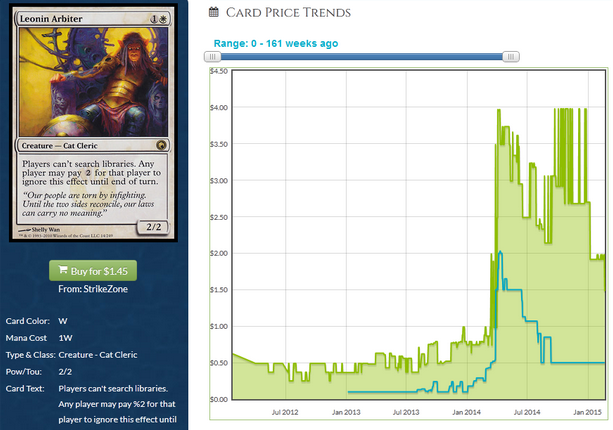
Mother of Runes was just announced as reprint in the upcoming Elspeth vs. Kiora duel decks, so I expect her to trend downward in price in the coming weeks based on the announcement. Leonin Arbiter is a hard call – at $1.50 retail it is very cheap for a card that occasionally sees Legacy play and definitely sees Modern play. However, I think many vendors and players are speculating its inclusion in Modern Masters 2 which has kept the price suppressed. Just last December the card was at $4 and seemed to be gaining in price. Then all of a sudden it dropped back down to $1.50 and seems to keep lowering.

leonin arbiter price history

So what happened? Its hard for me to put an exact reason for Arbiter’s price history, but it feels to me that his price reflects the wax and wane of the Hate Bears deck in Modern. Once Treasure Cruise was banned and the format shifted towards BGw Midrange Decks, Arbiter again found himself on the sidelines.

Historically, his drop in the middle of last year was leading up to Treasure Cruise and the general lack of large Modern events, and once the Hate Bears deck started doing well against the Treasure Cruise format he then shot back up to the $4 range. Of course, this is all just a theory – it could very well be the case that vendors just kept getting bought out at particular times which explains the temporary price spike of the card.

All in all, this tells me that Leonin Arbiter is a card that should be watched very closely for future gains or losses. Its volatile past tells me that the card could swing easily one way or the other depending on the direction that Modern or Legacy take.

Other notables from the tournament include a second place Merfolk list and Grixis Control placing in the Top 8 along with changes to Delver archetypes.

Merfolk made some interesting choices – main decking Waterfront Bouncer, Choking Tethers, and Chalice of the Void. It appears to to be a straight beatdown deck, playing four True-Name Nemesis and three Cavern of Souls in order to get the beats on. The sideboard included Ensnare and Back to Basics, cards I haven’t seen in a while in a Legacy Merfolk sideboard.

Grixis Control is playing Tasigur, the Golden Fang, Goblin Rabblemaster, Counterspell, and Dack Fayden along with a slew of one mana cost spells including Inquisition of Kozilek in order to control the early game. Mainly, the deck showcased that Tasigur and Rabblemaster are also Legacy playable apparently.

Delver decks now are splashing black for cards like Deathrite Shaman, Tombstalker, Cabal Therapy, and Tasigur. One version did strictly stay UR and opted to play three Dig Through Time over two or fewer to get the maximum effect out of the Delve keyword alongside cards like Gitaxian Probe and other cheap spells. Delver is still alive and well as one of the top decks of Legacy.

Results Are In

Its interesting to analyze different metagames in order to expand your knowledge of what possibilities for deckbuilding are out there. Even though non-Japanese metagames may not mirror the results that appeared across the three tournaments I covered, there are still some interesting trends that should be noted so that they don’t surprise you later down the road. If you’re interested in any of the decks or strategies that did well in Japan then you will want to get in on cards that are cheap now and look for good deals on cards that are currently overpriced.


FTV: Angels

By: Cliff Daigle

So back when the Commander 2015 preconstructed decks were announced, I thought sure we would get Serra and a deck full of Angels.

Instead we got some equipment and it was disappointing, Containment Priest notwithstanding.

Monday, Wizards announced that this summer’s From the Vault series will be Angels! This is both better and worse than being in a preconstructed deck. Thank goodness we’re no longer getting preview cards in the FTV series, as the slots are just too precious.

Multicolor

So what are the rules for FTV? How can we know what will be in this? The last three sets have been Realms, FTV 20, and Annihilation. So we have to go back to 2011 to find a creature-based set. Since that was from a while ago, and focused on multicolor cards, I’m not treating it as a hard and fast guide, but there’s a few key points.

#1: Increase supply of some hard-to-find cards. This is straight out of Gavin Verhey’s article on FTV: Annihilation last year. This is the category that I’m least sure about, as most of the Portal Angels have already seen a reprint. FTV represents one way to get foil versions of cards that couldn’t be put into a Standard set or a special set (Conspiracy, Modern Masters)

#2: Appeal to the casual and tournament players. This usually means that there will be one valuable card and a few of other semi-pricey ones, and then cards that are almost like filler, but fun filler.

#3: Represent a range of colors and strategies from the past. I love it. This is going to be a primarily white set, as white has nearly all the Angels. So the non-white Angels are going to be a bit more likely.

#4: Be a little surprising. Think Form of the Dragon in FTV: Dragons, or Smokestack in FTV: Annihilation. This is, by far, the most fun to guess about.

Let’s go over some honorable mentions. I feel these could make it in, but they are not my #1 pick for one reason or another.

Razia, Boros Archangel
Fallen Angel
Lightning Angel
Platinum Angel
Angel of the Dire Hour
Gisela, Blade of Goldnight
Luminarch Ascension
Archangel of Strife
Akroma, Angel of Wrath
Archangel of Thune
Angel of Light
Avenging Angel
Blinding Angel
Emeria Angel
Empyrial Archangel
Exalted Angel
Guardian Seraph
Serra Avenger
Wayward Angel
Angel of Despair
Copper-Leaf Angel
Crypt Angel
Linvala, Keeper of Silence
Iona, Shield of Emeria

These cards represent the ‘I wouldn’t be surprised’ tier of Angels. All of these would be worthy inclusions in detailing the history of this iconic tribe. Copper-Leaf Angel is a good candidate for a surprise, but I’d really be shocked if that was in over Platinum Angel. Luminarch Ascension is a hard card to leave out, but it’s a ‘target acquired’ sort of card that if you play it, you’ll be punished all game for it. It’s a bit punishing for casual players, too.

The last two, Linvala and Iona, are a strong hunch on my part. Linvala is rather reprintable, even as a legend. She’s not more powerful than High Sentinels of Arashin, for example. I’d expect to see Linvala in another set soon, maybe even MM2015 this summer. Iona has the distinction of being one of the most unfun and non-interactive cards ever printed, allowing you to have an answer in hand but sorry! you can’t play it. I don’t think Iona will be in this set. Her price and casual appeal don’t demand a reprint the way Avacyn does.

A special note: both Guiding Spirit and Sustaining Spirit would have been on the list, except they are on the Reserved List instead.

With regard to my picks for the set, I’m going to list what I think the value will be initially and what the value will end up at. I’ll also give the financial effect on the originals, foil and nonfoil. For reference, I’m looking at things like Jace, the Mind Sculptor, who took a hit in foil and nonfoil when FTV:Twenty came out. Many cards do take a hit to the foil and nonfoil prices, Maze of Ith and Armageddon among them. I expect a similar path for these Angels.

My picks

White

Avacyn, Angel of Hope – The lock of the set. Avacyn is ridiculous in any deck that can play her, and the reason why your EDH decks need to be packing non-destructive answers like Terminus or Hallowed Burial. She’s iconic, has a great story, and is incredibly powerful.

I would expect Avacyn to be the chase card of this set, and have a price to match. History, with Jace and others, suggests that her price will be at the highest immediately and come down gradually, and in her case, very slowly. The nonfoil will drop somewhat, to about $20 or so, but I think the foil version will rebound to its current level within a few months.

Serra Angel – You may not agree with its inclusion, but the story cannot be told without the original, overpowered version. Yes, she’s overpowered. She is nearly on par with Wingmate Roc, and she was an uncommon! In many ways, removal had to be good to deal with creatures this good, which is a history Magic has spent the last couple of years overcoming.

There are a lot of promo versions of this card out there, with lots of different art. The ‘redeem’ foil featuring the original Douglas Shuler art won’t be affected at all by this printing. Every other version will take a hit and stay low, considering the sheer number of sets this card has been in: sixteen of them, not counting duel decks!

Angel of Finality – This is the first of three ‘has never been foil’ cards I’m picking for this set. It’s a surprisingly underplayed sideboard card in Legacy (you can’t pay two colorless more than Rest in Peace to get a 3/4 flyer?) and it’s a card I really like in my Kaalia deck. More people should be playing this card in Commander and Cube.

The nonfoils from Commander 2013 will lose some value, but I expect this foil to keep a surprising price for a while. A bit of warning: I wouldn’t be surprised if this ended up in a regular set sometime soon. Four mana for a 3/4 flyer plus upside is Restoration Angel.

Silver Seraph – This is a card that is more fragile, more expensive, and less surprising than Dictate of Heliod, but it remains a really awesome card. Threshold is a very easy condition to satisfy in casual formats, and this does a lot of work for you despite costing eight mana.

I think that this will be one of the more expensive cards initally, as the foils are just tough to find, being from a low point in Magic’s sales. I doubt there will be much effect on the prices of the pack foil and the nonfoil, though.

Seraph – Seven mana for a 4/4 flyer. Sure, you get to keep anything it kills or helps to kill, but it’s still a lot of mana for not a lot of effect. This has not yet had a foil, its only printings have been in nonfoil sets to date. This is exactly the sort of card that Wizards likes to dig up and put into an FTV set, just as a reminder of days gone by.

Despite the fun flavor of an angel killing a creature and then enslaving it, I expect this to be one of the cheapest cards from the set and there will be downward pressure on the nonfoil’s price as a result.

Angel of Fury – Angels have had all sorts of abilities to show that they are spirits of the next world. Angels allow others to be reborn, and this one gets reborn. It was one of two Portal candidates, and while you might not like the cost or the shuffle, it’s another card that hasn’t had a foil version yet.

The price of this card is mostly due to the low supply of Portal cards out there. Not as rare as the Three Kingdoms cards, but still not easy to find. I expect this nonfoil to take a significant hit and not really recover.

Mardu

Tariel, Reckoner of Souls – Kaalia’s compatriot in the Heavenly Inferno deck, Tariel is a very busted card if you ever have it in play. Unlike Seraph, the cards it gets will stay even if Tariel leaves play, so it’s Wrath or bust once this gets going. It’s a random effect, but in a couple of turns, you’ll just have it all.

Price-wise, this is likely to be one of the stronger cards if the set shakes out as I expect it to. Tariel is easy to include in Kaalia decks, and this will be the only foil version available for some time. The FTV price will be reasonable, but the nonfoil is going to lose value.

Red

Akroma, Angel of Fury – The only mono-red Angel, she’s color-shifted and has Morph. Bringing back this mechanic right now is a little too perfect. She also adds a nice touch to casual decks with Morphs in them, because your Morph can now be super-terrifying. It’s always baffled me a bit that this Akroma lacks haste.

This will cause a hit to the price of the Planar Chaos foil, but it will recover. Remember that a lot of people really don’t like the foiling process of the FTV cards, so they will pay a premium to get the pack foil. The nonfoils, including the Commander 2011 version, will lose some of their value but not too much.

Boros

Aurelia, the Warleader – The red/white slot is surprisingly contested. Razia, Aurelia, Basandra, and Gisela are all fine cards, but I’m going to let personal bias win this one. Aurelia is a house, capable of ending games out of nowhere, and requiring an instant-speed removal spell.

I will be sad to see her reprinted, for I picked up ten of her around $3 each and I have been pleased to see her growth. I think her nonfoil takes a small hit, but will recover in a year or so. The foil will recover faster, and be more stable.

Bant

Jenara, Asura of War – It’s tough for me to put this in over the equally-mythic Empyrial Archangel, but being a legend, and from a smaller set puts Jenara over the top. Jenara also plays well with the Tiny Leaders format, though I don’t think this set was designed recently enough for that to have been a factor.

Her price will fall slightly but it’ll go back up fairly quickly, and Tiny Leaders will help with that. I suspect the FTV price will stabilize nicely between the current foil/nonfoil split.

Black

Desolation Angel – It’s tough for me to include this over Fallen Angel or Angel of Despair. The effect that Desolation Angel offers is unique, though, and this has one of the biggest foil/nonfoil splits around. I don’t think nonfoils will be hurt at all, but the foils will take a big dive and might not recover.

Azorious

Iridescent Angel – Pristine Angel was in Conspiracy, so now the broken predecessor can have a chance to shine. I really hope this has new art, as the blue line doesn’t really say iridescence to me. This can wear an Equipment for pure profit, as only colorless flyers (or colorless reach) can block it.

This is already quite cheap in nonfoil, but expect the foils to lower by a couple of dollars for a year or so.

WUBRG

Maelstrom Archangel – Another card from Alara block, with the price to match. It’s the only five-color Angel ever, and I imagine if they had the chance, they would go back and make this Legendary for Commander players. This is a card that Kaalia of the Vast would dearly love to have on the team, but it’s just not to be.

I think that this has the most to lose when it’s reprinted. The foil is currently only about twice the nonfoil, and both of those will be hit hard by an appearance in this FTV. Supply has never been big for Conflux, so adding this special set will do significant damage to the prices. I wouldn’t be surprised if it was down half its value in either foil or nonfoil.

Non-Angel Creatures

Angelic Destiny – This is the good way to turn your non-Angels into angelic beings, and do so over and over again. It’s got a certain level of inevitability, but not on the scale of Rancor. Just four mana to add flying, first strike, and +4/+4 is pretty bonkers, even for a mythic.

This is another card that will take a beating price-wise, I think. Magic 2012, being from nearly four years ago, is not as common as you might think. I love this art, and especially in foil. I don’t believe it’ll be as bad as Maelstrom Archangel, but it will be down for a long while.

Entreat the Angels – I really love the Miracle frame in foil, and the Terminus from last year looks good to me. Entreat has popped up a few times in Legacy Miracles, and it’s a card I love in any deck with white mana.

I actually don’t think the nonfoil price will be budged at all. This is an easy card to add to any casual deck, even Tiny Leaders! The foil will take a minor ding in price, but it won’t stay down for long.

Join me next week as we look ahead to one very expensive summer!


Lockbox

By: Travis Allen

A few days ago GP Seville wrapped up. It was a Standard GP over in the south of Spain. While looking through the top eight, I was fairly impressed with the diversity. It consisted, in no particular order, of GR Devotion, Jeskai Tempo, Mono-G Devotion, UB Control, Junk Aggro, Junk Midrange, UW Heroic, and Sidisi Whip. That’s an undeniably diverse format, something for which WotC should congratulate themselves. Building a Standard format that has that many competitive decks is difficult, a feat made more impressive when you consider that what constitutes the top layer has been changing from week to week.

Browsing through the lists from place one to ninety, over 10% of the field, I was pleasantly surprised by the number of Whisperwood Elementals to be found. I spoke highly of them in my set review several weeks back, and after hearing that they had jumped to $12 in Japan, I snapped up all the copies left on eBay under $6. It wasn’t long before the US market caught up – preorder prices on TCG hit nearly $15. That was in the week ahead of release though, and I still didn’t have my copies. I couldn’t list what I didn’t have in hand, and by the time the actual cards reached me, the price had fallen to $6 again. I wasn’t behind per se, but the price wasn’t high enough to sell yet. Since then prices on Whiserpood have started to creep back up after a solid performance at Seville, and while he hasn’t really broken through much to the US yet, I expect his popularity to gain on this side of the Atlantic.

Ideally I should have a number in mind that I’d like to get out. If I bought in for $6 each, what do I have to sell copies for to be happy? Is it $8? $10? $15? While considering how greedy I could be, a solemn fact once more foisted itself on me. There’s a pretty hard limit to just how expensive Whisperwood Elemental can be, and it’s determined by the rest of the cards in the set. 

The core concept we’re looking at today is how card prices are influenced by being the current in-print set. It’s a very simple idea, really. An open pack can’t be, on average, more valuable than a sealed pack. What does that mean, and what are the ramifications?

Figuring out the average value of a pack is simple. Add up the values of each rarity independent of each other, average it out across the number of that type of card, then multiply by the expected number you would find in a pack. For instance, if the average value of a rare in Fate Reforged is $1.91, and you know there’s an 87% chance of a rare being in a pack, then an average pack has an average rare value of $1.6617. Add in the common, uncommon, and mythic average values, and you have the value of a pack.

Once you understand the average value of a pack, you know the average value of a box. If a pack’s average is $2.18, then the average box is worth $78.48. That average box price – that $78.48, or whatever number is appropriate for a particular set at a particular time – is roughly how much in value you will open in a box. It’s not a hard number, of course. Some boxes will have two or three Nexus’, and other boxes will have a foil Ugin. It all evens out in the end though.

What if the average pack isn’t in the low two dollar range? What if there are gobs and gobs of $10 rares that drive the average pack value up to $4? Now a box’s value is $144. If that set is old – say, Innistrad – so be it. The boxes in the market are all that’s there, and they’re subject to normal rules of supply and demand, just like any normal card. But what if the set is in print, such as Fate Reforged is today?

If you’re a vendor and Fate Reforged boxes are $144, you are not wasting any time jumping on the horn and ordering piles and piles of boxes from WotC. WotC will sell you nearly limitless boxes of current sets, and they’ll do it all for somewhere in the neighborhood of $70 to $80 a box. You’ll crack boxes that cost you $70 and sell the singles for $140. That represents one hell of a profit, so you’ll scoop up as many as possible. And you’ll keep ordering them and cracking packs, until it’s not profitable to do so anymore. And so will every other store. And eventually, the market will be flooded with packs, and those packs won’t be worth an average of $4 anymore.

As more and more product is entering the market, more and more of each card is becoming available. No card, now matter how good it is, can maintain a $10 price tag if you put millions of them into the wild. As the market gets flooded with boxes, card values will keep dropping, until eventually the average pack isn’t $4 anymore, it’s back to the low $2 range again. Average boxes will drop from $144 to $80 again, people will stop buying them, vendors will stop ordering them, and new copies of cards will stop entering the market. Equilibrium. (Probably an awesome card in an Animar TL deck, by the way.)

Of course, we’re operating in an imperfect system. Taxes and shipping costs and manual labor all add inefficiencies to the system, as does time for boxes to move from one point to another. All the players needing a given card won’t suddenly have access to it because a store somewhere in a twenty mile radius just cracked a pack. The system isn’t perfect, and so the numbers won’t be either. Occasionally the average value of a pack may be twenty cents too high for a week or two while the supply catches up. This is simply the nature of a physical market.

When a set is out of print, there’s nothing to stop prices from getting out of control. That’s why Future Sight boxes are $700. While a set is in print, though, vendors will just keep ordering boxes as long as it’s profitable to do so. And with WotC willing to pump out as many boxes as stores are willing to buy at $70 or so, the average price of a box is chained to that value. With box values essentially mandated by WotC, it holds average pack prices steady, and therefore holds the total value of singles steady.

With average pack prices of an in-print set constrained, there’s only so much value that can be opened. You can’t have twenty-five $10 rares, and you can’t have eight $30 mythics. That would push pack values too high, which we just saw will self-correct. As cards find the price the market will bear, the entire rest of the set is shaped around it. Consider Ugin, currently a little over $30. Ugin is that expensive because demand is so high. Standard, Modern, Legacy, EDH, casual – everyone wants to be casting eight-mana Planeswalkers these days. Knowing that, we can look at Whisperwood Elemental and start to understand what his price potential is. If tomorrow everyone realizes Whisperwood is the second best mythic in the set and demand begins to rise, his price will go with it. Pack values would rise, and we already figured out what happens in that scenario.

We know that the market basically requires boxes to be worth roughly $80 each, and that has an impact on all the singles in the set. If market demand for Ugin is over $30 and Monastery Mentor is $20+, that’s going to suck up a lot of value for the other cards in the set. You simply can’t have $25 Tasigurs, because that would mean a box is too valuable. If a few cards in a set are expensive, it creates a limiting effect on the price of the cards that share a booster pack with it. Thus, my Whisperwood Elementals have a theoretical price ceiling by virtue of being in the same set as Ugin, Monastery Mentor, and Tasigur.

This works the other way as well, although we see it less often. Dragon’s Maze was a pretty godawful set, with very few cards people had any interest in. Voice of Resurgence was far and away the best card, and it fell off rapidly after that. Boxes couldn’t really be any cheaper than $80, since that’s what vendors had to pay for them, but with no other desirable cards in the set, that meant Voice of Resurgence had to carry that price tag on his own, which is how we ended up with $60 Voices at one point. When a single mythic is the only good card in a set, it’s going to carry most of the cost of a box on its own.

There are a few practical outcomes from all of this.

  • Within two or three weeks of a sets release, boxes will always fall to the same price of around $80ish. (So long as WotC keeps selling them to stores for around $75.)
  • If the singles within the set ever become too valuable, stores will start cracking packs to sell in their case, increasing supply and thus lowering prices.
  • When a handful of cards have high price tags, it will suppress the price of all the other cards in the set.
  • If there’s only very few good cards in a set, they’ll carry the weight of the box price on their own.

Applying this to Fate Reforged, we see that Ugin is holding strong at $30 and Monastery Mentor looks to be stable at $25 for now. With those two sustaining large price tags, there won’t be too much value in a box left to assign to cards like Whisperwood and Tasigur. In fact, that’s really the only reason Tasigur is as cheap as he is. If he was in Dragon’s Maze he would have been a $25 rare.

I keep looking at cards in Fate Reforged and thinking “that card could be worth twice that,” but then I have to remember that if I think that about twenty different cards, none of them are actually capable of rising that much in price. Even though all of these cards are quite strong and could be $15+ in other sets, when you put them all into a set together it limits the price of all. Keep this in mind when considering how much cards in Fate Reforged could conceivably rise in the near future. And just as importantly, keep it in mind for when Fate Reforged is off the printers – at that point WotC won’t be keeping the price of a box chained to $80 and the sky’s the limit.


MAGIC: THE GATHERING FINANCE ARTICLES AND COMMUNITY