All posts by Travis Allen

Travis Allen has been playing Magic on and off since 1994, and got sucked into the financial side of the game after he started playing competitively during Zendikar. You can find his daily Magic chat on Twitter at @wizardbumpin. He currently resides in upstate NY, where he is a graduate student in applied ontology.

UNLOCKED PROTRADER: Death of a Binder Grinder

By: Travis Allen

This weekend in Vegas was probably my favorite GP ever. I got to meet a ton of people that I had only known through computer screens prior. Not only did we meet, but because the event was so long, we had time to actually sit and talk. We spend so much time communicating and interfacing through digital mediums because it’s convenient and efficient, but there’s nothing that compares to actually pressing the flesh. It makes relationships concrete and lends them weight; no longer is it a series of characters prefixed by an @ sign, instead it’s a real person with real dimensions. We can know that academically, of course. Finally sitting down across from someone for a meal is still meaningful though. I was glad to have been a part of it.

Winning $200 at the craps table helped too.

craps

For all the things I did at GP Vegas – the main event, two-headed giant side event, lunching with other #mtgfinance people, eating absurd tacos and drinking even more absurd beer, hitting the casino with entirely different #mtgfinance people, handing out free shirts to female Magic players, eating absurd tacos (again), railbirding as my friend played for (and lost against) LSV for what would have been his first Pro Tour invite, hanging out at the AEther Games booth, taking in a Cirque show, selling to vendors – there is one very specific thing I didn’t do. I did not trade. In fact, I didn’t even bring my trade binder. Even still, at no point during the packing process did I even ever think of bringing my trade binder.


Nine At a Time

Like many, I found myself drawn to this field right around the time Medina was writing. It was fortuitous timing. I had been playing casually for years, always micromanaging pennies and only rarely making big purchases like my $20 playset of Doubling Season (hah). With the release of Zendikar I finally started showing up to FNM, and as my engagement with the game grew, so too did my financial interests. I loved playing new decks every week, which required lots of new cards. Spending real money at a time when I was barely covering rent was out of the question, so grinding trades in store and through the MTGSalvation forums was key. It was roughly around this time that Medina had begun writing, and being that I was desperate to find out how to make my Magic buck go further, I soaked it all up.

Trading was what I did. I was that guy at our local store. (Which was a precarious position to hold, let me tell you. This particular store banned all trading. Yes, I know it’s absurd. Yes, it is somehow still in business. No, I don’t know how either. I was eventually banned.) I showed up every week, full of juicy nuggets of brain candy that nobody else in the room had. Always be trading up. Eek out value on every trade. Trade as much as possible, even if you don’t need the cards you’re receiving. Ship cards that are rotating early, snag up cards that will be pillars in the fall. How many Kargan Dragonlords did I grab at $5 on MTGS over the summer, down from $25, when they would inevitably be $15 again in October? There was so little finance-oriented content, I had barely anyone to compete with. Lessons that we all take for granted today were rare and valuable information back then. As the obvious ideas such as card advantage and mana curve are key components of competitive Magic today but were not twenty years ago, so too have strategies such as trading for format staples in the summer been.  

I don’t recall exactly when things started to sour. Medina’s article about pack to power stands out in my head. Reading it was informative and interesting; a fun project he undertook. He wasn’t the first, I understand, but it was indisputably the most well-documented attempt. (It’s actually been done better outside of Magic, years ago.) Most people reading thought it was an interesting story – a seemingly impossible goal of turning a $1 card into something worth hundreds of dollars. I read it, thought it was nifty, and moved on. Others, however, had a different experience. “Hey, I can do that too!” they all thought. Seemingly overnight, every asshole at local stores and grand prixs was carrying two binders; their own personal collection and a pack-to-power binder. They were miserable to trade with, since they needed to jam trades as fast as possible, meaning the process was hurried, and you also knew they were trying to value trade you at all times, typically to an extreme degree.

Don’t get me wrong – I’ve done more than my fair share of value trading. But even when I do, I often don’t push too hard, since I don’t want to alienate the other person, and a large percentage of the time when I don’t do it at all. If the card I’m picking up is something I genuinely want, such as an EDH foil, rather than just a card I’m looking to flip, maybe a Tasigur, then I’m happy to make the trade even or in their favor.

With stores and GPs awash with pack-to-power grinders, the environment was noticeably more hostile. Plenty of pleasant trades were left to be had, but the seeds had been sown.

Back Into the Backpack

I’m not exactly sure of the exact chronological order of things after that. I know more finance content was showing up online. While I had been devouring anything I could get my hands on prior to that, I was starting to find that I couldn’t keep on top of it all. Smartphones were more and more present at trade tables. I didn’t hate them, as I understood that people didn’t want to get screwed, though I did resent what their presence meant. It meant that people were now caring enough to look up prices. People were thinking about how much cards were worth.

I need to be crystal clear here – it wasn’t that smartphones stopped me from screwing people. That was never my intention. Rather, it meant that much more attention was being paid to the dollars and cents by your regular store player. This was going to mean tougher trades, especially with those who had just enough knowledge to be dangerous. (This is still the case today. Educated players recognize that a few bucks on a $30+ trade doesn’t particularly matter, especially if one party needs the cards, and that matching pennies isn’t worth anyone’s time. Guys with an internet browser and no little more will ruin your day by haggling down to dimes.) 

It was about two-ish years ago I started writing for MTGPrice, and it was roughly around then that I basically gave up trading at anything larger than a local store entirely. I may toss my binder in my bag if I’m driving to a GP, but it probably doesn’t leave the hotel room. I don’t remember the last time I pulled out my binder at a PTQ. I bring it to FNM all the time, but it only comes out of the bag when I need the last piece for my deck or I have a specific card someone is looking for. This is a far cry from back during Zendikar block, when I used to patrol the tables, shoving the binder in everyone’s face with the now-maligned cry of the grinder, “trades?”

I won’t not trade. I still enjoy the process of discovery, of chatting with people, of getting excited when you find something you’ve been searching for for months. I certainly dislike the juggling of phones though, as it brings an otherwise friendly and relaxed relationship into a place of either tense negotiation or watching someone scour your binder for a $.79 card. It’s not that I won’t do any of this anymore, it’s more that it just isn’t fun any longer. It’s not worth the time or the effort. With the expansion of financial content over the last three years, everyone has wisened up, and while it means less people are getting sharked by those with fewer scruples than I, it also means the entire atmosphere has become dramatically more parsimonious.

My relationship to Magic and the Magic market has changed quite dramatically over the last six years, as I’m sure yours has as well. There are considerably more people invested, both in mental capital and real capital, in the prices of cardboard. I’ve seen an evolution of actors into what I believe are three general archetypes of financier. Just as we have Johnny, Timmy, and Spike, we have Pat, Pam, and Sam. Or Sarah, Mark, and Addison. Or Keong, Li, and Deshaun. Or Jaydien, Mahalya, and Xylethia. I don’t know. Nobody is going to use these.

The Dealer

These are the guys that have actual storefronts, typically online only, though sometimes brick and mortar. The volume they churn is unreal compared to anyone else. While we’re sitting around fretting about the $200 we spent on Kuldotha Forgemasters, they’re spending tens of thousands of dollars every weekend buying Magic cards, only to resell them ten minutes later at the booth or through their web presence. (I have no actual numbers from anyone here, but by my estimation, I’d guess most dealer booths on the floor of Vegas spent between $100,000 and $250,000 buying over the last four days.) People in this camp include Kyle Lopez and Paul Feudo.

I admittedly don’t have a lot of interaction with these guys. I attend two, maybe three GPs a year. These guys are sometimes at nearly every American GP, or damn close to it. They tend not to spend a lot of time worrying about what may spike and what may plummet, because of the sheer numbers of cards they buy and sell. They’re also their own community, by virtue of the fact that they’re sharing floor space so often. I know barely two or three guys in this field, but I’m willing to bet they all know each other quite well. They don’t usually write and they tend not to be as active on social media. This is mostly because unlike the other financial demographics, this is a full time job. While my habits put me squarely in the “hobby” camp, dealers have turned this into a profession. There are benefits to that as well. If you’re successful in this field, it’s a real wage. Nobody else flipping Magic cards is making enough to support their family, but these guys are.

The Collection, Case, and Buylist Grinder

If you consider dealers to be the heavyweights of MTG finance, in terms of time invested, volume of inventory, and total profits, this group of individuals would be the middleweights. A lot of your #mtgfinance personalities fall squarely into this camp – three fourths of Brainstorm Brewery, for instance: Corbin Hosler, Jason Alt, and Ryan Bushard. Their engagement strategy is three-fold.

Collections are their primary method of card acquisition. Whether through Craigslist, Facebook postings, a local storefront, or something else, they find and buy lots of large personal collections. Most probably fall in the range of a few hundred dollars to a few thousand, though I’m sure some number pop up that reach into the $10,000 to $25,000 range. After acquiring a collection, they (and perhaps their employees) will sort through the tens of thousands of cards, pick out anything worth a damn, and move in one of two directions with it.

Keeping a case at a local store is one option for outing purchases. I didn’t know this at first, but it seems not all card stores really want to deal with singles, or if they do, only on a limited basis. This is especially true of stores that do more than just Magic. Guys like Corbin come in and will pay the shop for the right to maintain their own case in the store. Reimbursement is often some combination of monthly rent and percentage of sales. They stock the case with cards they picked up through collections, check back in every few days to keep it stocked and manage inventory, and let the counter jockeys deal with actually selling the cards to people. It’s an effective strategy for moving reasonable volumes of cards, particularly when there isn’t much competition around.

The third prong for this group is the buylist. When you’re buying the number of cards these guys are, selling them all individually, whether through a case in a physical store, or through a service such as TCGPlayer or eBay, it will quickly turn into a full-time job. I spend enough time each week managing my incredibly meager TCGPlayer sales; I can’t imagine wanting to do easily ten times that much while still trying to have a real job of some sort. Instead, a major percentage of their product goes off to buylists. I’d imagine the best cards to sell this way is the smaller product. A single $100 card doesn’t take up much room in your case and doesn’t take too long to package and ship when sold online, but $100 worth of Lightning Bolts is a lot more inconvenient to deal with in either of these fashions. So instead they out them to dealers, who are equipped in infrastructure and time to deal with that amount of individual sales.

As we see with individuals like the three mentioned above, it’s not uncommon for these types to keep public profiles and be available on social media. It’s usually in their best interest, really, since word of mouth is an excellent way to generate collection purchases. There’s plenty more individuals out there I haven’t listed either, and many are active on Twitter.

The Speculator

This is the camp that I most firmly fall into. I don’t want a full-time job buying and selling cards, so the life of the dealer does not appeal to me. I also don’t live in an area where I have access to the volume that the collection grinders have. Those positions tend to open up in towns where there’s not enough local store action to fully serve the community’s needs. Here in Buffalo there’s an oversaturation of stores, which means that it’s easy for any individual to wander into a building and sell their cards, and even if they do take to social media to sell it, there’s no shortage of potential buyers.

Instead, we speculators are relegated to armchair finance. Whereas I would consider dealers, collection flippers, and true binder grinders as a part of the larger Magic market, I’m inclined to say that speculators are more observers of the market. I’m not engaging with any real volume of individual buyers and sellers, nor am I churning through much inventory. Instead I watch to see what all the players out there are doing. What’s popular with Standard players? What’s trending up/down? What reprints are on the horizon? These are the questions this group is asking, and we’re making purchases and selling accordingly.

stock-footage-computer-animation-representing-a-d-man-sitting-in-front-of-a-green-desktop

Speculating involves the least time and the least money. Our engagement is exactly however much we want it to be. Want to spend twenty hours a week scouring decklists, doing research, and making buys? Go for it. Want to watch with just a passing interest, only picking up a few extra playsets of something when everyone on the planet is telling you it’s underpriced? You can do that too. Whether you’re buying a card unbanned sixty seconds ago for the quick flip or sitting on Chromatic Lanterns for the two-year growth, your goal is to hoard piles of specific cards with the hope that they grow significantly in price. And because so many fewer cards pass through the hands of the average speculator, less money is made, and less consistently as well. Nobody is (reliably) paying their rent doing this. Rather they’re making enough to cover the cost of some other cards they’d like to buy for themselves, and maybe stashing some extra cash for whatever else.

Speculators, of the three groups, are typically the most active on Twitter. First of all, we’ve got more time available to us, because we don’t have to spend hours every day sorting through cards and sending things to buylists. Second, we are more in need of information than any other group. Dealers can dismiss single cards spiking because their inventory is so large that it’s mostly irrelevant. The guys working collections tend to be too busy with what they have in front of them to worry about whether they should be buying or selling Snapcasters right now, so the talking heads on social media don’t have a lot to offer. Speculators, on the other hand, need all the knowledge they can get. We live and die on knowing when to buy cards and when to sell them. Comparatively few cards pass through our hands, so it’s important to make sure the ones that do stand to make us the most money possible. Sharing insight openly and frequently is necessary to make informed decisions.


The rest of you

These three groups outlined above are specifically three subsets of Magic players at large. The millions of regular players who show up to FNMs and PTQs with the sole plan of playing are not meant to be captured in these three archetypes. People trading for the last two Collected Companys or Flooded Strands they need aren’t finance people in the way the above three demographics are.

feat253c_overhead

One way to conceptualize these three groups is along an axis, on which one end is volume, and the other end is accuracy. Shotguns and sniper rifles. Dealers grind through hundreds of thousands of cards, with little attention paid to any one in particular. Speculators live on the other end, uninterested in handling bulk, preferring to zoom in on a small handful of cards and profit on those and those alone. Collection grinders live somewhere in the middle.

There’s plenty of overlap between these three groups to be sure. I’ve no doubt that some of the dealers and collection grinders speculate on cards when they see a rich opportunity, and I’ve bought more than a handful of collections myself. Rather they define general trends of actors, in the same way that a Spike can still have strong leanings towards good Timmy decks.

Ok, enough rambling for this week. I’ll be curious to see what the impression is of these three general archetypes, and if I’m the only one that’s gotten sick of trying to work the trade circuit.


Live Update from #GPVegas

By: Travis Allen

It’s nice and toasty here in Las Vegas, and the cards on the floor are not much different than the weather. With a good twenty vendors or more spanning the hall, cards are moving fast and furious. There aren’t many booths where you can just walk up and sit down with the buyers, and some have lines that last upwards of thirty minutes! I’m hearing that some vendors have already spent nearly (or above) $200,000!  This is just the beginning too. The hall is noticeably busier than yesterday, and it’s still not anywhere close to full size or attendance.

So what’s moving?

  • The best buylist price I’ve seen on Tarmogoyf today is $125. Tomorrow will be when it takes the biggest dip, between 6pm and 11pm. That’s around when most players that aren’t in the running for day two will be looking to move the cards from their pools. Buylist numbers could drop into the sub-$100 range at this point in time.
  • Many Modern staples will be opened this weekend, but it may not be as many as you think. I’ve seen estimates of roughly 1,500 of a specific mythic, say Goyf, being opened. Assuming this is accurate, that’s about 375 playsets. I’m willing to bet there are more than 375 players in the room of Vegas still looking for a set of Goyfs. Rebounds on MM2015 cards may happen quick.
  • I found a single vendor with copies of Cunning Wish in stock, and they wanted $25. Keep an eye out tonight at your LGS for any copies in the display case.
  • Playmat redemption is only for five hours Sunday morning; from 7am until Noon. That’s going to make it tough to turn main event mats into the Vendilion Clique mats. I expect not many players will manage to make it in to accomplish this. There will be a lot less Clique mats out there than I had anticipated when they originally made the announcement.

Look for more news from the floor to come, as well as photos of the t-shirt recipients!

UNLOCKED PROTRADER: Going Hunting on the Banned and Restricted List

By: Travis Allen

When this article goes live, I’ll either be in or en route to Las Vegas, along with what feels like what must be a quarter of the Magic-playing population. I haven’t been aboard the #hypetrain that three-fourths of my Twitter feed has been, mostly because I’m incapable of experiencing these “emotions” I hear people constantly have, but I’m looking forward to it nonetheless.

I suspect that my plan for the event is similar to many: I’ll participate in the main event because I’m there and it should be fun, but it’s hardly the flagship activity of my attendance. Other activities, all just as important, will be two-headed giant events with friends, social mixers with various Magic personalities I’ve yet to meet in person, distributing MTGPrice loot to a handful of individuals, writing up coverage about what’s hot on the floor, taking in a show or two, and maybe even hanging out at the pool in the naked desert sun. If you see me wandering around the floor, feel free to stop me and say hello. I’m always happy to meet the few poor souls that read my articles.

I’ve spent the last three weeks writing about Modern Masters 2015, so I’ll spare you from that this week. After all, big price movements will be happening after all the events wrap up and tens of thousands of cards end up hitting dealer buylists or local binders across the world. A week or two after the festivities will be a good time to check in on MM2015 again. In the meantime, let prices settle a bit, enjoy the draft format, and see what else is going on.

No Reservations

With Dragons of Tarkir fully in the rear view mirror and Origins a good six weeks away, we’re smack dab in the middle of Standard set releases. This makes it a good time to discuss cards whose value can and frequently does run up close to release dates. I’m speaking of cards on the banned and restricted (B&R) list.

It seems that nearly every regular set release is accompanied by B&R speculation. What’s coming off the list? Are they finally banning card X? Was last weekend’s GP enough to push them in one direction? What would be good if format Y gets card Z back? And so on and so on. Speculation runs rampant. People make absolutely ridiculous claims about what would be fair to unban and how good the card would or wouldn’t be if legal.

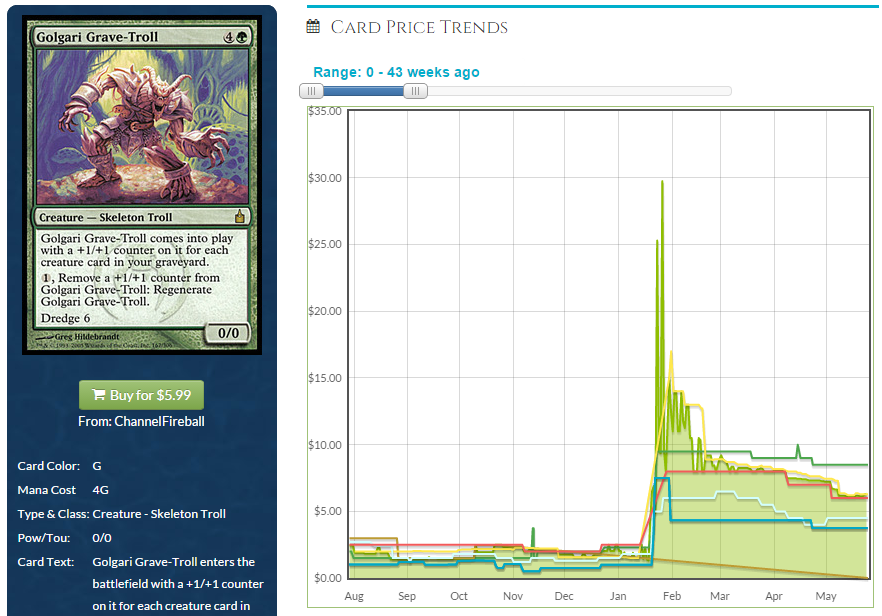
Perhaps a bit anecdotal, but it feels like Modern chatter is cyclical to me. A set release will bring with it extensive B&R speculation, and when the article finally goes live on DailyMTG, we get an answer one way or another. Banned cards hit buylists within minutes, unbanned cards are bought out even faster, and social media fills with complaints about dealers that cancel orders. Unbanned cards mostly fail to make an impact and prices slowly fall away over several months. Golgari Grave-Troll is a perfect recent example of this.

ggt

By the time the next set release rolls around, nobody seems to be talking about anything. I often forget that it’s going to happen until a day or two beforehand. The article is posted, no changes are made, and life goes on, at least until the next update is two weeks away and the speculation mill starts up again.

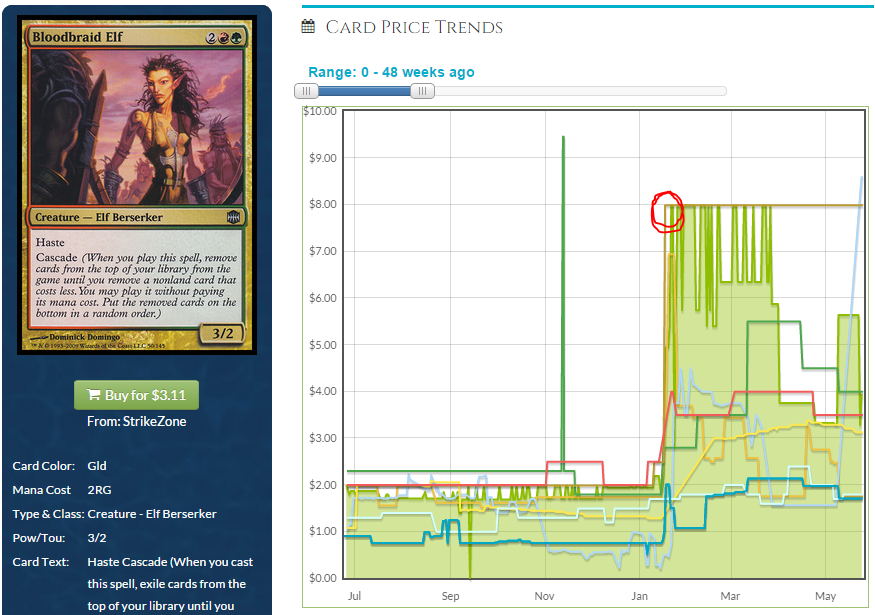
Back when Fate Reforged was on the horizon, everyone thought Bloodbraid Elf was coming back. Check out the price graph:

bbe

What’s amusing here is that 90-degree turn in the red circle is about a week before the update occurred. Rather than waiting for the update to find out if BBE would actually come back, people began moving in hard entirely on speculation. The update came and went, BBE stayed banned, and now we’re back to about $4, half the price of its frenzied peak, and double-ish the pre-rise lows.

Movement on cards ahead of B&R updates is happening earlier and earlier, and is exactly why we’re talking about this in the middle of two set releases, when speculation on the list is at its lowest. The time to buy cards coming off of the B&R list isn’t seconds after the update—everyone and their dog is trying to do that. Somewhere between a fraction to all of your orders will get cancelled, and you won’t have the cards until after the prices have already started to settle. If you really want to profit on B&R list updates, waiting until the list changes is a fool’s game. Action is required when nobody else is paying attention—now, essentially.

This is the primary lesson of today’s article. You don’t make money by buying cards immediately after updates. You make money by picking up cheap copies when nobody is looking, and then selling everything you have the second it’s unbanned.

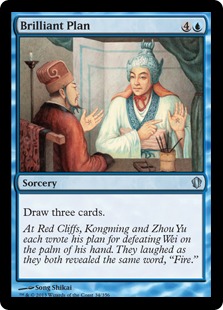
brilliantplan

Private Reserve

The secondary component of this article is looking at what’s on the B&R list today that’s worth picking up. Two key factors on this exercise: there’s no certainty whatosever in this process, not in the way that “Tasigur is going to go up” or “reserve list cards are safe” are certain. A card could be considered by the entire community to be impotent in a format and undeserving of a ban, but until WOTC scratches the name off the list, it’s going to languish in the bulk bin.

The other factor is urgency: there is none. You don’t have to run over to SCG or TCG or ABU or whatever immediately after reading this and go deep on Black Vise. My preferred acquisition on B&R targets is slower and less deliberate. If I see one in a trade binder, I’ll pull it out. People are often happy to move a card that has no immediate applicability. If I’m placing an order for something, I’ll see if they have any of my preferred banned cards in stock at reasonable prices. I also scan big sales like SCG’s back-to-school  for discounted cards on the list. Hall off on Mind Twist? Sure, why not.

All of that said, what’s currently on my watch list?

Modern

Bloodbraid Elf
While she missed last time, I’m confident that we’ll see her again eventually. There’s a good reason her price ran up so high before: a lot of people think she’s completely fair to add back into Modern, especially with the introduction of Siege Rhino as competition at the four-slot. If a portion of the community thinks that she’s fair to reintroduce to civilized society, there’s a good chance a few decision makers over at WOTC feel the same way. Also consider that when BBE was banned, Deathrite Shaman was legal. now that DRS is gone, the Jund strategy that BBE was supposedly propping up has mostly disappeared, replaced instead by Abzan.

Before the huge run-up in price, I liked FNM copies at $3 to $4. Post-surge, this price has stuck a lot closer to $10, unfortunately. While promos would probably hit $20 or more if she was actually unbanned, I like the normal copies more right now. They’re considerably cheaper, with $2 copies available if you look, and these will spike to $10 or more should she return. It’s also a lot easier to pick up a few $2 copies here and there than $10 copies.

Green Sun’s Zenith
With Birthing Pod’s departure, there’s a lot more room in the format for GSZ. The largest roadblock to Zenith returning is Dryad Arbor, as a single Arbor in your deck means that GSZ is always a better Llanowar Elf on turn one. A popular solution is to ban Dryad Arbor, which adds absolutely nothing to the format right now, and unban GSZ (hell, it’s worth banning just for that FTV: Realms art. How a card that deceptive passed inspection is beyond me).

Admittedly, this card was more interesting last year, while the price was still south of $5. Since 2014, we’ve seen the buylist increase significantly to keep pace with what appears to be casual and EDH demand. That’s good news, though. A solid demand profile without existing competitive appeal means that we’re unlikely to get burned holding copies, and prices could continue to rise from other sources while we wait for an unban. If this ever comes back, I expect prices in the $25 to $35 range out of the gate, and I’ll be right there with every copy I have.

Jace, the Mind Sculptor
I just want to take a moment to say that this is actually a terrible card to pick up on unban speculation. WOTC’s offices would be burned down if they unbanned Jace without printing a butt-ton more copies at the same time. Stay away on Modern speculation.

Legacy

Black Vise
The fact that people are scratching their head on this card every three months bodes well for Black Vise. Listening to people that know more about these strategies than I, it seems that this card is a completely fair addition to Legacy. A facet of the card is that it provides a way for burn strategies to beat up on combo decks that don’t manage to go off immediately, which is helpful in a matchup that currently leans heavily in combo’s favor.

With both Fourth Edition and Revised printings, there’s no shortage of copies out there. I’m targetting FTV copies, since it’s the only foil that exists. At $2 each, this is an easy $5 to $15 card should it get unbanned.

Mind Twist
Losing your entire hand to someone on turn one or two is the biggest fear with regards to Mind Twist. Some combination of land, Dark Ritual, Grim Monolith, and maybe another rock or two means you can take five to seven cards out of an opponent’s hand before they can meaningfully interact. However, under a slight bit of scrutiny this fear is easily allayed. A single Force of Will completely screws the guy casting Mind Twist, since he went all in to cast it, and his opponent is now only down two cards instead of six. And even if the Twist resolves, what’s left to do? The Twister casting it has a land, and maybe a mana rock or two left over, while the Twistee has maybe one card remaining. Advantage goes to the Twister, sure, but it’s not like the game is locked up. Both players are in top deck mode. Land, land, Tarmogoyf out of your twisted opponent is going to suck big time.

At $2 to $3, the buy-in is quite low. Like Black Vise, we’ve seen this in Fourth Edition and Revised, but at rare rather than uncommon. Concerns over the card being too good will abound in the days following the unban, with plenty of dark mages looking to play Twister in the near future. This will be $10 easily with a return to Legacy.

Mind’s Desire
I really doubt it, but I’ve got a small stack just in case. With only a judge promo and the original Scourge copies on the market, and a nearly guaranteed four-of status in any deck where it sees play, the reward is high enough for the risk that this never comes back.

Got Any More?

These are my current favorite B&R list targets these days. I’m curious to hear arguments for other options in the comments. Remember that the best time to scoop up these types of cards is exactly when nobody is talking about them. Set alerts on your calendar to remind you when to start looking if you have to.

As for those of you heading off to Vegas: see you on the floor!

UNLOCKED PROTRADER: Left Behind

By: Travis Allen

Over the last two weeks, we’ve looked at the complete Modern Masters 2015 spoiler. We explored lots of individual cards, what this printing means for their price outlook, and the texture of the set overall. I wanted to make sure we all had as much insight as possible into what was hitting the streets, so that when it does, we’ll all be ready.


One thing I didn’t cover yet that is quite important, like yin to yang, is not what’s in the set, but what’s not in the set. The absence of some cards will have just as dramatic an impact on the market as the inclusion of others will. After all, when Emrakul, the Aeons Torn was spoiled, prices didn’t crash overnight. Yet once the full spoiler hit and Inkmoth Nexus was nowhere to be found, it more than doubled in hours. Keeping tabs on what’s in the pipeline and not standing in the way when the reprint bus barrels down the street is a good way to make sure you don’t lose money, but if you want to make money, you need to be paying attention to what’s not showing up on time.

Today, we’re looking for the gaps and the omissions. Our goal is to understand some of the reasons some of these cards may not have made it in, where they may show up next, and what all of this means for prices over the next six months.

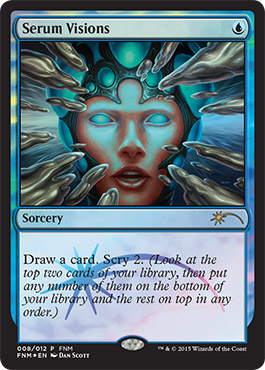
Serum Visions 

Visions is perhaps the most egregious offender in this roundup, with public discussion regarding its curious absence more prevalent than any other card. As a $10 common played in roughly one-fourth of all Modern decks, what could possibly be a better option for a reprint? Many, myself included, thought it was coming all the way back in September when the art for Omenspeaker was revealed independent of the rules text. When the Theros block, which even contained scry, came and went without Visions, we were all a bit confused. Expectations shifted, placing Visions in MM2015. It all felt a bit like I imagine a doomsday cult must feel when the day of rapture comes and goes without even thunderstorms. People mill aimlessly, dazed, lost. Where are the Visions?

My guess is that Wizards got  caught with its pants down on this one. About a year ago, Visions was about $6—expensive, but not yet out of control. A year prior to that, it was between $2 and $3, which is true of many commons and no cause for concern. It sounds as if R&D may have considered Visions briefly for MM2015, but after deciding scry wasn’t making it in the set, chose instead to print it as a summer FNM promo. They hoped that the FNM promo would be enough to keep the price in check, not realizing that the card was destined to gain another $4 to $7 by the time MM2015 was on shelves. Unfortunately, FNM promos almost never do much to prices. Supply is low and alternate art often drives those with existing copies to acquire the promo. The new artwork for Visions is dramatic, and the result is that many that already own playsets of the Fifth Dawn copies will want a new set anyway.

Wizards is now stuck. Visions is badly in need of a larger reprint and there’s nowhere for it to go. It missed Elspeth versus Kiora, it missed MM2015, it’s terrible in Commander, and no expansion sets will have scry anytime soon.

At this point, my thinking is that there are two potential lines for Visions to take. The first is that Wizards is going to make scry evergreen, as has been done with hexproof. It’s not a terribly complicated mechanic, and it provides an additional knob with which to balance spells. If this comes to pass, it could show up in any Standard-legal set. Is any of this likely? I can’t say that it is, but it’s one possible avenue.

The second possibility is that Wizards may shoehorn it into Zendikar versus Eldrazi or this spring’s planeswalker Duel Deck. Either would be an appropriate place to include it. We saw Remand included in Jace versus Vraska last spring, which was no different.

There exists an opinion that the absence of Visions indicates a banning on the horizon. There are a variety of reasons I don’t believe that to be the case. Rather than detail them all, suffice to say that it’s possible, yet I’m not operating as if it will come true.

Unless scry becomes evergreen and is printed in Origins, none of the reprint avenues will do much to dramatically reduce the price. Showing up in a Duel Deck will take a notch out of it, sure, but not down to $3 or $5 levels. Mostly, it seems like Serum Visions is slated for continued growth, with $15 or $20 possible this summer. I’m not saying it will rise that high, but with no extra copies on the horizon and a mild panic regarding its absence, it’s not outside the realm of possibility. I’m happy to take these in trade in the short term. Pick them up now, ride any gains we see through the Modern PreTQ season, and ship them if they ever hit $15. Keep a personal set, and see just how high a modern-border common can go.

Goblin Guide

As a contender for “card your opponent hates you most for casting on turn one,” Goblin Guide has been a tool of sadists in Modern since the birth of the format. With the recent “what the hell were they thinking” printing of Eidolon of the Great Revel, Guide has only gotten stronger. It spiked dramatically last summer, and lately has been hanging around in the $20 range. It’s possible that part of the reason it didn’t hang around closer to $30 was because people expected it to show up in MM2015. Now that it hasn’t, what’s the play?

My guidance is to stay away. When Visions didn’t appear in the full spoiler, everyone was left asking, “Well then, just where the heck are they going to put it?” and, “Why is Travis using so many fake quotations?” With Goblin Guide, though, it’s just been, “Oh, I guess it’s in Battle for Zendikar.” Guide can show up in theoretically any expansion set, so long as it’s balanced around its presence. With no keywords and a name that doesn’t tie it to a specific plane, it’s the closest thing Magic has to a free agent. Knowing this, if we own speculative copies, we’re going to be biting our fingernails about whether Goblin Guide is going to show up every single time a spoiler season starts. This isn’t a position I’d like to be in. Even if they don’t reprint Guide this year and it ends up at $40, we can’t feel bad about staying away. Remember, be process-oriented.

Aven Mindcensor

While Serum Visions is the most obvious missing common in Modern Masters 2015, I find Aven Mindcensor to be the most glaring omission in the silver slot. Mindcensor has been running around Modern and Legacy for years now with a peak price of $15 for nearly all of last year. That price has since come down to around $10, but without any extra copies entering the market, we may see that number climb back towards or even north of its previous peak.

Magic 2015 brought with it Hushwing Gryff, another 2W 2/1 flash flyer with hateful text. At first blush, it seems that Aven Mindcensor may be primed to take over that slot this summer in Origins. After all, like Goblin Guide, there’s no keywords or flavor on the card that would prevent its inclusion in a core set or other expansion.

And yet, I’m highly suspect of the theory that we see it in either Origins or Battle for Zendikar. Why? Well, part of the reason Mindcensor is so popular is that it hoses fetch land activations. When someone cracks a Scalding Tarn, you flash down Mindcensor in response, and then they can only look at the top four to find an island or a mountain. No luck? Too bad. It’s a way for hatebear style decks to restrict an opponent’s resources while simultaneously applying pressure.

My concern is just how powerful this effect can be. Modern is a faster format, where losing your third or fourth land doesn’t necessarily lock you out of the game. There’s plenty of powerful ways to answer Mindcensor, such as Electrolyze or Forked Bolt. It’s dead against some opponents, and a format like Modern typically punishes dead cards much harder than Standard does.

Mindcensor in Standard would be much stronger. Games go longer and average spell costs are much higher. Stopping someone’s fifth or sixth land in Modern is often irrelevant, but in Standard, it’s still possibly a completely backbreaking play. It effectively becomes an instant-speed Stone Rain for 2W that also leaves behind a 2/1 flyer.

So long as fetch lands are in Standard, I don’t think we’ll see Mindcensor. The effect is simply much stronger in Standard than Modern as long as fetches are running around, and it’s strong in exactly the way Wizards doesn’t want it to be. Perhaps next spring, when Khans and the fetches rotate out, we’ll see Mindcensor show up. Until then, assuming Wizards doesn’t want it in Standard, it’s in the same boat that Serum Visions is: the two Duel Deck releases and maybe Commander product. If that’s the case, the short-term outlook for Mindcensor is quite rosy.

Inkmoth Nexus

This would have been great to talk about if it didn’t spike within 24 hours of the full spoiler dropping. As is: sell extras, stay away.

Blood Moon

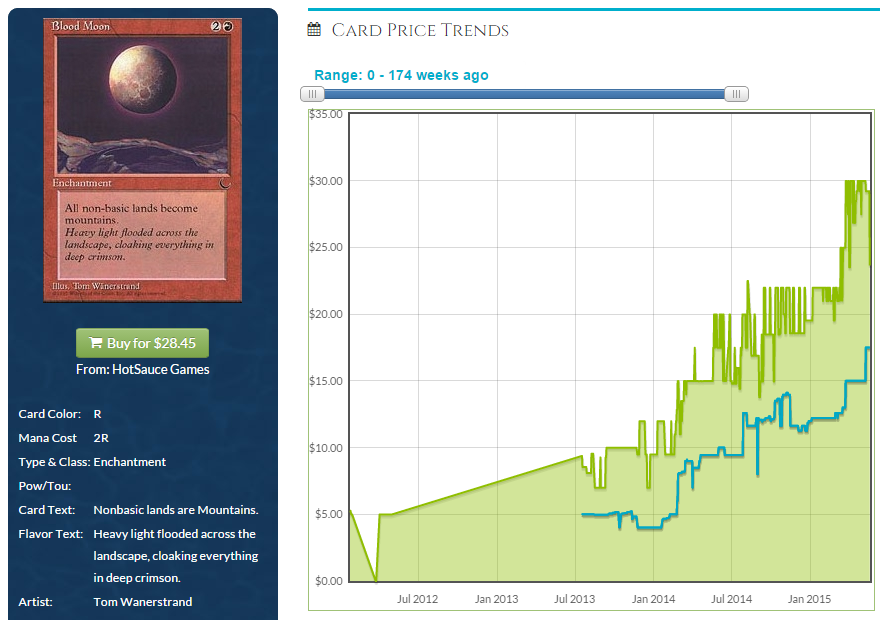
The land denial strategy of choice in Modern, Blood Moon has a whopping five printings in the wild, and still clocks in at $30 today. Advocates of format accessibility (AFAs) were desperately hoping to see some full moon action in MM2015, but alas, we’ve seen no such exposure. There’s little debate regarding this one, either. While BMing is satisfying, it’s simply not an appropriate thing to do at your card store every Friday night. Very few would consider this a reasonable card to print in Standard, so we’re exclusively looking at supplementary product for more copies. Once again, that leaves us with a short list: upcoming Duel Decks and Commander product. Blood Moon would be a rather odd inclusion in the DD series, and putting it in a product aimed at EDH players is sure to piss off a huge swath of kitchen-table players that just want to be able to cast their spells.

bm

We’ve seen consistent and unchecked growth on Blood Moon so far, and at this point I see no reason for it to abate. No more copies are on the horizon, avenues for reprint won’t bring many to the market anyways, and this card’s price ceiling is at least $10 away. I’m expecting $40 before the end of the year, possibly higher. Trade accordingly.

What Else?

The list of cards not in MM2015 is of course much longer than the list of cards above. I’ve captured several high-profile cards here, but I’m sure there are many more out there that stand to gain. Infect commons like Vines of Vastwood and Might of Old Krosa come to mind. What others have you noticed and think are ripe opportunities?