Apples and Oranges

The apples and oranges of MTGFinance might be clear cut to some, however to others they can lead to mistakes that make Magic a very frustrating game to play on a set-to-set basis when considering the financial aspect of the game. These are some of the areas of interest that we all are aware of but sometimes think that the application of one area can apply similarly to the another in exactly the same way. The differences are subtle, but can make a world of difference when you consider the ramifications.

Let’s take a look at some of these scenarios and see where the differences lie.

Print mtg1

Example One – I’m buying or trading into my Standard cards for the next few months by closely watching Pro Tour coverage, and making my decision based on the the results seen. My friend is also making these same decisions at the same time but instead of watching Pro Tour coverage he is instead following the advice of Twitter personalities (finance or otherwise) in order to make his decisions.

Here, we might wrongfully assume that these two scenarios are basically the same thing. However, picking cards through watching coverage is vastly different than using Twitter to decide on which cards are the best to get in on. Twitter in this case can actually be much slower, and the reason why is the old adage “If someone already is talking about something it’s too late.” Also, by watching coverage you can actually see just how powerful the card in question really is. Did the card make an actual, significant impact on the game? Or was it just a “win-more” card that supplemented the game but wasn’t the vital piece of the deck’s strategy? A picture is worth 1,000 words and video coverage is almost impossible to convey in 140 character blurbs.

The reason I mention this is because even I myself have been burned in the past by thinking that Twitter is enough to see where card prices are going based on weekend results. The real gains come from a more in-depth look at the weekend, including watching live coverage and also deck analysis (if you have insider access to SCG premium for example) prior to the event.

In this example, both players would be on the same level if they both analyzed results on a deeper level.
mtg4

mtg3

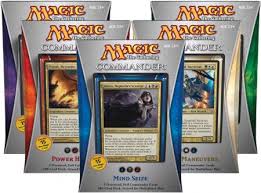
Example Two – I have a great idea for a spec, and want to buy in on that spec in mass quantities before the market catches up to the real demand. So, I buy 300 copies of the card all at less than $1. The card is from the Commander product series and does see an increase from $0.75 to $4 within the next week.

My friend also decides to spec on a card, and he buys in on 300 copies of his card as well. The card is from a Standard legal set and also goes from (let’s say) $0.50 to $3 overnight as results from the latest tournament roll in. We’re both going to making bank, right?

Well, here you would (almost always) be dead wrong. Commander speculations are certainly great, however they are always for the long term – when making a Commander speculation I know that I am going to hold onto that card for at least one year before I can start largely liquidating the stock. Standard, on the other hand, everyone wants because it is the most popular format. That card that my friend speculated on will be super easy to liquidate since all the big retailers are going to want 20+ copies each, and will continue to want them as they keep selling out of stock. This also means that the buylist price will stay higher for a longer time since the demand is just so much greater. Niche cards tend to have their buylist prices decreased once supply is filled since stores run out of stock less often.

This is why for Commander I prefer to stock up on foil versions of popular cards rather than non-foil versions, simply because as they age they will go up even more in value than non-foil versions and I get the added benefit of being able to easily sell them on eBay since many players pick up foils through that medium. I’ve got a solid binder of Commander foils that keeps appreciating nicely over the years, and I attribute it to my philosophy on trying to get foil versions of Commander cards over non-foil.
mtg5           mtg6

Example Three – I keep a running tab of my purchases, sells, and profit margins through a spreadsheet that I maintain myself. My friend uses several different sources to keep track of progress – PucaTrade, Deckbox, MTGPrice, etc. We both know exactly where we stand in terms of net profits, right?

Here, the line becomes more blurred between apples looking more like oranges but I still feel that these two separate methods are distinct in a very big way. Time management. Managing your own spreadsheet of gains and losses, trades and buylist sells, can be exhausting and it doesn’t have to be that way. I used to spend hours combing through my list, sometimes daily, to see where I was headed in terms of boosting the value of my collection. Now, the internet and programming have made much that management very efficient. Utilizing tools like PucaTrade, Deckbox, and MTGPrice to keep track of a collection is nothing short of incredible. Only slight updates are needed and the system takes care of the rest. Sure, there are still time management issues when it comes to inputting large amounts of cards at a time (which hopefully will be resolved as picture scanning software becomes more usable for both commercial and private ventures) but hopefully as time goes on it will become less painful to manage larger and larger collections.

Look Out for Differences!

I hope that this article has shown you that there are differences, however slight, in the way that scenarios are setup that can lead to hugely different outcomes when dealing with the financial side of Magic. I’ve shared my top three scenarios that I find can sometimes mislead players into thinking they will get the same outcome as someone else, however did you have any other scenarios in mind when reading this article that you also think are pretty relevant to Magic (or more specifically MTG Finance) ?

I’m always on the lookout for more ways in which things appear to be the same but are actually different, for it is in this way in which we find the best path to compare methods and to see the optimal way to improve them.
PROTRADER: A Deep Dive Into Fetch Lands

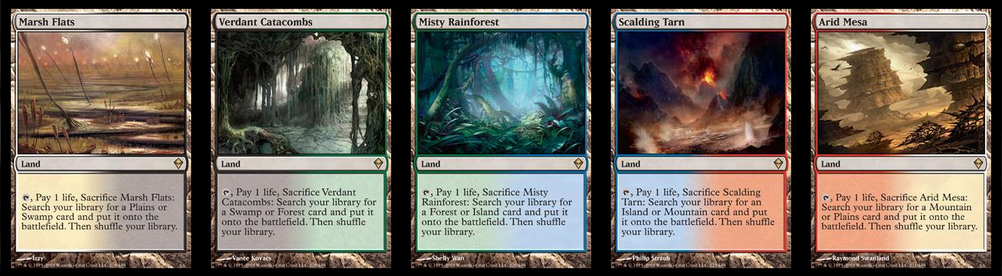
It’s been nearly three years since we saw the reprint of shock lands. In other words it’s been three years since dozens of MTG speculators invested in fistfuls of the Modern dual land – it was the beginning of a long, arduous journey…a journey with few bumps and even fewer profits. If bonds are seen as safe, unexciting investments then RtR shock lands are the epitome of MTG bonds. Except, with shocks there were no distributions or dividends.

Naturally, when Khans of Tarkir brought us the Onslaught fetch land reprint, many financiers, myself included, were leery of the investment opportunity. Could this be another shock land debacle? Would fetches be reprinted again and again in subsequent sets, making all prospect of profits virtually absent?

I’ll be first to admit I thought the answer to these two questions was “yes.” Acting cautiously as always, I limited my exposure to Khans fetches to no more than around twenty copies. When I shifted focus towards a portfolio refresh via massive liquidation at GP Vegas, I unloaded the vast majority of my Khans fetches. Fortunately, I made a handy profit on this pursuit. Unfortunately, I missed out on additional gains.

I hadn’t foreseen this:

Tumblr

The rest of this content is only visible to ProTrader members.

To learn how ProTrader can benefit YOU, click here to watch our short video.

expensive cards

ProTrader: Magic doesn’t have to be expensive.

PROTRADER: Not My Fifth Dawn Review

So I originally promised that today would be the Fifth Dawn review, and you’ll see that in this space before long (probably), but there is something else I want to talk about first, and it may turn out to be one of the more interesting finance topics of the year.

What do you know about the Magic board game?

Yes, I’m serious.

The rest of this content is only visible to ProTrader members.

To learn how ProTrader can benefit YOU, click here to watch our short video.

expensive cards

ProTrader: Magic doesn’t have to be expensive.

Are You a Terrible Trader?

By: Cliff Daigle

I imagine that most of the people reading this have, at some point, carried around a binder full of unneeded Magic cards and have traded some of those cards for other cards which you did need.

Ideally, you found a partner, both of you found some cards you wanted, you agreed on values, one of you added or took away from the pile, there was an agreement, perhaps a handshake, and you both walked away happy. That is how most trades go. It’s why I love trading! I get rid of what I don’t want and get what I do want!

Unfortunately, as much as it pains me to say it, trading Magic cards with someone else can also really suck.

Let’s talk about some of the behaviors that can not only make a trade difficult to complete, and in some cases, can prevent people from trading at all.

If these are behaviors that you exhibit, don’t worry, I’ll help you change your terrible ways.


Symptom #1

You have lots of cards in your binder that are not for trade. 

So if you’re ever been flipping through a binder and you see something you’re interested in, you should ask about its availability. It’s okay if that card is not going to be part of a trade…to a point. I can understand if you are thinking of building a deck, or it has sentimental value, or some other reason it’s not for trade. But please, please, please, I beg you, don’t keep them mixed in with the cards you do want to trade. About the third time you tell me something isn’t for trade, I want to slam your binder closed and hurl myself through a window.

I will still respect you if you don’t want to trade that card for the measly pickings in my binder. I’m an adult. I can handle being told “There’s nothing in here I’d trade my foil fetches for.” That’s perfectly acceptable. That’s honest and clear. Don’t use “That’s not for trade” as a euphemism for your lack of interest.

The cure: Get a different binder, and put the special cards in it. It’ll be up to you if you want to bring that binder around. Turn the special cards upside down, or put them all in the last page of the binder behind a spacer page, clearly marked as NFT.

Symptom #2

You don’t look up prices or get impatient with those who do.

Though I’ve been writing here for a while, I don’t have every price of every card memorized. Therefore, I look up prices! I imagine almost all of you do. But if you did bother to memorize every price in Origins in time for the prerelease, don’t expect me to take you at your word. Prices change, people want to be sure, and if you’re in a hurry to close a deal it can look awfully shady.

Generally speaking, people are cool with trade partners checking a price on their phone but I’ve met some who aren’t, and that’s someone I don’t want to make a deal with.

The cure: Learn to be patient. Even professionals have to be patient when dealing with amateurs. Understand that no one wants to be taken advantage of.

Symptom #3

You fixate on one card.

The worst offender in this category is the person at your LGS who fancies himself the next great financier by only trading for fetchlands right now. You want his Obelisk of Urd, he picks out your Polluted Delta, and then it’s off to headache-land because he won’t consider small trades. It’s really easy to burn someone at your store by being relentless about these things, and you have to remember that you are making an impression with every interaction.

It’s fine if you need that Polluted Delta and the Obelisk is the starting point, but needlessly escalating a trade is something that will turn everyone off from you rather quickly.

The cure: Be okay with small trades. Recognize that you’re building valuable friendships. The Delta might not be traded today, but there’s always tomorrow.

Symptom #4

You try to set up both sides of the trade.

Let’s go back to that guy’s Obelisk and your Delta. You say “You don’t have enough that I want to trade away the Delta,” a perfectly reasonable statement. He says, “don’t be silly. I will add a playset of Hero’s Downfall and now it’s a dollar in your favor! Are we good?”

Did you ask for the Hero’s Downfalls? If you didn’t ask for that card, why is he proposing this? If you’ve ever worked at a restaurant, you know that the chef’s special is something that is about to go bad and the kitchen needs to get rid of it. In this case, the Downfalls are about to rotate out and it sees almost no Legacy/Modern play. This guy is trying to move cards he knows are going bad for a card that has nowhere to go but up.

The cure: Let people decide what they want. You’re allowed to propose things, especially if you’ve established that there’s a certain deck being built. Don’t offer cards they don’t need just because the numbers theoretically line up. You’ll build a reputation as a shark and someone to avoid.

Speaking of people to avoid…

Symptom #5

You have ever been a ‘Value Trader.’

There have been more than a few infamous people who wear this label with glee. Because you have a card someone else wants, you feel privileged enough to ask for more than that card’s value. This is much more than asking for a markup when trading your dual land for their Collected Companies and Siege Rhinos. This runs a wide range of behaviors, from the slight one of always making sure your side of a trade is $3-$5 more, to the extreme, of putting their values at buylist while yours are full retail.

I’m sure you have a thorough rationalization as to why it’s okay for you to do this. The worst excuses are that you can get any card; that you are the one people come to for all sorts of cards. Maybe you’re trying for a pack to power, or whatever goal you have. Maybe you trade cards as a business to pay your rent.

I would probably sit through it and then excuse myself. Who will trade with you twice when you do such unfair things? I’d rather deal with actual buylists than your amateur behavior.

The Cure: Understand that at this moment, everyone’s cards have value. Theirs are not worth less just because it is currently in their binder. You are not a special and unique snowflake who gets to rip people off. Learn to trade for future value, and grow your binder that way instead of making uneven trades today.

MAGIC: THE GATHERING FINANCE ARTICLES AND COMMUNITY