PROTRADER: A Game of Crowns, Part I

Spoilers for Conspiracy 2 have begun, and the early results are… concerning. I enjoyed Conspiracy 1 the few times I found people who were willing to play it, and the new mechanics so far seem to do a good job of addressing the inherent flaws in multiplayer Magic. On the other hand, there is a lot to be really nervous about from a financial perspective. Let’s start with the most obvious issue, one that we actually first broached when EMA was released.

EVERYTHING IN ITS RIGHT PLACE: When Mark Rosewater and company “discovered” the Magic psychographics (Timmy/Tammy, Johnny/Jenny, Spike/…Faye Valentine?), they were used as a means of explaining the various subgroups of players that particular types of cards appealed to. What has happened since then, however, is that we’ve seen a rise in smaller supplementary products which are geared more largely towards alternative types of play. In the big picture, this is a pretty good solution- too many big green idiots in a Standard set (an appeal to Timmy/Tammy) just makes green less playable in Standard. But printing a green Commander deck full of hydras and elves and ramp spells or whatever gives that type of player EXACTLY what they want (and all in one box!), without having to compromise standard for several months.

The system isn’t perfect, however. Some cards don’t fit neatly into one category or the other. Even though things like Lightning Bolt and Bloodbraid Elf look rather tame in Commander, things like Jace, the Mind Sculptor are still good enough to make the team. Additionally, and this is what we talked about with Eternal Masters, WotC wants to make sure that there are cards in these ancillary products for other types of players/formats. That’s where things start to get complicated. It’s easy to put a few splashy and interesting rares or “build-around-me!” uncommons in a normal set and keep people happy. For players who aren’t deeply entrenched in Magic or playing in sanctioned events regularly, it’s often enough to keep them interested. With things like Commander decks, supply-side factors like “making sure we print enough of them” and “maybe don’t make things like True-Name Nemesis anymore” have solved the problems that come with putting Legacy-defining cards in otherwise casual products. Ultimately, Conspiracy is neither of these things.

You need your insulin!

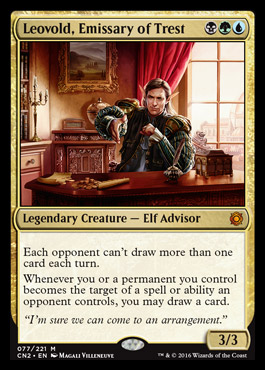
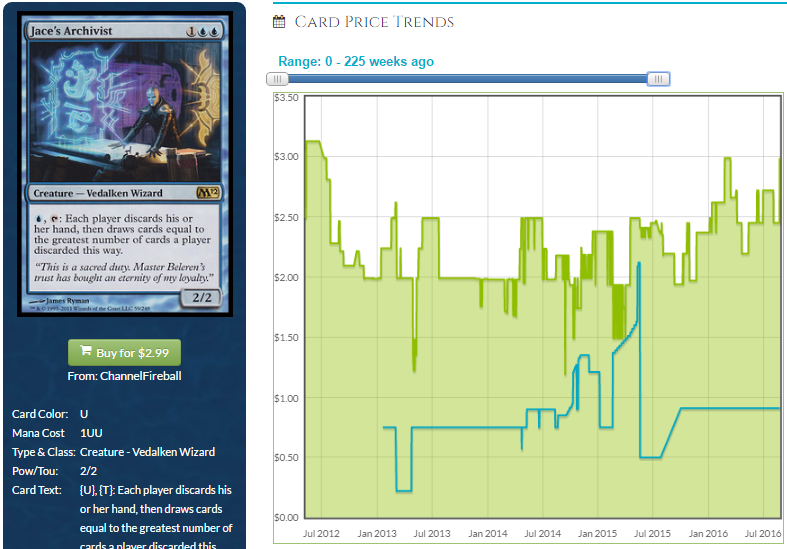
Let’s assume that there are three roughly equal markets for a product like Conspiracy: Constructed Magic1 players who want saucy reprints, Commander players who just want new stuff (and different flavors of saucy reprints), and people who play things like Cube or other casual formats. Because WotC can now direct entire product lines (in this case, an entire draftable set) at a subset of players that AREN’T tournament-oriented, they need to include cards that appeal to these other markets as a means of buoying interest among the underserved populations. Plainly, we want to make sure this sells, so some of the cards are not going to be for the people this product is meant for. In the first Conspiracy set, that was made obvious by things like this:

This card is awful in a 4-player game.

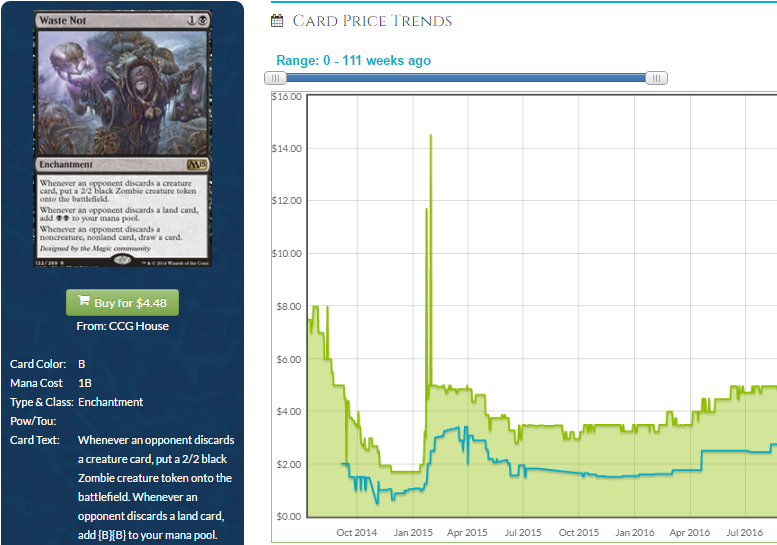
Only to be followed up by this:

This card is roughly as awful as Stifle (in this context).

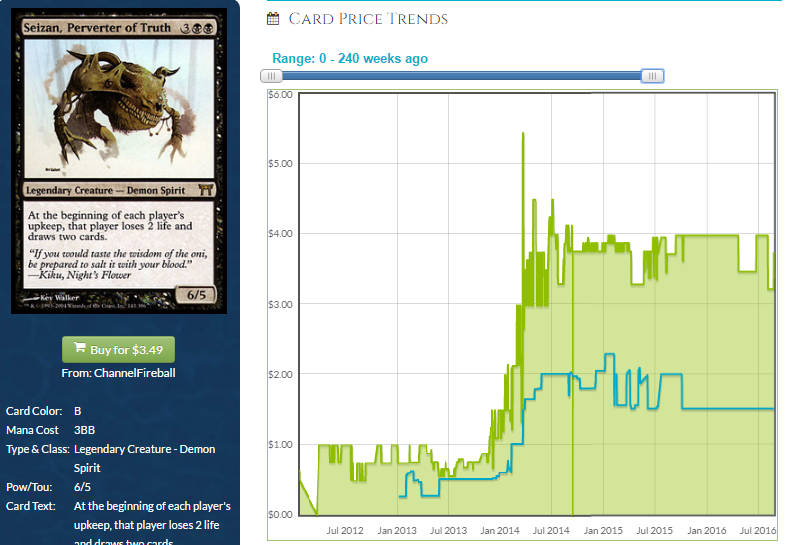
This(!):

At least this kills a guy?

And (BREAKING NEWS!) potentially this:

Honestly, this one makes the MOST sense.

If all of these spoilers are true, then it’s going to be interesting to see what percentage of rares/mythics are playable in Constructed. Why? Because (and this is not a sleight against casual players) the demand for tournament-level cards is stronger. Not necessarily “higher” (although we can’t know for sure), but you definitely need four REAL copies of Berserk to play Legacy Infect. Because there is no true pull to make sure that there are no proxies or worse versions of a card in your Kitchen Table Commander League, there is no pressure to get them at a time or price outside of your existing comfort level.

SUPPLY: If we can expect the majority of the remaining rares/mythics to be Conspiracy (the alternative play format) centric, then it’s very likely that this set holds a tremendous amount of value in a very narrow percentage of cards. Show and Tell is currently sitting around $65 on SCG, and they sold out of new Berserks at $50. Inquisitions are available around $13 in their previous printings, and Burning Wish is available for about $8. Ignoring foil prices, there are only two cards in the first Conspiracy set above $10. The majority of the rares/mythics in the bottom half of the price spectrum are multiplayer-oriented and essentially unplayable in Legacy. There is still some CNS available in most stores that I pop in to, but it’s largely because there’s not a huge drive towards getting it.

We don’t know the print run size yet, but it’s safe to assume that because this is a smaller market product (aimed at a narrower band of players, is not going to be in mass retailers like Wal-Mart) that it won’t be produced as heavily as Eldritch Moon. I expect a little bit of the product (10% or so) to stay on distributor shelves in case the product sells really well so that it can act as a proverbial carrot to move something less exciting (those new intro planeswalker decks?). A lot of it will get opened by players trying to get a set of Berserks and/or S&Ts, meaning that most of the cards in the set will bottom out right away. I don’t know how many copies of Adriana, Captain of the Guard YOU need, but they will certainly be available. Because things like Berserk are (nearly) impossible to print, expect these marquee cards to not show up again for several years. This is going to buoy the price once printing stops, and they’ll slowly creep back up after that. Also, because all the cards people REALLY want are mythics, don’t expect your local environment to be flooded with them overnight. You’re still going to have to work to finish out your Sneak & Show list.

But hey, cheap birds.

Tune in next week for the shocking conclusion of my Conspiracy 2 analysis. That is, if the GOVERNMENT doesn’t get to me first. Or is it just a shadowy cabal of people who work in the government? And who does that alien bounty hunter guy work for? Them, right? You know, the one played by that actor who was essentially TV Schwarzenegger in the 90s? And Alex Krycek died, right? Man, that show was crazy.

The truth is out there,

Ross

1Bearing in mind that this set doesn’t affect Standard at all, and has, currently, one high-profile Modern reprint (at a higher rarity!). Constructed here really just means “Legacy and Vintage”.

PucaPicks for August 18, 2016

Welcome back to PucaPicks!

I can’t wait to go over some of the cards which are undervalued and which are overvalued. Last week I talked about Oath of the Gatewatch and Battle for Zendikar, and this week most of my attention is on the rotation: Magic Origins and Dragons of Tarkir!

There are some cards in here which I love love love, and others barely worth the effort of a stamp. Let’s get to it!

The rest of this content is only visible to ProTrader members.

To learn how ProTrader can benefit YOU, click here to watch our short video.

expensive cards

ProTrader: Magic doesn’t have to be expensive.

PROTRADER: Expeditions, Ten Months Later

By: Travis Allen
@wizardbumpin


Don’t miss this week’s installment of the MTG Fast Finance podcast, an on-topic, no-nonsense tour through the week’s most important changes in the Magic economy.


The rest of this content is only visible to ProTrader members.

To learn how ProTrader can benefit YOU, click here to watch our short video.

expensive cards

ProTrader: Magic doesn’t have to be expensive.


A couple of weeks ago we looked at how Battle for Zendikar prices have fared overall with respect to the Expeditions. This sort of retrospective is useful, as it informs us about how the market responds to changes in typical expansion products. The next time they do an Expeditions run, we’ll know much more about how the set they’re included with will react.

How about the Expeditions themselves, though? Originally released in Battle for Zendikar on October second, it’s now been a little over ten months since the initial run, with the Oath of the Gatewatch cycle coming three months later. This special print run was the first of its kind in more ways than one. The closest we’ve seen to special pack inserts at that distribution level was the original Zendikar “priceless treasures” promotion, which included cards from Magic’s earliest years showing up extremely rarely in packs. We had never seen “luxury” lands quite like this, at least not in this volume. They came with all new art and all new borders. Some of the cards were Standard legal while others weren’t even legal in Modern. Overall, Expeditions as a whole was a theretofore unknown quantity.

Initial expectations were that prices would be wild on these. Alternate art, new-border foils of some of the most played cards across Magic’s domain had to be valuable, especially if their print run was limited. What devout Vintage, Legacy, or Modern player wouldn’t at least consider them? Every writer chimed in, even the non-finance ones, with their expectations of how these would impact Magic as a whole. It didn’t take long before there was activity. Scalding Tarn exploded pretty quickly, and other blue fetches saw rapid movement as well. Expectations were generally that it would be tricky to pin down exactly what the rate of growth would be, but that there would almost definitely be steady growth for a long time. With limited supply and no foreseeable reprints on fancy, highly-desirable constructed cards, what else could happen?

Today we’re here to see how that has panned out. I noticed a couple on my desk the other day and began thinking about how well they have or haven’t done. Several months ago I bought quite a few, and I haven’t bothered to check in on them in awhile. I’m sure I’m not the only one with spare copies set aside, so let’s see how Expeditions are looking almost a year after release.

cata1c

floo

vents

stom

Clearly, things are not all rosy profits.

Looking through price graphs for all the Battle for Zendikar Expeditions (I’m ignoring ones from Oath of the Gatewatch for the time being), there’s a consistent theme among them. Prices were loopy at pre-release, then dipped pretty hard. They climbed to a peak sometime in January, and since then they’ve mostly been losing ground, albeit at a snail’s pace. There’s minor variations on that theme, but overall, it’s a recognizable pattern.

If we extend our purview to the Oath of the Gatewatch copies things don’t change much. Anything that isn’t Ancient Tomb or Eye of Ugin — both lands that were (and still are, in Legacy) part of Eldrazi Winter — remarkably resembles the bunny hill at your local ski slope.

Looking at this data, I find myself with two questions. What the hell happened, and what do I do now?

As for the first — I’m not quite sure. Sussing out causality in a muddled market burdened by the inconclusiveness of reality is always a questionable endeavor at best. Without clear and measurable evidence you’re never really quite sure why things that happen, happen. You’re left with educated guesses and not much more. (And if you’re Hume, that’s all you ever get, period.)

Basically everyone expected these things to begin rising in price within a month or two of hitting shelves. A simple understanding of economics would lead you to that conclusion. You have a good for which 95% of supply will be available within several weeks of its initial release. After that players will slowly acquire their own copies whether via binder grinding, PucaTrading, or purchasing them outright. Slowly but surely less and less copies will be available to the general public. Prices will begin to rise as a result. Seems easy, right? It can be tricky to nail down the scale of time, but the general trend was clear.

Instead, these have lost ground since the beginning of the year for the most part. Why would they do the opposite of the obvious?

One explanation is that they’re still on track to behave as we always planned, except over a much longer time frame than anticipated. Perhaps the period where supply is outpacing demand and prices are falling as a result didn’t take two or three months, but instead is taking upwards of a year or more. These are undoubtedly expensive cards, and it may take time for people to scrounge up enough capital to acquire these. Only after the slack in the market gets picked up will supply begin to see constraint and subsequent rises in price. If this is the case, then we would expect to see an inflection point eventually, and then the climb back up. At the very tail end of some of the shocks you can see an upturn. Is that a wrinkle or the start of a trend? It’s impossible to say at this point.

Perhaps instead it’s not a time frame issue, but one of incorrectly assigned demand? Prices may have been as high as they were early on because everyone thought everyone else wanted copies, but it turns out nobody actually wanted them. Upon examination, they’re truthfully not the greatest looking. They’re dark, trend towards warping, and the foiling process isn’t ideal. Even though the frames and art are selling points, once they were in people’s hands, the general consensus was “oh, these aren’t as cool as I thought.” As a result perhaps there’s considerably less demand in the population for these, and we’re just watching the prices fall until they finally meet people’s revised opinions.

Another perspective is that it’s just been a mediocre eight months for flashy manabases. Here’s the chart for a few Return to Ravnica block foil shocks.

vents 2

tomb 2

shrine 2

grave 23

Looking at these graphs, with the exception of Steam Vents perhaps, I find the word “malaise” on my fingers. Foil RTR shocks have been around a lot longer than Expeditions; certainly enough to burn through excess supply. Why then would prices be softening on these as well? This would indicate it’s not just a matter of Expeditions trying to work through the initial onslaught of supply. Interestingly, the original Zendikar foil fetches have fared a bit better. Only Marsh Flats looks worse today than it did around BFZ’s release.

flats

tarn

My suspicion is that this has to do with our understanding that the overall playerbase of Magic is shrinking, or at least growing far less quickly. Evidence of this is found in Magic’s product release schedule changes over the last year and a half or so. Standard seasons have been shortened, requiring players to purchase more cards to keep up, and the product release schedule is blazingly fast these days between expansion sets, summer multiplayer set, clash packs, commander decks, limited release products, and more. If you’ve got fewer total players buying cards, increase the number of cards each player needs to buy.

If it’s true that this is related to playerbase shifts, it still makes sense that cards from the Zendikar era can rise in price while cards from RTR and forward just can’t keep it up. Return to Ravnica was the tipping point where they cranked print runs to 11, and since then, there has seemingly been far more supply relative to the player base than years prior. As a consequence of that, it may be that luxury (as if that somehow differentiates one Magic card from another) cards from newer sets aren’t going to have the staying power that older ones do. Now even if we went into BFZ with this as a clear concept we wouldn’t necessarily think Expeditions would be as vulnerable to this, given the limited run. And yet, here we are.

We could probably sit around and philosophize about the flaccidity of foil mana bases for awhile. We’ll never have an exact answer though, and we’ve got to decide what to do before this article ends.

This is not an easy call. In one universe, I hold onto the Expeditions with the expectation that they begin rising. Instead they continue to falter, and rather than having cut my losses, I end up even deeper underwater. In another universe, I sell them now so as not to get gotten by the gambler’s fallacy, and by this time next year they’re up 30%. How do we avoid getting nailed by both of these?

I went looking for more data points to try and better educate myself on what the right strategy is. What has happened with other cards in the same general vein? I started with FTV sets. Those are limited run reprints that always contain a handful of constructed relevant cards. They’re not exactly the chasiest of chase cards, as the FTV foiling is heinous and a detriment to the product rather than a boon, but the Expeditions foiling isn’t superb either.

FTV: Realms

Realms

FTV: Twenty

Twenty

FTV: Legendslegends

Basically across the board FTV sets have been flat lining for years or falling. There’s almost no impressive growth from them as an entire category. In a few places we see growth — FTV Realms, most notably — but that was almost assuredly because the cards inside became more desirable from a constructed standpoint.

I also checked in on judge promos. Gaea’s Cradle, the most expensive promo to date, was flat, saw a huge spike in response to the legend rule change, and then is flat. Elesh Norn, Grand Cenobite: flat. Lightning Bolt: flat, spike, flat. Imperial Recruiter: flat, spike, flat. Last year’s Wasteland: steady decline. Karakas: A year of growth, followed by a year of loss. Sneak Attack: flat, spike, steady decline. Gemstone Mine: steady growth.

Evidence on the judge side of things is less clear. Most are worth more now than they were in the past, though their path to get there is not consistent nor inspiring. Many go long periods of time with no action at all, and then spike suddenly, whether because of a rules change or just the whims of the market. After this spike they mostly plateau again. Others, though fewer, trend up or down. Overall they’re a mixed bag, generally marked by an increase in value, not reliable or predictable. As a whole they’re partially inspiring, since large spikes that you can’t see coming appear par for the course, which would mean that my Bloodstained Mires may be $180 one morning after months of no activity. It’s only partial though. I could be waiting years, and who’s to say it will ever actually happen?

It’s been several days since I started writing this article, and as I send it to publication Tuesday evening, I find myself wringing my hands over the conclusion. I’m underwater on the seven Bloodstained Mires I bought, but I’m in the black on the Wooded Foothills at enough to basically break even across the board. The Temple Gardens and one or two other assorted ones I have are all in the black as well, though once you subtract fees and shipping, only by pocket change. This isn’t an article where I can just pick a direction and throw it out there without really caring if it’s right or not. (Not that I do that anyways.) I’ve got a lot of personal money wrapped up in this, and making the right decision is important.

At first I was thinking about selling the ones I’m positive on and holding the ones I’m behind on, with the thought process that I’ll take the profits where I’ve found them and hope things get better where I haven’t. I find that the profits are so marginal though, and the losses on the Mires shallow enough that neither of those is compelling in either direction. Selling everything is just about break even, and probably the safest play overall, though it’s tough to shake the feeling that I’m leaving a lot of money on the table, especially when going back and reading my original article on the purchase shows several intelligent peers all recommending these as investments. I do have to admit though, those foil shock charts are scary. Why are those losing value over such a long period of time? With Modern’s growth over the last two or three years, shouldn’t they be rising instead?

I suppose I’m landing on holding for the time being. It’s the default option for now, as it’s what happens if I take no action. I have to think — hope, I think is probably more accurate — that things turn around later this year or early next year. Even if it’s taking longer to burn through excess supply, they’re still distinct and some of the most playable cards in every format of Magic aside from draft and Standard, and even not necessarily on the latter. It’s a small comfort that prices aren’t dropping precipitously, so if at any point we decide that it’s better to move funds elsewhere, they shouldn’t be too much cheaper than they are today. And all the while we maintain the possibility of doubling up on these, and if judge promos are any indication, practically overnight.

After this article is live I’ll be quite curious to see what others chime in with. I don’t think I’ve ever finished an article with so soft a conclusion. Sometimes there’s no obvious answer.

MTG Fast Finance Podcast: Episode 28

 
MTG Fast Finance is our weekly podcast covering the flurry of weekly financial activity in the world of Magic: The Gathering. MFF provides a fast, fun and useful sixty minute format. Follow along with our seasoned hosts as they walk you through this week’s big price movements, their picks of the week, metagame analysis and a rotating weekly topic.

Show Notes: Aug 13th, 2016

Segment 1: Top Movers of the Week

Note: Price movements reflect posted NM prices, and may not represent prices players have paid.

Conflagrate (Foil, Eldritch Moon)
Start: $11.00
Finish: $35.00
Gain: +$24.00 (+218%)

Thespian’s Stage">Thespian’s Stage (Foil, Gatecrash)
Start: $13.25
Finish: $38.00
Gain: +$24.75 (+187%)

Desert Twister">Desert Twister (Arabian Nights)
Start: $7.50
Finish: $16.00
Gain: +$8.50 (+186%)

Pithing Needle (Foil, Saviors)
Start: $40.00
Finish: $10.00
Gain: +$60.00 (+150%)

Voldaren Pariah/mtg_card] (Eldritch Moon)
Start: $1.15
Finish: $2.75
Gain: +$1.60 (+140%)

[mtg_card]Emrakul, the Promised End">Voldaren Pariah/mtg_card] (Eldritch Moon)
Start: $1.15
Finish: $2.75
Gain: +$1.60 (+140%)

[mtg_card]Emrakul, the Promised End (Eldritch Moon)
Start: $12.50
Finish: $28.00
Gain: +$15.50 (+124%)

Strip Mine (Antiquities)
Start: $12.50
Finish: $25.00
Gain: +$12.50 (+100%)

Kozilek’s Return (Oath of the Gatewatch)
Start: $5.50
Finish: $11.00
Gain: +$5.50 (+100%)

Traverse the Ulvenwald (Shadows Over Innistrad)
Start: $2.00
Finish: $3.75
Gain: +$1.75 (+88%)

Deranged Hermit (Foil, Urza’s Legacy)
Start: $27.50
Finish: $50.00
Gain: +$22.50 (+81%)

Segment 2: Cards to Watch

James Picks:

  1. Cryptbreaker (Eldritch Moon) Confidence Level 7: $2 to $6 (+40%, 0-12+ months)Foils at $5 also likely to represent good value long term.
  2. Hanweir Battlements (Foil, Eldritch Moon) Confidence Level 6: $5 to $10 (+100%, 12+ months
  3. Hanweir Garrison (Foil, Eldritch Moon) Confidence Level 6: $5 to $15 (+150%, 12+ months)

Meld cards represent a unique long term collectible and foils are likely to rise over time. Garrison has a shot at some Standard success and could go $2 to $5 in the right meta with it being used as a 4-of in multiple decks. Battlements often just a 1 or 2-of, and has more to gain but a lesser chance to pop at $1 for non-foils.

4. mtg_card]Thalia’s Lancers[/mtg_card] (Foil, Eldritch Moon) Confidence Level 8: $3 to $10 (+333%, 12+ months)

As an open-ended synergy card that can fetch up legendary permanents, in EDH, Lancers is has the potential in to be pulling out Griselbrand, Gaea’s Cradle or Umezawa’s Jitte. That power and flexibility likely means that these foils are destined to top $10 or even $20 given a few years to mature.

Travis Picks:

  1. Golgari Grave Troll">Golgari Grave Troll, Ravnica: City of Guilds, Confidence Level 7: $9 to $20 (+122%, 0-6+ months)

Disclosure: Travis and James may own speculative copies of the above cards.

Segment 3: Metagame Week in Review

Pro Tour Eldritch Moon was a dramatic affair full of big swingy matches that required tight play and saw the Channel Fireball crew dominate the Top 8. Emrakul, Traverse the Ulvenwald, Liliana, the Last Hope and Elder Deep Fiend are just some of the cards the guys cover in breaking down the Pro Tour metagame.

Segment 4: Topic of the Week

TCGPlayer.com has added additional data points to card pages this week. The guys talk through which ones are useful, which not, and speculate on the impact on the marketplace of freshly minted buylist data.

MAGIC: THE GATHERING FINANCE ARTICLES AND COMMUNITY